
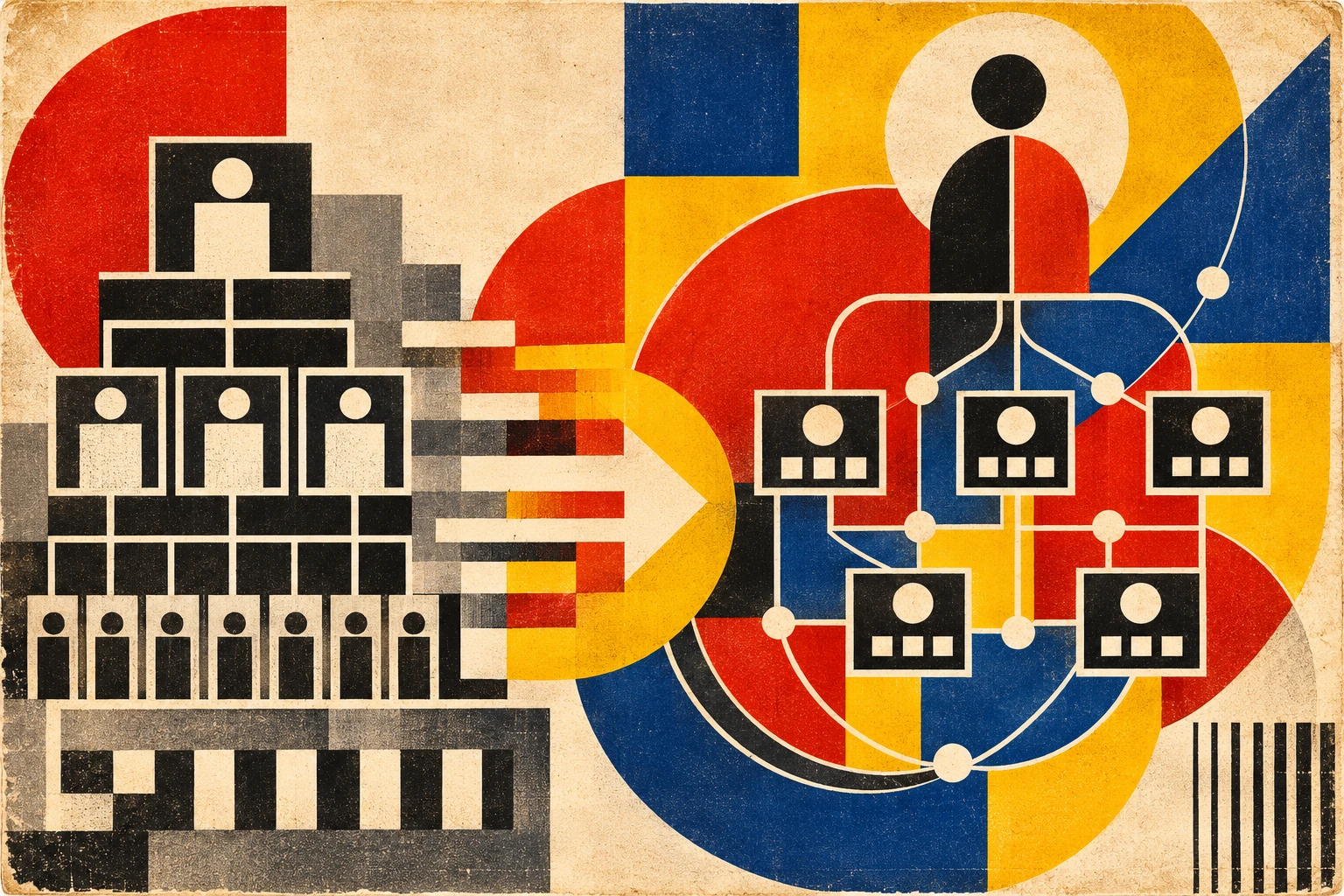
Satya Nadella's explanation of Microsoft's 60,000 voluntary exit offers reveals a more ambitious transformation than replacing employees with AI. The company wants to change how work is organised, who performs it, and what human expertise is actually for.
Imagine receiving an email from your employer.
It's one of the largest technology companies in the world. You've worked there for years. You know the systems, the processes, the products, and the peculiar internal logic that makes an enormous corporation function.
The email offers you money to leave.
Voluntarily, of course.
You can stay.
But the company is undergoing a fundamental transformation, and the job you currently perform may not resemble the job you'll be expected to perform in the future.
You might enjoy the new arrangement.
You might hate it.
And rather than waiting to discover which, your employer is offering you a financially supported opportunity to make a decision now.
This is essentially the situation Microsoft created in October 2026 when it announced voluntary exit offers covering approximately 60,000 eligible employees.
Not 60,000 redundancies.
Not 60,000 confirmed departures.
An offer to a substantial portion of the workforce to consider leaving on negotiated terms.
Naturally, the headlines were spectacular.
Microsoft wants 60,000 people to quit.
AI is replacing workers.
The machines are coming for the programmers.
But Satya Nadella's subsequent explanation was more interesting than the usual story about artificial intelligence eliminating jobs.
His argument is that Microsoft isn't merely trying to automate existing tasks.
It is trying to rebuild the company around a different definition of human work.
And that distinction has implications well beyond Microsoft.
The Agency Paradox
On November 18, Nadella spoke with Andrew Ross Sorkin at the New York Times DealBook Summit.
Asked about the voluntary departure programme, he said the intention was to ensure employees retained a sense of agency in making their choices.
There's a rather wonderful linguistic coincidence here.
Microsoft wants to turn human employees into managers of AI agents.
And Nadella says he wants those employees to preserve their own agency while the transformation takes place.
Agency for humans.
Agents for the machines.
It's a clever formulation.
But it also describes a genuine management problem.
Imagine being told that the professional abilities you've spent fifteen years developing are still extremely valuable, but the way you're expected to apply them is about to change almost beyond recognition.
You are still a software engineer.
Except that writing software may no longer be your primary activity.
You are still responsible for delivering the product.
Except that much of the execution will be delegated to AI systems.
You will still be evaluated on results.
Except that those results now depend partly on autonomous processes you must configure, supervise, and verify.
Some people will find this exhilarating.
Others will discover that the new job is not the one they wanted.
That doesn't necessarily make them resistant to technology.
A professional may enjoy the craft of writing software, not merely the administrative responsibility for getting software produced.
A designer may love designing.
An analyst may enjoy the actual investigation.
Someone who chose a career because they liked doing the work may not want to spend the rest of their professional life managing a collection of automated systems.
That preference is legitimate.
Nadella's position appears to be that employees should have the opportunity to decide whether they want to participate in the new operating model.
But there is an uncomfortable qualification.
A choice is not entirely free when the organisation has already decided which future it will pursue.
Microsoft can provide financial support, opportunities for retraining, and internal mobility. Those are meaningful measures.
But the voluntary nature of an exit offer does not eliminate the broader pressure created by organisational transformation.
Employees may choose their response.
They do not necessarily get to choose whether the transformation happens.
From Writing Code to Building the Software Factory
The most revealing part of Nadella's explanation concerned a small engineering team.
He cited the group developing Microsoft 365 Cowork, an AI-assisted work product within Microsoft's productivity ecosystem.
According to Nadella, the team consists of approximately eleven developers.
His description of their approach was striking.
They built a software factory that builds the product.
Think about what that means.
The traditional image of software development involves a team of engineers receiving requirements, designing architecture, writing code, debugging, testing, reviewing changes, and deploying the result.
AI tools have already begun assisting with many of those activities.
But the next step is not simply giving every developer a better autocomplete tool.
It's creating a system in which the development process itself becomes increasingly automated.
A human defines the objective.
An agent investigates the repository.
Another proposes changes.
Others generate tests, examine dependencies, review outputs, or prepare documentation.
The system runs validation.
Failures return to an earlier stage.
The process continues until the result satisfies specified conditions or requires human intervention.
The engineer is no longer responsible for personally performing every operation.
They become responsible for designing and governing the process that performs those operations.
This changes the unit of work.
Instead of asking how quickly a developer can complete a task, the organisation begins asking how effectively a developer can construct and supervise a system that completes entire classes of tasks.
The difference is substantial.
And it explains why Nadella believes software engineering will remain important even as machines write increasing amounts of code.
The expertise does not simply disappear.
It moves.
The Engineer Becomes an Architect of Execution
An AI coding agent can generate a function.
A more capable system can implement a feature.
But producing code and delivering reliable software are not identical activities.
Someone still needs to determine what the product should do.
Which constraints matter.
What constitutes a correct result.
How the system behaves when requirements conflict.
Which failures are acceptable.
Which failures are catastrophic.
And how to verify that the implementation meets the actual objective.
The more code becomes inexpensive to generate, the more important these questions become.
An organisation that can generate a thousand lines of code in seconds has not necessarily improved its software engineering.
It may simply have increased the speed at which it can create problems.
The real challenge is verification.
Not merely whether the generated code compiles.
Whether it does the right thing.
Whether the tests are meaningful.
Whether security assumptions hold.
Whether the new behaviour is compatible with the existing system.
Whether the solution remains maintainable.
And whether the agent has achieved the specified objective without quietly violating some other requirement.
This was also a central theme in Nadella's November conversation with Gergely Orosz on The Pragmatic Engineer.
As code generation becomes cheaper, verification becomes a more significant part of engineering.
A software factory therefore needs more than powerful models.
It needs specifications.
Testing infrastructure.
Evaluation systems.
Execution controls.
Observability.
Permissions.
Failure handling.
And clear rules about when a human must intervene.
The interesting new engineering work is not simply writing instructions for agents.
It's designing an environment in which agents can produce useful results without creating unacceptable risks.
A factory is not just a building full of machines.
It is a production system.
And production systems require engineering.
Why AI-First Is Not the Same as Using AI
This is where Microsoft's plan becomes strategically interesting.
Almost every large company can announce that it uses AI.
Employees receive access to a chatbot.
Developers get coding assistants.
Marketing teams generate drafts.
Managers summarise meetings.
The company publishes an enthusiastic report about productivity.
Everyone applauds.
And the underlying organisation remains essentially unchanged.
The same departments.
The same approval chains.
The same reporting structures.
The same workflows.
Only now, every activity includes an opportunity to ask an AI system for help.
This is AI-assisted work.
It is not necessarily an AI-first organisation.
An AI-first organisation begins by reconsidering how work should be performed if autonomous software systems can handle significant parts of execution.
Perhaps the process no longer needs seven manual handoffs.
Perhaps some decisions can be made automatically within established constraints.
Perhaps the human role moves toward setting objectives, validating outcomes, and handling exceptions.
Perhaps teams become smaller.
Perhaps the relationship between specialist functions changes.
And perhaps traditional job descriptions no longer correspond to the actual distribution of work.
The important change is organisational.
AI becomes part of the production architecture rather than an accessory attached to existing employees.
That is a much more difficult transformation than deploying a tool.
It forces companies to reconsider responsibility, budgets, management, training, and performance evaluation.
And in a corporation with more than 200,000 employees, it is not something that happens after a successful weekend hackathon.
The Eleven-Developer Example Has Limits
Nadella's Cowork example is compelling.
Eleven developers working through a software factory certainly sounds like an attractive model for the future.
But we should be careful about what the example proves.
We do not have an independently established comparison showing how many developers the same product would have required under traditional working methods.
Nor does the number establish the total organisational resources involved.
The team may rely on shared infrastructure, models, security services, product systems, and other engineering groups.
These dependencies matter.
An eleven-person team operating inside Microsoft is not economically equivalent to an eleven-person startup constructing all its own infrastructure.
Nor does one effective team prove that every department can be reorganised around the same staffing ratio.
Some work is highly automatable.
Other work involves physical systems, complex relationships, uncertain objectives, or regulatory responsibilities that remain difficult to delegate.
And software factories themselves are not free.
They consume computing resources.
Require maintenance.
Introduce new failure modes.
And create additional requirements for security, evaluation, and supervision.
The right comparison is not simply the number of people writing code.
It is the total cost, quality, reliability, and speed of the system delivering the product.
Nevertheless, Nadella's example illustrates a real possibility.
A smaller human team may be able to coordinate a much larger amount of productive activity when execution is increasingly automated.
The implications for organisational design are enormous.
But the results should be measured, not assumed.
The Problem of the Fifty-One-Year-Old Company
Microsoft is not a startup that can rewrite its entire operating model overnight.
It is a company founded in 1975, with decades of accumulated infrastructure, management structures, business processes, customer commitments, and established professional roles.
That history is an enormous advantage.
It also creates inertia.
A small AI-native company can design its workflows around agents from the beginning.
A large incumbent has to transform processes while continuing to operate products used by millions of customers and businesses.
Existing systems cannot simply be switched off.
Employees cannot all be reassigned simultaneously.
Responsibilities cannot become ambiguous merely because the organisation has adopted new technology.
And customers are unlikely to accept widespread service failures as an unavoidable consequence of Microsoft's exciting internal transformation.
The challenge is therefore closer to renovating a city while people continue living in it than constructing a new building on an empty site.
Some departments will transform rapidly.
Others will move slowly.
Some teams will discover major productivity gains.
Others may find that the new process creates more complexity than it removes.
And management will have to decide which arrangements should be retained, redesigned, merged, or abandoned.
Nadella acknowledges that the transition will take longer than enthusiasts expect.
I think this may be the most realistic part of his explanation.
The difficulty is no longer merely obtaining capable AI models.
It is making an enormous human organisation function differently.
And doing so without damaging the business it is supposed to improve.
Who Manages the Managers of Agents?
There is another complication.
When everyone becomes a manager of agents, what happens to management itself?
The traditional organisation is built around layers of human coordination.
A manager assigns work.
Reviews progress.
Resolves problems.
Controls priorities.
Evaluates performance.
Some of those functions can also be supported or partially automated by AI.
An agent might assign tasks to other agents.
Monitor execution.
Identify failures.
Compile reports.
Escalate exceptions.
Now the human manager supervises a system that already performs many of the activities associated with management.
That suggests a deeper restructuring than merely teaching employees to write better prompts.
The organisation must determine where authority resides.
Which actions an agent may perform independently.
Which decisions require human approval.
Who is accountable for mistakes.
And how responsibility passes between automated and human participants.
This becomes especially important when agents can interact with external systems, move money, modify production infrastructure, access sensitive data, or make decisions that affect customers.
In his conversation with Orosz, Nadella emphasised the need to verify AI behaviour and treat agents as potential internal risks.
That is a sensible engineering principle.
A capable agent should not automatically receive unlimited authority simply because it performs useful tasks.
Intelligence and permission are different things.
An organisation built around agents will need to formalise that distinction.
And this may produce an interesting paradox.
As the amount of human execution decreases, the importance of human accountability may increase.
Because the company still needs someone who understands what the system is doing, why it is doing it, and what should happen when it goes wrong.
The Career Ladder Problem
There is one part of this transition that deserves more attention.
How do people become the experienced engineers who supervise software factories?
Traditionally, junior developers learn through implementation.
They write relatively simple code.
Make mistakes.
Receive feedback.
Review other people's work.
Gradually develop an understanding of architecture, systems, trade-offs, and failure modes.
If the simplest implementation tasks are increasingly performed by agents, the traditional learning path changes.
A company may need fewer people to write routine code.
But it will still need specialists capable of evaluating complex systems.
Where will those specialists come from?
This is not a minor staffing issue.
It is a problem of professional development.
You cannot produce an experienced engineer merely by appointing someone to supervise agents.
Judgment comes partly from encountering real problems, making decisions, and understanding the consequences.
Companies will need to create new ways for less experienced employees to develop those abilities.
Nadella has acknowledged the slowdown in junior hiring and discussed new approaches to AI-accelerated engineering education.
Microsoft's reported preceptorship work with Carnegie Mellon is one attempt to address that gap.
But the broader challenge remains.
If AI-first organisations eliminate too much of the work through which people traditionally acquire expertise, they may eventually undermine their own supply of qualified human supervisors.
The future of software engineering therefore depends not only on making experienced people more productive.
It also depends on developing the next generation of experienced people.
Does Agency Really Mean Having a Choice?
Now return to the voluntary exit programme.
Microsoft's official announcement describes financial support, career-planning resources, and opportunities for employees to shape their next chapter.
That is more constructive than announcing a mass redundancy and leaving people to deal with the consequences.
It also recognises that employees have different interests.
Not everyone wants the same career.
Not everyone will enjoy the same work.
And not everyone should be expected to find fulfilment in managing automated systems.
But the programme also serves Microsoft's organisational interests.
It provides a mechanism for changing workforce composition.
It may reduce the disruption associated with compulsory layoffs.
And it allows the company to adjust staffing while presenting the decision as an opportunity for employees.
Both things can be true.
The offer can provide meaningful options to individuals.
And it can be an instrument of corporate restructuring.
The harder question concerns employees who want to remain but whose roles are disappearing or changing.
Will they receive sufficient training?
Will they have genuine opportunities to move into new positions?
Will compensation reflect the increased responsibilities of supervising automated systems?
Will the productivity benefits be shared?
Or will employees be expected to accept more complex responsibilities while the economic gains flow primarily to the organisation?
Nadella's agency argument is strongest when employees are given meaningful ways to participate in the transition.
It is weaker if the practical choice becomes accepting an entirely different job or leaving.
There is a difference between offering someone a decision and giving them influence over the conditions under which that decision must be made.
The Real Question Is Who Captures the Productivity
Suppose an AI-first team produces twice as much valuable work with half the human effort.
That sounds like a remarkable productivity improvement.
But what happens next?
The company might use the additional capacity to build better products.
Lower prices.
Improve reliability.
Enter new markets.
Or reduce working hours.
It might invest in employee development.
Or redistribute work more sustainably.
Alternatively, it might simply reduce headcount while expecting the remaining employees to produce more.
Technology does not decide how its benefits are distributed.
Organisations do.
This is why the transition cannot be evaluated solely through the number of tasks completed by AI agents.
A company may become more efficient without becoming a better place to work.
It may automate execution while increasing pressure on the people responsible for supervision.
It may reduce routine work while concentrating decision-making authority in fewer hands.
And it may create substantial economic value without ensuring that the people managing the transformation share proportionately in that value.
These are management and economic choices.
Not inevitable consequences of model capability.
Nadella's vision describes how work might be reorganised.
It does not, by itself, answer who benefits most from that reorganisation.
The Future Engineer Is Still an Engineer
I find Nadella's position on software engineering more convincing than the familiar prediction that programmers are about to disappear.
If AI makes code generation inexpensive, that does not eliminate the need to understand software.
It changes where that understanding is applied.
Engineering has never been reducible to typing code.
It involves defining problems.
Making trade-offs.
Designing systems.
Understanding constraints.
Managing complexity.
And establishing confidence that the result works as intended.
AI can participate in all of those activities.
But greater capability does not automatically remove the need for judgment, accountability, and verification.
In some circumstances, it increases the importance of those functions.
The engineer of an AI-first organisation may spend less time implementing individual features manually.
They may spend more time designing specifications, evaluating generated work, maintaining production systems, and improving the automation itself.
That is still engineering.
But it is a different professional experience.
And some people who are excellent at today's engineering work may not enjoy tomorrow's version.
We should not dismiss that preference as irrational resistance to progress.
The transformation changes more than productivity.
It changes the character of the work.
The Company Is the Product Being Rebuilt
The usual AI story begins with technology.
A new model arrives.
It performs better on benchmarks.
A company integrates it into existing software.
Customers receive another feature.
But what Nadella describes is a different kind of project.
Microsoft itself becomes the system being redesigned.
Its employees.
Departments.
Workflows.
Responsibilities.
Career paths.
And methods of producing software.
The AI models are components of that transformation.
They are not the transformation itself.
This is probably why the process will be considerably harder and slower than the most enthusiastic forecasts suggest.
The technology can change faster than the organisation.
A new model can be deployed in days.
A workforce of hundreds of thousands cannot be reorganised with the same ease.
And unlike an inference cluster, employees have ambitions, preferences, financial obligations, professional identities, and opinions about what constitutes meaningful work.
You cannot simply update their operating instructions and assume the new configuration will function as intended.
The shift toward AI-first operations therefore demands something beyond technical leadership.
It requires organisational design.
Training.
Negotiation.
Trust.
And the ability to acknowledge that some people will make different choices.
That is what makes Microsoft's experiment worth watching.
Not the headline about 60,000 exit offers.
Not the impressive eleven-person engineering team.
But the attempt to transform a mature technology company from an organisation of people executing tasks into an organisation of people directing increasingly automated production systems.
The difference is profound.
And the outcome is far from guaranteed.
Rebuilding the Work, Not Just Replacing the Worker
I suspect the most important part of Nadella's explanation will be remembered less for the exit programme than for the idea of the software factory.
A team that builds a system capable of building products.
An employee who becomes responsible for an automated workflow rather than every individual operation within it.
A company that reorganises itself around a new relationship between human judgment and machine execution.
This trajectory is plausible.
It is already visible in parts of software engineering.
And it may extend into other knowledge-work professions.
But its success will depend on whether companies can solve the problems that follow automation.
Verification.
Accountability.
Training.
Economics.
Human authority.
And the preservation of meaningful professional choices.
The optimistic interpretation is that people will spend less time on repetitive execution and more time on consequential decisions.
The pessimistic interpretation is that fewer people will supervise more automated work under greater pressure, with less control over the systems they are expected to manage.
Both possibilities are consistent with the technology.
The difference will be determined by the organisations deploying it.
Microsoft is now attempting one of the largest experiments in that transformation.
And Nadella is telling employees, perhaps more clearly than many executives would, that the future job may not resemble the one they originally accepted.
Some will want to participate.
Some will not.
Some may have little practical choice.
That tension cannot be resolved by a clever play on the word agency.
But at least it places the real question on the table.
The future of work is not simply about whether AI can do our tasks. It is about what remains of our jobs when the tasks are no longer the centre of them.
And perhaps the most revealing test of an AI-first company will be whether it manages to preserve meaningful human agency while surrounding its employees with increasingly capable agents.
Sources
- Julie Bort, TechCrunch, November 18, 2026: Microsoft CEO Satya Nadella Explains Why He Asked 60K Employees to Quit
- Microsoft, October 26, 2026: Introducing a Voluntary Exit Offer
- Gergely Orosz, The Pragmatic Engineer, November 16, 2026: Software Engineering After Code Becomes Cheap with Satya Nadella
- New York Times DealBook Summit, November 18, 2026: Satya Nadella on the New Algorithm
The analysis and conclusions in this article are the author's interpretations. The voluntary exit programme, team examples, and statements attributed to Nadella are based on the cited reporting and interviews.