
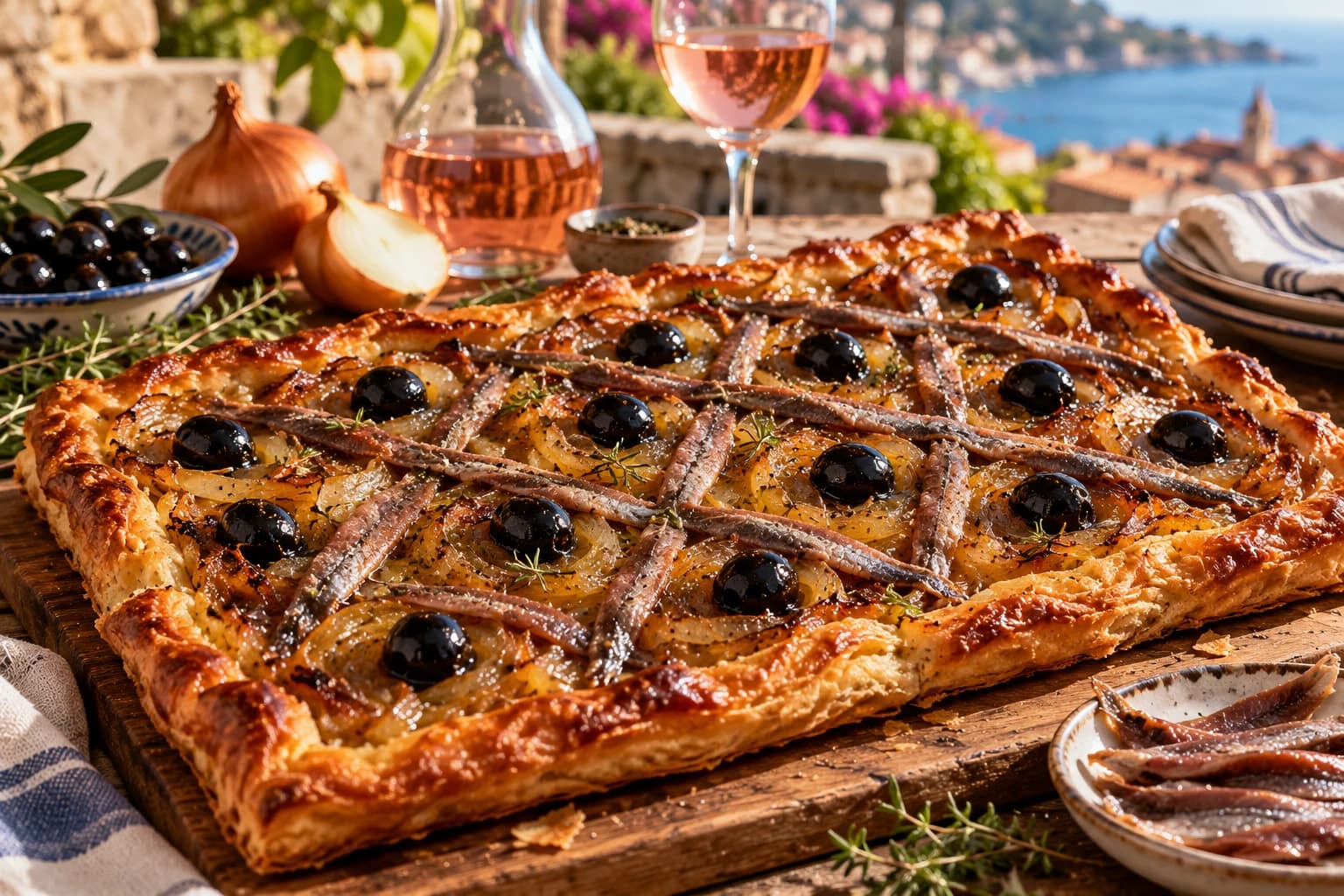
Caramelised onions, anchovies, black olives, and a dish I spent years trying to find again. Eventually, I gave up looking and started making it myself.
I have a weakness for certain combinations of flavours.
Sweet and salty.
Rich and acidic.
Something soft and caramelised against something sharp and intensely savoury.
And if you give me caramelised onions, anchovies and black olives together, you've already won.
Which is probably why I fell in love with pissaladière almost immediately.
The funny thing is that I discovered this very French speciality in Corsica.
Where, as my wife later informed me, it didn't actually originate.
But let's start with the pizza.
The suspiciously cheap pizza bar
We were on holiday in Corsica with the family.
My wife, our children and me.
And at some point, we discovered a small bar serving enormous slices of pizza at remarkably low prices.
Not bad pizza.
Not the sort of sad, greasy triangle you buy at three in the morning because you've made several questionable decisions.
Properly good pizza.
Large slices.
Delicious.
And extremely affordable.
I was delighted.
So delighted, in fact, that I ended up having dinner there almost every evening.
Two enormous slices of pizza.
A carafe of light, uncomplicated house wine.
And that was usually enough.
I also began to understand the possible business logic.
The pizza was an excellent reason to come in.
Once you were sitting there, you would probably order wine.
Or something else.
And the drinks weren't quite as extraordinarily cheap as the pizza.
They weren't expensive either. Just more normally priced.
I never asked the owner about the economics, so perhaps I'm unfairly attributing a clever marketing strategy to someone who simply liked selling good pizza.
But it certainly worked on me.
I kept coming back.
And then I noticed something else on the menu.
Pissaladière.
I had no idea what it was.
Which, naturally, meant I had to try it.
Three ingredients. One perfect combination.
At first glance, pissaladière looks like a pizza that has developed some unusual opinions about toppings.
There is a base of dough.
A generous layer of soft, sweet onions.
Anchovies.
Black olives.
And not much else.
No mountain of cheese.
No tomato sauce.
No ham, mushrooms, pineapple or twelve varieties of sausage competing for your attention.
Just onions, anchovies and olives.
I took a bite.
And immediately understood the appeal.
The onions were soft, sweet and deeply flavoured.
The anchovies brought a powerful, concentrated saltiness.
The olives added their distinctive Mediterranean bitterness and richness.
And the dough held everything together.
It was one of those combinations that seemed almost embarrassingly obvious once I'd tasted it.
Of course these things belong together.
Why hadn't I been eating this all my life?
It quickly became one of my favourite things on the menu.
In fact, it became one of my favourite discoveries of the entire holiday.
Which is when my wife decided to correct my geographical education.
Apparently, I had discovered Nice in Corsica
I was enthusiastically discussing my new Corsican discovery when my wife pointed out a minor detail.
Pissaladière wasn't really Corsican.
It was a speciality associated with Nice and the surrounding Mediterranean coast.
The Côte d'Azur.
The region around Nice, not far from Menton.
Now this was embarrassing.
Because Menton was hardly unfamiliar territory to me.
I'd been there many times.
I had business connections there.
I'd visited that part of France repeatedly.
And yet somehow I'd never noticed pissaladière.
I couldn't believe it.
How could I have travelled all the way to Corsica to discover a dish that apparently belonged to a part of France I knew rather well?
So I began paying attention.
Looking at bakery displays.
Checking menus.
Glancing at snack counters.
And for some reason, I still couldn't find it.
This became mildly irritating.
France had introduced me to something wonderful.
Then apparently hidden it.
We went looking for snow. I found an onion tart.
A few years after we'd left Ukraine, we were spending time in Menton.
It was summer.
Hot Mediterranean summer.
The kind of weather where the sea looks particularly inviting and almost any form of physical activity seems like a deeply unreasonable proposal.
Then our son mentioned something.
He hadn't seen snow in a long time.
Could we find some?
Now, one of the more entertaining things about that part of France is the proximity of the mountains.
You can be sitting beside the Mediterranean in the heat and, after driving up a succession of increasingly dramatic mountain roads, find yourself in a completely different landscape.
So we went up into the mountains.
In my memory, it was about forty minutes of winding roads, heading towards a ski resort area.
And we found some snow.
Not an entire winter wonderland.
Just enough for a child who'd been missing the stuff.
We enjoyed our little reunion with winter.
And somewhere up there, we came across a street vendor selling snacks and baked goods.
Including—
Pissaladière.
Finally!
There it was.
The elusive onion-and-anchovy masterpiece.
I bought some immediately.
Was it as good as the one I'd discovered in Corsica?
No.
Not quite.
But I was delighted anyway.
At least I now knew the dish really existed outside that particular Corsican bar.
And this seemed like progress.
Back in Nantes, I decided to stop searching
Eventually, we returned home to the Nantes area.
And I had a thought.
Why was I spending so much effort trying to find pissaladière?
The ingredients weren't exotic.
Onions.
Anchovies.
Olives.
Dough.
All readily available in France.
Surely I could make the thing myself?
So I looked up some recipes.
And discovered that the traditional Niçois approach usually involves bread dough.
Which is perfectly reasonable.
But I had encountered different versions, and I wasn't particularly interested in turning the evening into an elaborate bread-making exercise.
I wanted the flavours.
And I wanted something crisp.
So I decided to use ready-made puff pastry.
Yes, puff pastry.
Before anybody from Nice calls the police, I know this isn't the canonical version.
It's my version.
And I happen to love it.
First, an unreasonable quantity of onions
The most important part of my pissaladière is the onion.
Not the anchovies.
Not the olives.
Not even the pastry.
The onions.
You need a lot of them.
Ordinary white onions work beautifully.
I slice them and start cooking them slowly in a pan.
The objective isn't simply to soften them.
I want them properly caramelised.
Sweet.
Golden.
Concentrated.
Almost jammy.
I often help the process along with a little sugar.
Usually the unrefined cane sugar I keep at home.
Then I may add a small splash of wine.
A few drops of balsamic vinegar.
Some Herbes de Provence.
Sometimes the tiniest amount of garlic.
Occasionally a little heat, if I'm in the mood.
The exact seasonings depend on what I have and what I feel like doing.
I don't want the garlic to take over.
I don't want the herbs to start shouting.
And I certainly don't want the onions tasting like dessert.
I want a deep, savoury sweetness.
One that will eventually meet the saltiness of the anchovies.
Because that's the entire point.
Incidentally, traditional pissaladière recipes often favour slowly softened onions without the pronounced browning I personally like.
I'm well aware of this.
I'm also quite happy with my onions.
Puff pastry makes everything easier
While the onions are cooking, I prepare the pastry.
I buy it ready-made.
Usually chilled, sometimes frozen.
I let it become workable according to the package instructions, then lay it on baking parchment on a tray.
The shape doesn't particularly matter.
Round.
Rectangular.
Whatever suits the pastry and the tray.
I make a small raised edge to keep the onions where they belong.
Then I spread the caramelised onions generously over the base.
And into the oven it goes.
Sometimes, before baking, I add the slightest dusting of grated cheese.
Parmesan.
Or a well-aged Comté.
Not enough to make it cheesy.
Not enough that anyone should immediately identify cheese as an ingredient.
Just enough to create a very delicate finish on top of the onions.
This is entirely optional.
And again, not traditional.
But I like it.
The pastry bakes.
The onions are already cooked.
And once the base has become golden and crisp, I take it out.
Now comes the best part.
The anchovies go on afterwards
A lot of recipes put the anchovies and olives on before baking.
I don't.
I prefer to arrange them on the finished pastry.
I usually buy salt-cured anchovies.
They can be intensely salty, so I rinse them carefully.
Sometimes I soak them briefly to remove more of the excess salt.
Then I separate the fillets and arrange them over the onions in a diagonal lattice.
A neat little grid of intersecting anchovy lines.
Which creates diamonds.
And in the centre of each diamond, I place a black olive.
It's wonderfully simple.
And rather beautiful.
The dark olives.
The anchovy fillets.
The deep golden onions.
The crisp pastry.
Then I add a little extra-virgin olive oil.
Just a drizzle.
And let the whole thing cool slightly.
That's it.
My pissaladière is ready.
A word about French olives
This is a subject on which I've developed some rather strong opinions.
Living in France has made me increasingly interested in French olive oil and olives, particularly those produced in the south.
Naturally, Italian and Spanish olive oils are much better known internationally.
They are excellent, too.
But I've tasted French oils and olives that I personally prefer to many of the more famous imported options.
They're often considerably more expensive.
And I think they're underappreciated outside France.
So when I'm making pissaladière, I like using French black olives and French extra-virgin olive oil.
Preferably from the south.
Is this strictly necessary?
Of course not.
But it makes the whole exercise feel rather coherent.
A speciality from the south of France.
With onions, anchovies, black olives and olive oil from the same culinary landscape.
Plus puff pastry.
Well.
Nobody's perfect.
My homemade pissaladière
This is the way I usually prepare it. I don't measure every ingredient precisely, because the quantities depend on the size of the pastry and how generously I feel like covering it.
Ingredients
- One sheet of ready-made puff pastry
- Plenty of white onions
- A little vegetable or olive oil for cooking
- A small amount of unrefined cane sugar
- A splash of wine, optional
- A few drops of balsamic vinegar
- Herbes de Provence
- A very small amount of garlic, optional
- A little chili, optional
- Salt-cured anchovy fillets
- French black olives, preferably from the south
- Extra-virgin olive oil for finishing
- A little finely grated Parmesan or aged Comté, optional
Method
1. Thinly slice the onions and cook them slowly in a pan until soft, sweet and deeply caramelised.
2. Add a little cane sugar if desired, followed by a splash of wine, balsamic vinegar and a restrained amount of herbs or other seasonings.
3. Prepare the puff pastry on a parchment-lined baking tray, forming a slight raised edge.
4. Spread the onions generously over the pastry.
5. If using cheese, add only a very light dusting.
6. Bake according to the pastry's instructions, until the base is fully cooked and crisp.
7. Meanwhile, rinse or briefly soak the salt-cured anchovies to adjust their saltiness, then prepare the fillets.
8. Remove the baked tart from the oven and arrange the anchovies in a diagonal lattice over the onions.
9. Place a black olive in each diamond of the lattice.
10. Drizzle lightly with good extra-virgin olive oil and allow to cool slightly before serving.
The result is crisp pastry, sweet onions and a wonderfully salty, savoury topping.
And unlike many things I experiment with in the kitchen, this one is extremely reliable.
Eventually, I found it in Nantes
After making pissaladière myself several times, something mildly absurd happened.
I found a very good version in a bakery in Nantes.
Then another one.
Two boulangeries.
Both making excellent pissaladière.
Apparently the dish had been available much closer to home all along.
Naturally.
It's rather like spending years searching for some obscure imported delicacy, only to discover that the shop around the corner has been selling it every Thursday.
Now I don't necessarily need to make it myself.
I can just buy some.
But I still enjoy preparing it when friends come over.
It's one of those dishes that works beautifully as something to share.
Cut it into pieces.
Put it on the table.
Open something cold to drink.
And watch it disappear.
What should you drink with it?
I live near Nantes, so there's an obvious local answer.
Muscadet.
A good, well-chilled Muscadet can work beautifully with the onions, anchovies and olives.
The freshness of the wine balances the richness of the pastry and the saltiness of the topping.
But if I'm choosing purely according to my own preferences, I'd probably go for a light, dry rosé.
Very dry.
No noticeable sweetness.
Well chilled.
Something uncomplicated and refreshing.
Preferably the sort of wine you might find served in a simple carafe in a small Mediterranean bar.
Which, of course, brings us back to Corsica.
And that little place with the extraordinarily cheap pizza.
The pizza was only the beginning
Looking back, I find it funny that one of my favourite French dishes entered my life through what was essentially a budget pizza offer.
I walked into a small bar because the slices were large, delicious and cheap.
I returned because I liked the atmosphere, the simple wine and the food.
And somewhere along the way, I discovered a combination of onions, anchovies and olives that I would go on to make repeatedly at home.
My wife explained where it came from.
I searched for it along the Côte d'Azur.
Found it unexpectedly during a trip into the mountains in search of snow.
Recreated it in Nantes.
Modified the pastry.
Adjusted the onions.
Changed the order of the toppings.
And eventually discovered that two local bakeries were making it very well anyway.
Which is a rather satisfying journey for something containing so few ingredients.
I still remember that Corsican bar.
The big slices of pizza.
The house wine.
The uncomplicated evenings.
And the first bite of pissaladière.
Some dishes win you over through complexity.
This one did it with onions, anchovies and olives.
Apparently, three excellent ingredients are quite enough to make someone spend years looking for lunch.
Related Kitchen Notes: French shortbread cookies in a frying pan and my everyday French-style salad.