
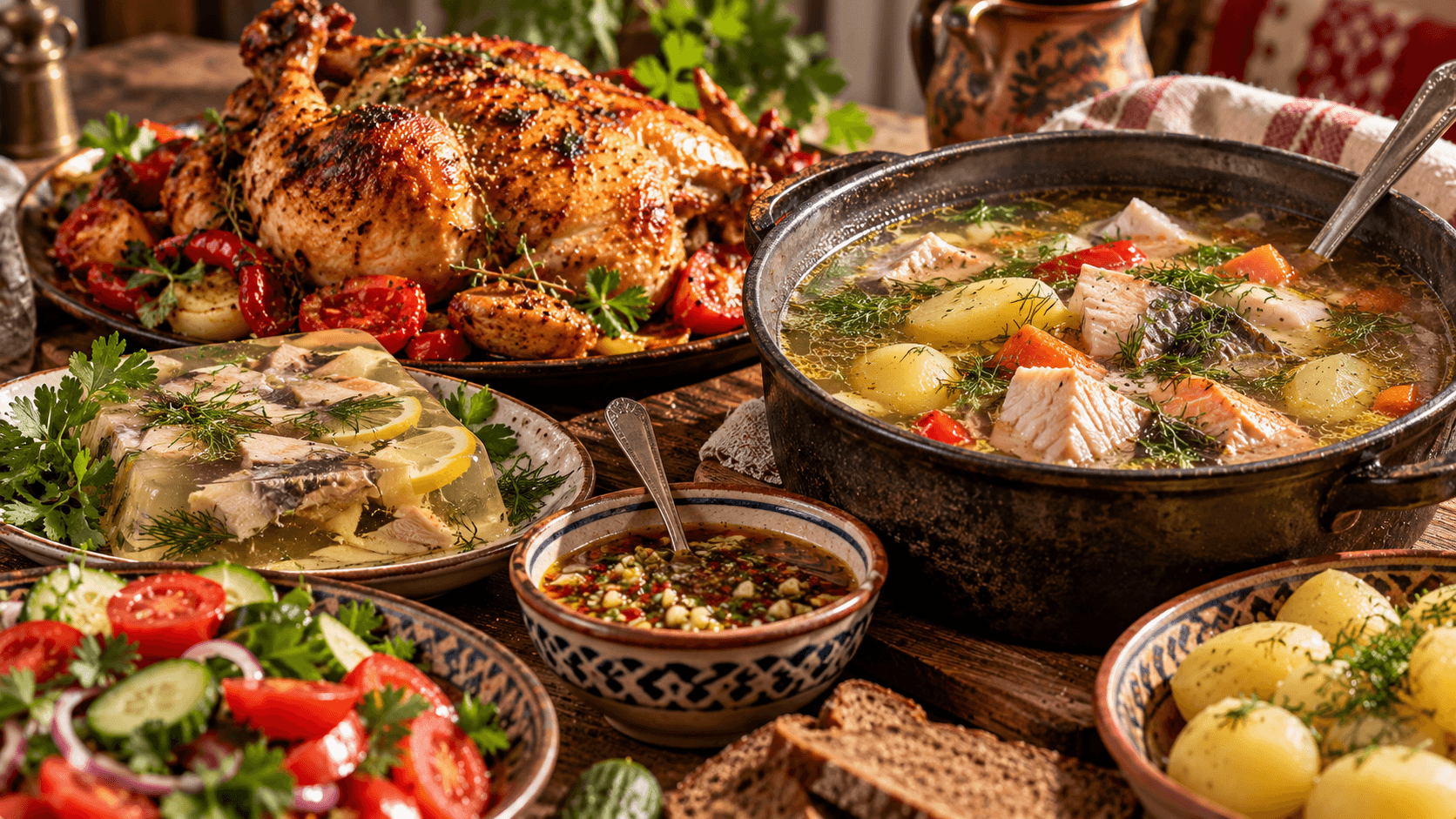
An extraordinary recipe I learned from a Bulgarian acquaintance in southern Ukraine. It starts with a rooster, continues with three kinds of fish, and somehow produces almost an entire holiday table.
Many years ago, while working in southern Ukraine, I met a young man whose family came from Bulgaria.
We had something in common.
We both loved cooking.
Occasionally, he would share Bulgarian family recipes with me. Some were interesting, some were delicious, but one in particular stayed in my memory.
I've prepared it only a handful of times since.
Not because I don't like it.
Quite the opposite.
It's just that preparing it is something of an undertaking.
The dish has a wonderful name.
Ukha iz petukha.
Literally, fish soup from a rooster.
In Russian, the words ukha and petukha rhyme, which makes the name particularly satisfying.
And completely absurd.
Because ukha is a traditional fish soup.
And a rooster, last time I checked, is not a fish.
But there's an explanation.
In fact, there's an entire culinary philosophy behind it.
And the most interesting thing is that this supposedly single dish produces not one, not two, but practically an entire festive dinner.
First, you'll need a rooster
Ideally, a proper mature rooster.
Not one of those young, delicate supermarket chickens designed to cook in approximately twelve minutes.
You want a bird with character.
The kind that has spent a considerable part of its life walking around, making noise and generally behaving like it owns the place.
An older laying hen will also work.
The objective is to produce a rich, deeply flavoured broth.
Young chickens are excellent for many things, but an older bird can make a particularly satisfying stock.
You'll also need a large pot.
Really large.
Because ideally, we're cooking the bird whole.
If it doesn't fit, you can cut it in half, but there's no reason to chop it into little pieces.
Add water, whole carrots, perhaps some aromatic roots, and let everything simmer gently.
For quite a long time.
This isn't a quick weekday dinner.
We need the bird fully cooked and the broth rich enough to become the foundation of everything that follows.
And this is where the recipe starts to become clever.
Because we're not going to serve that chicken in the soup.
The rooster becomes the main course
Once the bird is ready, remove it carefully from the pot.
Strain the broth, removing the carrots, roots and any loose pieces.
Keep that beautiful liquid.
We'll need it.
Now take the cooked rooster.
Season it with spices.
Spread a layer of mayonnaise over the skin.
Arrange it on a roasting tray with vegetables.
I particularly like using bell peppers and tomatoes here.
Not potatoes or carrots, which will have their own role later.
We want vegetables that roast relatively quickly, releasing their juices and developing some colour.
Put the tray in the oven until the bird is nicely browned and the vegetables are roasted.
The mayonnaise helps create a golden coating.
The vegetables add aroma and moisture.
And suddenly, we have our first proper dish.
A whole roasted rooster with vegetables.
A beautiful centrepiece for a festive table.
And we haven't even started making the fish soup.
Now comes the fish
Here's where the original broth begins its second life.
You ideally want three kinds of fish.
First, some small, inexpensive fish.
The kind fishermen often have plenty of.
Second, a good white fish.
And third, preferably, some salmon or another fish with richly coloured flesh.
The exact species are less important than having different flavours, textures and parts of the fish contributing to the broth.
And here's a practical trick.
You don't necessarily need to buy several expensive whole fish.
For the larger fish, you can buy a head and a smaller portion of fillet.
The head contributes flavour and body to the broth.
The fillet provides the beautiful pieces we'll eat later.
It's an economical and rather intelligent arrangement.
Clean and gut the fish properly, removing the gills from the heads.
Set aside the good fillets.
Take the heads, bones, fins and other suitable stock-making parts and tie them in a piece of cheesecloth.
Now lower that bundle into the simmering rooster broth.
Add the cleaned small fish as well.
Cook gently, just long enough for the fish to be ready and the stock to develop its flavour.
Then remove the small fish carefully.
Lift out the cheesecloth bundle.
Strain the liquid if necessary.
We now have something rather special.
A stock with the depth and richness of poultry, combined with the flavour of several different fish.
Neither an ordinary chicken broth nor a conventional fish stock.
It's both.
And it's magnificent.
The small fish become another dish
Remember those little fish we just removed?
We're not throwing them away.
Carefully remove any bones that would make eating difficult, then arrange the fish in small serving dishes.
Add a little garlic, black pepper and whatever delicate seasoning you prefer.
Pour over some of the concentrated broth.
Then refrigerate until cold and set.
If the broth contains enough natural gelatin from the poultry and fish, it can turn into a beautiful savoury jelly.
If it doesn't set reliably, a little unflavoured gelatin can help when adapting the recipe for home cooking.
The result is zalivnoye — fish in savoury aspic.
Another traditional feature of festive tables in Eastern Europe.
Delicate fish suspended in a deeply flavoured jelly.
Best prepared in advance, with the fish handled carefully and the shallow dishes refrigerated promptly.
So now we have two dishes.
The roasted rooster.
And the cold jellied fish.
Still no finished soup.
And then there's lyok
This might be my favourite part of the whole process.
Because the soup also provides the base for its own condiment.
It's called lyok, or лёк.
A powerful, garlic-heavy sauce traditionally served with fish soup in parts of southern Ukraine and neighbouring regions.
There are various versions, and the closely related Bessarabian salamur performs a similar role.
The preparation I learned was based on the broth itself.
Take some of that rich rooster-and-fish stock.
Pour a little into a small bowl.
Add plenty of crushed or grated garlic.
Black pepper.
A little vinegar.
Aromatic herbs.
Other spices to taste.
Sometimes a little adjika for additional heat.
Mix everything together.
The result should be boldly flavoured.
Garlicky.
Spicy.
Slightly acidic.
Almost aggressively aromatic.
This isn't a delicate sauce intended to disappear politely into the background.
It's supposed to wake up the entire dish.
And depending on how you serve the soup, lyok can play two completely different roles.
But we'll get to that in a moment.
Because we still have a pot of broth on the stove.
Finally, we make the actual ukha
By this point, the stock has already done an extraordinary amount of work.
It has cooked the rooster.
Extracted flavour from the fish heads and bones.
Provided the liquid for the aspic.
And become the base for our garlic sauce.
Now it's finally time to turn it into soup.
Bring the strained broth back to a gentle simmer.
Add potatoes.
I like them cut into substantial pieces.
If you have small or medium potatoes, you can even leave them whole.
Add carrots, again in fairly generous pieces.
Some bell pepper.
Let the vegetables cook until they're nearly ready.
Then add the reserved fish fillets.
White fish.
Salmon or another suitable fish.
Cut into large, attractive pieces rather than tiny cubes.
We want the fish to remain recognisable.
Not disintegrate into an anonymous seafood paste.
Cook gently until the fish is just done, then finish with bay leaf, black pepper, salt, a little garlic and fresh herbs.
Parsley.
Dill.
Whatever works with the particular fish you've chosen.
And that's it.
At last, we have our ukha iz petukha.
Fish soup made from a rooster.
A rich poultry-and-fish broth with vegetables and generous pieces of fish.
But here's the final interesting detail.
There are two very different ways to serve it.
The familiar way: everything in one bowl
The first approach is what many people in Eastern Europe would recognise as a normal serving of soup.
Take a deep bowl.
Add potatoes and vegetables.
Add pieces of fish.
Pour over the hot broth.
Scatter some fresh herbs.
Done.
The lyok sits separately on the table.
Each person can add a little to their bowl, adjusting the amount of garlic, acidity and heat to their preference.
It's an excellent soup served this way.
But I think the second approach is much more interesting.
The Bessarabian way: soup you eat and drink separately
This is the serving style I associate with the southern Ukrainian, Bessarabian and neighbouring Moldovan culinary traditions in which I encountered the recipe.
And it's quite different.
First, the boiled potatoes and vegetables are arranged separately.
Then the cooked fish is placed on another serving dish.
The hot broth is poured into mugs or small bowls.
And the lyok is served alongside everything.
Now you eat.
Take a piece of potato.
Dip it into the lyok.
Eat it.
Take a piece of fish.
Dip that into the sauce too.
Eat it.
Then take a sip of the hot broth.
It's a completely different experience.
Instead of mixing everything together, each component retains its own texture and character.
The potato is soft and substantial.
The fish is delicate.
The lyok is sharp, spicy and powerful.
And the broth brings everything together.
I find this an extraordinarily satisfying way to eat fish soup.
Although, strictly speaking, I'm not sure we're still dealing with soup in the conventional sense.
More like a collection of dishes accompanied by a drinkable broth.
Which brings me back to the remarkable efficiency of this entire recipe.
One pot, almost an entire holiday table
Consider what we've produced.
We started with one rooster and several kinds of fish.
And now we have:
- A roasted rooster with bell peppers and tomatoes.
- Cold fish in savoury aspic.
- A rich fish-and-poultry soup.
- Boiled fish, potatoes and vegetables that can be served separately.
- A powerful garlic sauce made from the same broth.
And there's one more thing I would always put on the table.
A fresh vegetable salad.
Nothing complicated.
Good tomatoes.
Cucumbers.
Bell peppers.
Spring onions.
Fresh herbs.
Coriander works particularly well if you like it.
Or simply arrange the fresh vegetables on a large plate and let everyone take what they want.
The acidity and freshness provide a wonderful contrast to the richer dishes.
And there you have it.
An entire celebratory meal.
All built around one large pot of stock.
A recipe worth remembering
I've only cooked this a few times.
It requires planning, quite a lot of ingredients and considerably more attention than my usual experiments with oatmeal, cheese and whatever happens to be in the refrigerator.
It's not the kind of thing you casually decide to prepare at eleven in the evening because you're hungry.
But I remember it very fondly.
Partly because it's delicious.
Partly because of the person who introduced me to it.
And partly because the whole structure of the recipe appeals to me.
You start with something simple.
A rooster.
A pot.
Water.
Then, through a sequence of decisions, one preparation becomes the foundation for several others.
Nothing important is wasted.
Each ingredient performs more than one job.
The broth becomes richer as the meal develops.
The fish contributes to both the soup and the cold appetiser.
The rooster becomes a separate main course.
Even the sauce comes from the same pot.
It's almost a little culinary production system.
And perhaps that's why this particular recipe stayed with me for so many years.
Not just because of the taste.
But because of the idea behind it.
You don't really cook a soup. You build an entire feast around a broth.
And it all starts with a wonderfully ridiculous name.
Ukha iz petukha.
Fish soup from a rooster.