
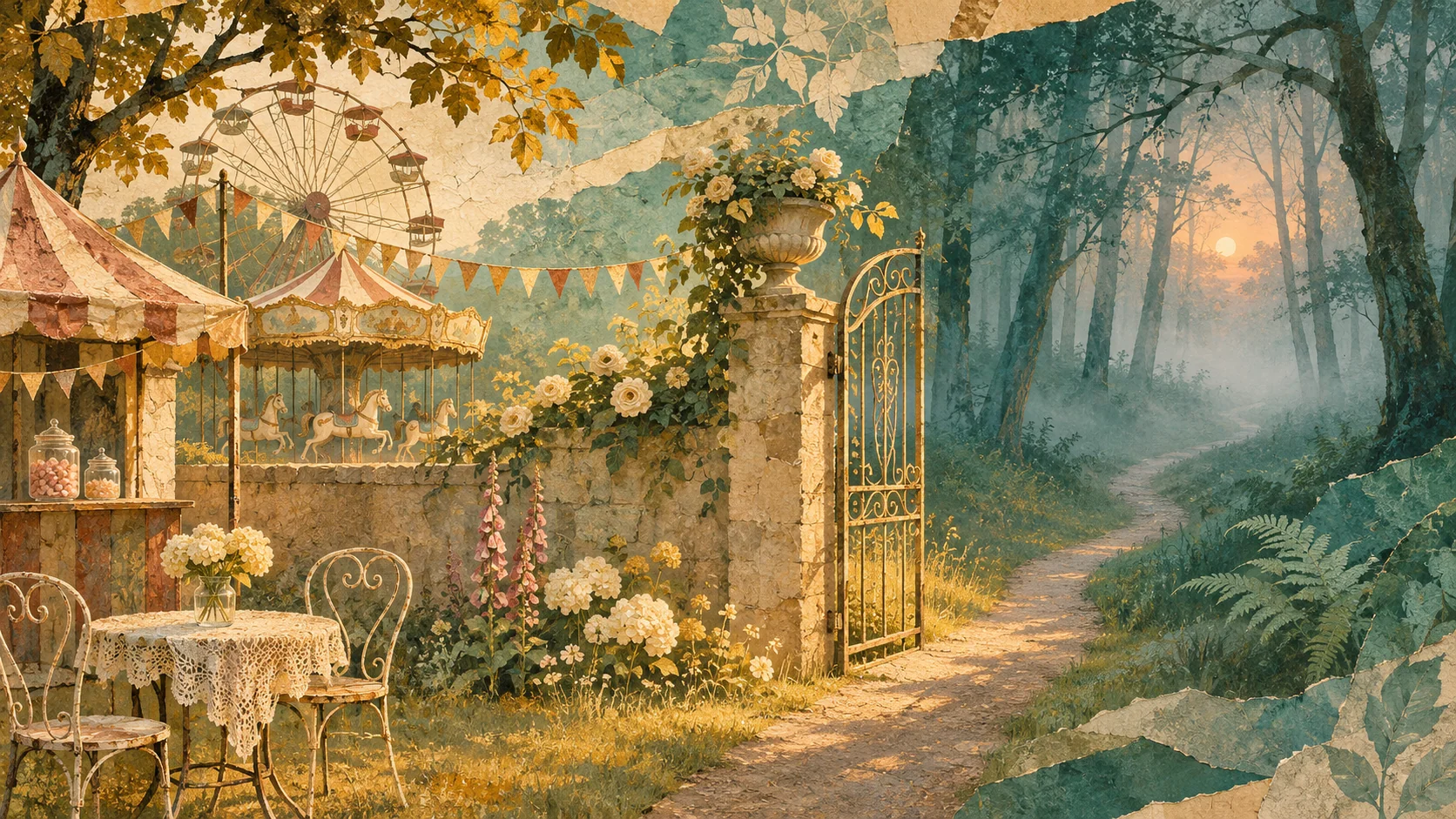
An imagined summer fair and the path beyond it. AI-generated illustration.
What if you could live in a world where nobody disappointed you, nothing important ever ended, and every wish came true? Gravity Falls offers exactly that possibility, then asks a much more difficult question: can we preserve what we love without demanding that life remain exactly as it was?
There is something deeply unfair about summer.
It arrives with an enormous promise.
Long days.
Unexpected friendships.
A temporary freedom from ordinary obligations.
The possibility that something wonderful might happen simply because we have enough time to allow it.
And then, just when everything begins feeling familiar, summer ends.
The people we met go home.
The places we loved become memories.
The routines that seemed permanent disappear.
And someone, usually an adult with an alarmingly practical attitude toward life, reminds us that school starts next week.
This is an unpleasant arrangement.
Especially when you are twelve years old.
Especially when you have spent the summer fighting supernatural monsters, discovering family secrets, befriending extraordinary people, and living in a town where almost every ordinary object might conceal an interdimensional conspiracy.
For Mabel Pines, the end of summer in Gravity Falls is not merely the end of a holiday.
It threatens the end of a world.
And when she discovers that the future may also involve separation from her twin brother, Dipper, the prospect becomes almost unbearable.
So she wishes for something perfectly understandable.
She wants summer to last forever.
Unfortunately, she lives in a universe where wishes can be answered by entities with extremely questionable intentions.
And so Mabel gets what appears to be the ideal solution.
A world designed specifically to make her happy.
A place where disappointments disappear.
Where growing up can be postponed indefinitely.
Where relationships remain reassuringly predictable.
Where reality no longer has the authority to interfere.
It is beautiful.
Colourful.
Absurd.
Filled with sweets, imaginary friends, and creatures whose entire existence seems dedicated to providing emotional support.
It is also a prison.
And the most disturbing thing about this prison is that the person inside it has very little reason to want to leave.
The End of Summer Is Not a Small Problem
Before examining Mabel's fantasy world, it is worth understanding what she is trying to preserve.
Throughout Gravity Falls, Mabel is the character most openly committed to enjoyment.
She loves parties.
Sweaters.
Romance.
Glitter.
Friendship.
Unusual animals.
And the possibility that almost anything might become the beginning of an adventure.
Her imagination is not a minor personality trait.
It is one of her principal ways of engaging with the world.
Dipper often approaches mysteries through investigation.
He searches for explanations.
He collects evidence.
He wants to understand how things work.
Mabel is more interested in what might happen if she participates.
She is willing to trust, improvise, and take ridiculous possibilities seriously.
Neither approach is sufficient on its own.
Dipper can become excessively concerned with control and competence.
Mabel can overlook dangers because she prefers the more exciting interpretation.
But together, they repeatedly manage situations that neither could handle alone.
Their summer is meaningful partly because of this partnership.
The problem emerges when the summer begins ending.
In Dipper and Mabel vs. the Future, the twins are approaching their thirteenth birthday.
For Dipper, growing older carries a promise.
He might become more independent.
More capable.
More respected.
And when Ford offers him the opportunity to remain in Gravity Falls as his apprentice, Dipper sees an extraordinary possibility.
He could study the mysteries that have fascinated him all summer.
He could work alongside someone who takes his intelligence seriously.
He could begin living the future he has imagined.
For Mabel, the same possibility feels like abandonment.
She is already distressed by the prospect of leaving Gravity Falls.
High school seems frightening.
Her friends may disappear from her everyday life.
And the one person she expected to remain beside her is considering staying behind.
Her brother's exciting future threatens the continuity of her own.
The conflict is not simply between a mature boy and an immature girl.
Both are frightened by change.
They just want different things from it.
Dipper wants to move toward adulthood.
Mabel wants to protect what childhood has given her.
And neither fully understands what the other stands to lose.
The Wish That Opens the Door
After arguing with Dipper, Mabel runs into the forest.
She wishes that summer could continue forever.
Then Blendin Blandin appears.
Or rather, someone who appears to be Blendin Blandin.
In reality, Bill Cipher has possessed him.
Bill offers Mabel a way to create a time bubble that will prevent the summer from ending.
All she needs to do is hand over a small device belonging to Ford.
Mabel finds the dimensional rift in the backpack she accidentally exchanged with Dipper.
She does not understand its importance.
She believes she is accepting a solution to her personal crisis.
Instead, she has been deceived into giving Bill the means to break open reality.
Weirdmageddon begins.
The mistake has catastrophic consequences, but the context matters.
Mabel did not knowingly decide to unleash an interdimensional apocalypse.
She was frightened, emotionally overwhelmed, and deceived by someone who understood exactly what she wanted.
This is important because the story is not simply punishing her for being selfish.
Bill recognises a vulnerability.
He offers a solution that seems perfectly matched to it.
And he hides the price.
The arrangement resembles a particularly dangerous form of temptation.
You are suffering because reality is changing.
I can make that suffering stop.
You do not need to understand how.
You only need to accept.
The offer is attractive precisely because it promises relief before Mabel has to confront what she fears.
And later, when she is imprisoned inside Mabeland, the same logic governs everything around her.
A Prison That Gives You Everything
In Weirdmageddon 2: Escape from Reality, Dipper, Wendy, and Soos enter Mabel's prison bubble.
What they discover is not an ordinary place of confinement.
Mabeland is a paradise of childish imagination.
There are impossible attractions.
Friendly creatures.
Ridiculous celebrations.
Perfectly arranged pleasures.
And an almost aggressive commitment to making everything wonderful.
The environment responds to Mabel's wishes.
Things are colourful because she likes colour.
The world is entertaining because she wants entertainment.
Unpleasant complications are removed because she does not want to experience them.
It is a reality designed around one person's preferences.
Which initially sounds rather appealing.
Most of us have probably imagined something similar.
A world without bureaucracy.
Without awkward conversations.
Without disappointing birthdays.
Without people who insist on discussing practical responsibilities when we are trying to enjoy ourselves.
Mabeland appears to solve all these problems.
But there is a hidden condition.
Reality must not be allowed to contradict the fantasy.
Dipper discovers that mentioning the outside world is prohibited.
When he challenges the illusion, he is threatened with exile.
The supposedly perfect world becomes coercive the moment someone questions its perfection.
This reveals the fundamental difference between a comforting place and a prison.
A comforting place allows us to recover before returning to the wider world.
A prison prevents us from returning.
And Mabeland is carefully constructed so that leaving feels like an unnecessary act of self-destruction.
Why return to disappointment when everything here is designed to make you happy?
Why accept uncertainty when every desire can be satisfied?
Why risk losing someone when the world can simply provide a version of them who will never leave?
The problem is not that Mabeland contains too much happiness.
It is that happiness has been separated from freedom.
The World That Never Says No
One of the most revealing features of Mabeland is the absence of meaningful resistance.
The world is constantly agreeable.
It celebrates Mabel.
It affirms her preferences.
It gives her what she wants.
But genuine relationships involve something more complicated.
Other people have their own desires.
Their own fears.
Their own plans.
And sometimes those plans conflict with ours.
A friend may disagree with us.
A partner may want something different.
A sibling may develop interests that lead them away from familiar routines.
These experiences can be painful.
But they are also evidence that we are relating to another person rather than controlling an extension of ourselves.
Mabeland removes much of that difficulty.
When the real Dipper threatens to leave, the fantasy provides Dippy Fresh.
A cheerful, relaxed, conveniently uncomplicated alternative brother.
He possesses the reassuring function of a sibling without the inconvenience of Dipper's independent ambitions.
He will not insist on becoming Ford's apprentice.
He will not complicate the summer with difficult decisions.
He is more agreeable.
More entertaining.
And considerably less likely to interrupt a perfectly good fantasy with the unpleasant observation that reality still exists.
But Dippy Fresh is not a better brother.
He is a substitute designed to avoid the difficulty of having a real one.
This is where Mabel's desire to preserve their relationship becomes something more restrictive.
She does not merely want to remain close to Dipper.
She wants their closeness to remain unchanged.
But Dipper is changing.
His ambitions are developing.
He is beginning to imagine a future that might not always place him physically beside her.
If preserving the relationship requires eliminating those possibilities, preservation has begun turning into control.
A relationship cannot remain alive simply by preventing the other person from becoming different.
Dipper Gets His Own Perfect Illusion
The episode wisely refuses to make Mabel the only person vulnerable to fantasy.
Dipper encounters a version of Wendy who tells him exactly what he has always wanted to hear.
She suggests that they could be together if Mabel simply made him older.
The offer is extraordinary.
Dipper's romantic uncertainty disappears.
The age difference becomes a solvable technical detail.
The person he admires expresses precisely the feelings he has wished she would express.
For a moment, the fantasy is tempting.
But then Dipper recognises something wrong.
The apparent Wendy is too convenient.
She is behaving according to his wishes rather than her own character.
He realises that this is not the Wendy he knows.
It is a construction designed to satisfy him.
The illusion collapses.
This is a crucial scene because it reveals that Mabeland does not simply eliminate suffering.
It also eliminates the separateness of other people.
The fictional Wendy exists to provide Dipper with the response he desires.
She does not have meaningful freedom to disappoint him.
But genuine affection depends upon the possibility of refusal.
Another person must be able to say no.
Otherwise, their yes loses much of its meaning.
This is the fundamental difference between receiving what we want and establishing a real relationship.
In fantasy, the other person can be arranged around our preferences.
In life, we must encounter someone whose experience is not under our control.
Dipper rejects the illusion not because wanting Wendy is inherently wrong.
But because he recognises that a relationship in which the other person exists solely to fulfil his wishes is not the relationship he actually wants.
The fantasy becomes less attractive when he notices what has been removed to make it perfect.
The Psychology of Avoiding the Future
Mabeland provides a vivid fictional representation of experiential avoidance.
In psychology, this term refers to attempts to escape, suppress, or control unwanted internal experiences such as distressing thoughts, memories, emotions, and bodily sensations.
Avoidance is not always harmful.
Sometimes we need a break.
A difficult day may justify an evening of comforting entertainment.
Imagination can help regulate emotion.
Fantasy can provide relief, creativity, and psychological distance.
Not every retreat from immediate reality is a failure to live.
The important question concerns what happens afterward.
Does the temporary refuge help us return to life with greater capacity?
Or does avoiding discomfort become the primary objective?
Mabel's fear concerns several genuine losses.
The end of summer.
The uncertainty of adolescence.
The possibility of changing relationships.
The prospect of separating from her brother.
Mabeland does not help her understand or manage these changes.
It eliminates the conditions under which she would need to confront them.
At least temporarily.
The psychological bargain is straightforward.
If I never encounter an ending, I will never need to experience grief about that ending.
If nobody can disappoint me, I will never need to tolerate disappointment.
If people never change, I will never need to renegotiate my relationships with them.
The trouble is that these solutions require progressively restricting contact with reality.
And the more completely life must conform to our wishes, the less freedom remains for anything unexpected to happen.
Psychological flexibility offers a different possibility.
It involves remaining capable of meaningful action even when uncomfortable emotions are present.
Fear does not have to disappear before we act.
Sadness does not mean we have made the wrong decision.
And uncertainty does not require postponing every important choice.
This is not a demand that Mabel simply become brave.
She is frightened because something important is ending.
The question is whether she can allow that fear to exist without letting it determine the entire shape of her future.
Fantasy Can Be a Refuge Without Becoming a Home
It would be a mistake to treat imagination itself as the problem.
Mabel's creativity is one of the series' most valuable qualities.
She makes ordinary situations playful.
She sees possibilities that Dipper overlooks.
She helps other people participate in experiences they would otherwise dismiss.
She turns awkwardness into humour.
And her willingness to embrace the ridiculous is frequently part of what allows the twins to survive their adventures.
The show does not ask her to stop being Mabel.
It does not suggest that adulthood requires abandoning glitter, colourful sweaters, absurd ideas, or the pleasure of making things unnecessarily delightful.
That would be a rather miserable definition of maturity.
Instead, it distinguishes two uses of imagination.
One expands our relationship with reality.
The other attempts to replace reality.
An imaginative person can invent games, stories, jokes, and possibilities that make ordinary life richer.
They can use memories as inspiration.
They can imagine a better future.
They can create experiences that would not exist without their participation.
But fantasy can also become a defensive structure.
A place where disappointment is prohibited.
Where difficult choices never arrive.
Where relationships remain permanently arranged around our needs.
And where no one is allowed to introduce information that might disturb the illusion.
Mabeland is dangerous not because it is imaginative.
It is dangerous because it cannot tolerate contradiction.
The imagination has stopped opening possibilities.
It has begun excluding them.
Why Nostalgia Is Not the Enemy
Mabel's desire to preserve the summer is closely related to nostalgia.
She knows that something wonderful is ending.
She wants to remain connected to it.
And she fears that moving forward will make the experience disappear.
It is tempting to respond by declaring that nostalgia is unhealthy.
But psychological research suggests a more complicated picture.
Studies by Constantine Sedikides, Tim Wildschut, and their colleagues have found that nostalgia can support social connectedness, personal meaning, and a sense of continuity between past and present.
Nostalgia is not merely a refusal to accept change.
It can help people carry meaningful experiences into new circumstances.
A person remembers a childhood friendship.
The memory reminds them that they are capable of connection.
Someone recalls a time when they felt confident.
The memory helps them recognise a quality they may still possess.
A family revisits old photographs.
The images connect people across years of change.
The past can become a resource.
And this distinction is central to Gravity Falls.
Mabel does not need to stop loving the summer.
She does not need to regard its ending as proof that it was unimportant.
She can remember it.
Celebrate it.
Carry parts of it into adolescence.
The problem begins when she treats the continuation of summer as a condition for preserving its meaning.
If summer ends, everything is lost.
If Dipper changes, the relationship is destroyed.
If the future is uncertain, perhaps the past must become permanent.
But memory does not require permanent repetition.
Something can remain important precisely because it happened.
And because we were changed by it.
The Scrapbook That Works Against the Fantasy
The central confrontation inside Mabeland takes the form of a wonderfully ridiculous trial.
Fantasy versus reality.
Dipper must defend the world outside the bubble.
Mabel's representatives argue that reality is full of disappointments.
And they possess evidence.
Mabel's scrapbook.
It contains memories of embarrassment, rejection, and unpleasant experiences from the twins' childhood.
The fantasy's argument is simple.
Reality hurts people.
Here are the examples.
Why return to a world that repeatedly makes you unhappy?
The argument is not entirely wrong.
Reality does contain disappointment.
Children can be cruel.
People can be rejected.
Plans fail.
Relationships become complicated.
But Dipper notices something that the fantasy's interpretation leaves out.
The scrapbook also records what happened after the difficult moments.
When Mabel was humiliated before a school photograph, Dipper found a way to share the embarrassment.
When Dipper experienced rejection, Mabel comforted him.
The memories are not simply evidence of suffering.
They are evidence of how the twins responded to suffering together.
The same events can support two different stories.
The fantasy says:
Look how often reality disappointed you.
Dipper says:
Look how often we faced disappointment and still found ways to care for one another.
Neither interpretation erases the painful experience.
The difference lies in what the memory is being asked to prove.
For the fantasy, the past demonstrates that reality should be escaped.
For Dipper, the past demonstrates that reality contains resources for living through difficulty.
This is the emotional centre of the episode.
The scrapbook does not need to become a collection of perfect memories.
Its value lies partly in the imperfect ones.
They show that the twins' relationship was never based on the absence of problems.
It was built through their responses to those problems.
And that means the future does not need to be free of difficulty for their relationship to continue.
Love Cannot Mean That Nobody Changes
The argument between Dipper and Mabel is more difficult than the trial's resolution may initially suggest.
Dipper has been offered a meaningful opportunity.
Working with Ford could advance his interests and abilities.
He wants to become someone capable of understanding the mysteries that have fascinated him.
Mabel fears losing the everyday closeness they share.
Both have legitimate concerns.
And this is where a careless reading could turn the story into a troubling moral lesson.
Perhaps Dipper's duty is simply to abandon his ambitions because his sister is frightened.
Perhaps love means sacrificing the future one person wants in order to preserve the other person's comfort.
But that would reproduce the logic of Mabeland in a less obviously magical form.
The other person's growth would still be treated as a threat.
The relationship would still depend upon preventing change.
Fortunately, the episode contains a more complicated exchange.
During the trial, Dipper reconsiders Ford's apprenticeship.
He recognises that he has been too eager to grow up.
He begins questioning whether spending his teenage years in Ford's laboratory is really the future he wants.
He tells Mabel that he will return home with her.
The decision helps her confront the fantasy.
But the more important moment comes afterward.
Once they escape the bubble, Mabel tells Dipper that she will not stand in his way if he still wants the apprenticeship.
This matters enormously.
She is no longer demanding that his future conform to her fear.
She recognises that he has a choice.
And Dipper confirms that he wants to return home with her.
The distinction is essential.
He does not simply become the brother who must sacrifice himself to keep Mabel happy.
She does not simply become the sister whose anxiety always determines his future.
They begin recognising one another as people who can make different choices while remaining connected.
The resolution is not universally transferable.
In real life, siblings may choose different schools, countries, professions, or relationships.
They may spend years apart.
Remaining close does not require every important decision to preserve physical proximity.
The valuable lesson is not that Dipper must always choose Mabel over opportunity.
It is that the twins can begin discussing their futures without treating difference as abandonment.
Love becomes less dependent upon sameness.
The Courtroom Cannot Decide the Future
There is something revealing about the fact that Mabeland puts reality on trial.
The fantasy wants a verdict.
Which world is better?
The one containing pain and uncertainty?
Or the one in which everything goes according to plan?
But the comparison is rigged.
Mabeland can manufacture pleasant experiences.
It does not have to accommodate the independent choices of real people.
It does not have to honour the passage of time.
It does not have to account for the consequences of its own existence.
And it does not permit evidence that might challenge its basic assumptions.
Reality, by contrast, must include what actually happens.
Including the difficult parts.
The trial is therefore not a fair comparison between two ways of living.
It is a comparison between an edited fantasy and an unedited world.
Of course fantasy appears more agreeable.
It has removed everything that might count against it.
But that also means the fantasy cannot support the kind of life it claims to improve.
A real relationship requires another person.
A real decision involves uncertainty.
A real future contains circumstances that have not yet occurred.
Mabeland offers happiness by reducing the number of things that can happen.
And this is the strange price of perfect control.
The world becomes increasingly pleasant.
But increasingly narrow.
Eventually, there is no meaningful future left to discover.
Only more of what has already been approved.
Acceptance Is Not Surrender
When Mabel finally decides to leave Mabeland, she is not accepting Bill Cipher's domination.
Quite the opposite.
She is abandoning a fantasy in order to resist him.
This is the central philosophical paradox of the episode.
The heroes must stop rejecting reality before they can effectively oppose what is happening within it.
Mabel must acknowledge that summer is ending.
That she is growing older.
That Dipper has his own ambitions.
That disappointment cannot be permanently eliminated.
But accepting these facts does not require accepting Bill's control of Gravity Falls.
It gives her the opportunity to respond to that control.
A useful psychological distinction appears here.
Acceptance concerns acknowledging what is happening, including experiences we dislike.
Resignation concerns abandoning the possibility of meaningful response.
They are not the same thing.
Consider a person who loses a job.
They may spend weeks insisting that the decision was unfair and should never have happened.
Perhaps it was unfair.
Perhaps the employer behaved badly.
But the fact of the job loss still requires attention.
Accepting that it happened does not mean approving of the employer's conduct.
It may allow the person to examine their options, seek assistance, challenge the dismissal, or begin looking for other work.
The sequence matters.
I recognise what has happened.
I stop requiring reality to be different before I can respond.
I act within the circumstances that actually exist.
The first step is not moral approval.
The second is not the elimination of grief.
And the third does not guarantee success.
But together they describe a way of remaining capable of action.
Mabel's decision works in a similar way.
She does not need to like the end of summer.
She needs to stop treating its approach as a reason to abandon the real world.
A Zen Perspective on the Summer That Must Never End
Zen Buddhism offers a productive comparative perspective through the broader Buddhist teaching of impermanence.
Experiences arise through changing conditions.
Relationships develop.
Bodies age.
Circumstances shift.
Pleasant moments end.
Unpleasant moments end too.
The desire for a good experience to continue is entirely understandable.
But suffering can be intensified when we demand that the experience remain unchanged.
Mabel's wish expresses this demand with unusual clarity.
Summer must not end.
The twins must not grow apart.
The familiar world must remain available.
And if reality cannot satisfy these conditions, another reality must be created.
The wish is emotionally recognisable.
But it treats change as though change necessarily destroys meaning.
A Zen-inspired response would question that assumption.
The summer can be meaningful without lasting forever.
The relationship between the twins can remain important while changing.
Mabel can continue enjoying imaginative play without remaining twelve years old.
And the future can contain genuine possibilities without guaranteeing that every experience will be pleasant.
This is not an invitation to become indifferent.
Non-attachment should not be confused with an inability to love or grieve.
A person can care deeply about a temporary experience.
They can mourn its ending.
They can preserve memories.
They can remain grateful.
The distinction concerns whether they demand that the world prevent the ending in order to justify the attachment.
Mabel's affection for the summer is not the problem.
The fantasy that its value depends upon never ending is.
Growing Up Does Not Mean Becoming Ford
Dipper's position deserves equal attention.
He initially treats growing up as an opportunity to escape the limitations of childhood.
He wants competence.
Recognition.
Intellectual seriousness.
Ford's apprenticeship offers a future in which he can accelerate the process.
But Dipper's desire to become an adult also contains a form of avoidance.
He is uncomfortable with being twelve.
He wants to stop feeling inexperienced.
He wants other people to recognise his abilities.
He may be tempted to skip the uncertain period in which people gradually learn who they are.
In this sense, the twins are not complete opposites.
Mabel wants to prevent time from moving forward.
Dipper wants to move forward too quickly.
Both struggle with the present transition.
One attempts to preserve childhood.
The other attempts to escape it.
And both risk missing something important.
For Mabel, that something is the possibility that relationships can survive change.
For Dipper, it is the possibility that childhood still contains experiences worth having.
Ford's offer is not inherently bad.
Learning from a knowledgeable mentor can be valuable.
Following an intellectual passion is not a betrayal of family.
But the choice needs to be Dipper's, informed by more than his desire to become impressive.
He must consider what he would gain.
And what he would give up.
Maturity does not necessarily mean selecting the most adult-looking opportunity.
Sometimes it means recognising that an attractive future is not the only future worth considering.
And that growing up is not a competition to stop being young as quickly as possible.
The Older Brothers Who Couldn't Let Go
The relationship between Stan and Ford provides a darker reflection of the twins' conflict.
Their shared childhood also contained dreams of a future together.
They imagined adventures.
Travel.
A life built around their bond.
But circumstances changed.
Their ambitions diverged.
Disappointment hardened into resentment.
And the brothers spent decades separated by injuries neither could fully release.
Their conflict is not identical to Dipper and Mabel's.
The circumstances and responsibilities are different.
But it illustrates what can happen when a relationship becomes organised around an earlier version of itself.
One person believes the other ruined their future.
The other believes an important opportunity was taken away.
Both continue interpreting the present through a past that cannot be changed.
Neither can simply recover the childhood relationship they remember.
And their attempts to defend their own accounts of what happened repeatedly interfere with the possibility of rebuilding something in the present.
This is one of the emotional stakes of Dipper and Mabel's argument.
The twins are not required to remain identical in order to remain close.
But if every difference becomes evidence of betrayal, their relationship may gradually resemble the conflict between the older brothers.
A shared past can become a source of connection.
Or a permanent court in which both parties continue prosecuting one another for failing to preserve it.
The difference lies partly in whether the people involved allow one another to change.
Stan and Ford must eventually confront the fact that their original future is no longer available.
But a different relationship may still be possible.
Their past does not have to be erased.
It also does not have to determine everything that happens next.
The Bubble Finally Breaks
Once Mabel recognises the fantasy for what it is, Mabeland begins revealing its darker nature.
The endlessly agreeable inhabitants become threatening.
The comforting environment turns hostile.
The rules that once appeared playful become instruments of confinement.
The paradise is no longer pretending that it exists merely for Mabel's happiness.
It is protecting its own continuation.
And Mabel herself takes the decisive action.
She bursts the bubble.
This detail matters.
Dipper can enter the fantasy.
He can challenge its assumptions.
He can remind Mabel of their shared history.
But she must decide to leave.
The story does not resolve her fear by having another person simply drag her into reality.
Her decision becomes meaningful because she recognises the difference between what the fantasy offers and what she actually wants.
She wants to remain connected to her brother.
But the fantasy preserves that connection by eliminating his freedom to become different.
She wants to preserve happiness.
But the fantasy achieves this by excluding the experiences through which a real life develops.
She wants to avoid disappointment.
But avoiding disappointment requires surrendering the possibility of an unknown future.
So she leaves.
Not because the outside world has become safer.
Bill is still there.
Gravity Falls is still in danger.
The apocalypse has not politely ended while the twins were discussing their feelings.
The situation is, if anything, considerably worse than the ordinary future Mabel feared.
But she is no longer refusing to encounter it.
And that changes what becomes possible.
The siblings can act together.
They can seek help.
They can confront the real danger.
Acceptance has become the condition for resistance.
The Scrapbook Returns
The series finale, Weirdmageddon 3: Take Back the Falls, extends this idea through another form of loss.
Stan helps defeat Bill by allowing his own memory to be erased.
The act is courageous, and its consequences initially appear devastating.
The family has survived.
But Stan no longer recognises the people he loves.
Mabel refuses to accept that nothing can be attempted.
She turns to her scrapbook.
The same kind of object that helped reveal the limitations of Mabeland now becomes part of an effort to restore connection.
The family revisits memories.
Shared experiences.
Photographs.
The history of their summer together.
Stan's memory begins returning.
The scene has a comforting resolution, and the fictional mechanism should not be mistaken for a realistic account of neurological memory loss.
But thematically, it offers something important.
The scrapbook is no longer being used to preserve a summer against the passage of time.
It is being used to sustain a relationship within changed circumstances.
Memories have become resources for action.
They do not require the past to exist again in exactly the same form.
They help people respond to what is happening now.
This is a more useful relationship with nostalgia.
The past matters.
Its meaning survives in the present.
And remembering becomes a way of continuing rather than a reason to stop.
The Real World Is Not Always Better
There is an important limitation to the story's comforting conclusion.
Reality is not automatically preferable simply because it is real.
People sometimes face circumstances that are genuinely unbearable or unsafe.
Escaping a harmful environment can be necessary.
Imagination may provide psychological relief when immediate change is impossible.
Fantasy, art, and play can support resilience.
And a person who retreats into comforting experiences during a difficult period should not automatically be accused of refusing to grow up.
The distinction is not between responsible people who confront everything and immature people who seek pleasure.
It concerns the relationship between refuge and agency.
Does the refuge help us recover?
Does it provide enough distance to think?
Does it allow us to return with more capacity for action?
Or does it increasingly require that we abandon everything outside it?
Mabeland is a prison not because it contains sweets, games, and affectionate creatures.
It is a prison because remaining there requires rejecting the independent world.
And because the person who controls the environment is ultimately Bill Cipher.
The apparent freedom is conditional.
Mabel can have almost anything she wants.
Except an honest relationship with reality.
This is why the pleasure of Mabeland is not evidence of genuine freedom.
The world has been arranged so that leaving is emotionally intolerable.
A choice between permanent pleasure and overwhelming distress is not necessarily a free choice simply because the preferred option feels wonderful.
Sometimes the most effective trap is the one that seems to understand our needs better than we understand them ourselves.
The Freedom to Be Disappointed
There is a strange advantage to living in a world that does not always give us what we want.
Other people can surprise us.
They can disagree.
They can make decisions we would not have chosen.
The future can develop in ways we cannot predict.
Sometimes these experiences are painful.
But they also create the possibility of genuine discovery.
A friendship can become something we never anticipated.
A disappointing ending can lead to an unexpected opportunity.
A relationship can change without disappearing.
A place can cease to be home while remaining an important part of our history.
None of these possibilities can be guaranteed.
That is precisely why they belong to life rather than fantasy.
Mabeland removes the risk of disappointment by removing much of the uncertainty through which meaningful experiences occur.
But a life without that uncertainty is not simply a better life.
It is a narrower one.
And the desire to eliminate every unpleasant possibility can gradually make the world too small to contain anything new.
Psychological flexibility does not require us to enjoy disappointment.
It means remaining capable of responding when disappointment arrives.
We can feel sadness.
We can grieve.
We can change our plans.
We can ask for help.
We can decide that a particular situation is unacceptable and work to change it.
What we do not need is a guarantee that nothing painful will happen before we allow ourselves to participate.
The freedom to encounter disappointment is not a romantic celebration of suffering.
It is part of the freedom to encounter something other than our own expectations.
See You Next Summer
At the end of Gravity Falls, the summer really does end.
The twins celebrate their thirteenth birthday.
They say goodbye to the people they have met.
They leave the Mystery Shack.
They return home.
The series does not solve the problem by granting Mabel her original wish.
It does not make the summer permanent.
But neither does it suggest that everything meaningful has been lost.
The twins have changed.
Their relationship has developed.
Their family has been transformed.
The adventures remain part of their lives.
And the people they leave behind continue to matter.
Wendy's farewell message offers a modest promise.
There may be another summer.
Another visit.
Another opportunity to return.
But the promise does not restore the exact circumstances of the one that has ended.
Even if Dipper and Mabel return to Gravity Falls, they will return as different people.
The town may have changed.
Their friends may have changed.
The experiences they once shared cannot simply be repeated.
And that is not necessarily a tragedy.
A place can remain important without remaining unchanged.
A relationship can continue without preserving every earlier form.
A childhood can end without becoming meaningless.
Perhaps this is why the series' conclusion is so affecting.
It allows the summer to be finite.
And by allowing it to end, it allows the characters to carry it forward as something they have genuinely lived.
Not an experience they must endlessly reproduce.
Not a fantasy in which nobody is permitted to grow.
But a part of their history.
Something that helped make them who they are becoming.
The Difference Between Keeping and Preserving
There are two very different ways to keep something we love.
We can try to preserve its circumstances.
The same place.
The same people.
The same routines.
The same feelings.
The same version of ourselves.
Or we can allow the experience to remain meaningful while its circumstances change.
The first approach may work temporarily.
Sometimes stability is genuinely valuable.
We protect relationships, homes, traditions, and memories for good reasons.
But perfect preservation is impossible.
People grow older.
Relationships develop.
Circumstances change.
And even when the external environment remains familiar, the people inhabiting it are not exactly the same.
The second approach is less reassuring.
It does not promise that every loss will be compensated.
It does not guarantee that relationships will survive every transition.
It does not require pretending that endings are pleasant.
But it allows meaningful experiences to continue influencing our lives without demanding that they remain physically present.
This is where the psychological and Zen perspectives meet.
Our suffering may intensify when we treat change as the destruction of everything that mattered.
But recognising impermanence does not require abandoning care.
We can love what is temporary.
We can mourn what ends.
We can preserve memories.
We can work to protect things that deserve protection.
And we can recognise when our attempts to prevent change have begun interfering with the very relationships we wanted to preserve.
Mabel does not need to stop loving her brother.
She needs to allow him to become someone she cannot entirely predict.
Dipper does not need to stop being ambitious.
He needs to recognise that growing older does not require immediately escaping every part of childhood.
And neither twin needs to stop loving Gravity Falls simply because they must eventually leave it.
The World That Says No Is Also the World That Can Surprise Us
The strange achievement of Gravity Falls is that it presents growing up without demanding that the characters become less imaginative, less affectionate, or less interested in extraordinary possibilities.
The twins do not leave the summer behind because it was childish and therefore unimportant.
They leave because it has ended.
And because the fact that it was wonderful does not give them the power to make it permanent.
Mabeland offers something superficially superior.
An environment that always agrees.
A future that never arrives.
Relationships that never become inconvenient.
A world where nobody has to confront the possibility that what they love may change.
But its perfection depends upon removing the very things that make life more than the repetition of familiar pleasures.
Other people's freedom.
Uncertainty.
Unexpected developments.
The possibility of becoming different.
The possibility of discovering that the future contains something we did not know to ask for.
Psychology helps explain why avoidance can feel protective and why meaningful memories can support us during transitions.
Zen offers a complementary challenge to the belief that what we love must remain unchanged in order to remain valuable.
Neither asks us to become indifferent to loss.
And neither requires us to approve of every circumstance.
Acceptance is not surrender.
It is the recognition that we cannot respond meaningfully to a world we refuse to acknowledge.
Mabel must accept that summer is ending.
Then she can help save the town.
Dipper must accept that adulthood is not simply a reward for becoming intellectually impressive.
Then he can make a more considered choice about his future.
Both must accept that their relationship will change.
Then they can begin discovering what remaining close might mean.
The fantasy promises that nothing good ever has to end.
Reality offers no such guarantee.
But reality offers something the fantasy cannot.
The possibility of a future that has not already been arranged around our wishes.
And perhaps that is the most important difference.
A perfect world can give us everything we know we want.
A changing world can give us experiences we never knew were possible.
We cannot discover those experiences if we insist that life must remain exactly as it was.
Sometimes leaving a beautiful place is painful.
Sometimes growing older feels like losing something essential.
Sometimes the future appears considerably less attractive than the past.
Those feelings deserve recognition.
They do not need to be dismissed as childish.
But they also do not have to become instructions.
We can be sad that something is ending.
We can remember how wonderful it was.
We can wish it had lasted longer.
And still choose to find out what happens next.
Mabel does not escape her prison by deciding that summer was unimportant.
She escapes by recognising that summer was important enough to become part of a life larger than itself.
That is the difference between keeping a memory and living inside it.
Between loving someone and requiring them never to change.
Between taking refuge in imagination and allowing imagination to replace every possible future.
The summer ends.
The bus leaves.
The road continues.
And somewhere behind the twins is a town filled with mysteries they may never completely understand.
They cannot keep that summer forever.
But they do not have to lose what it meant.
There may be another summer.
There may be other adventures.
There will certainly be disappointments.
And there will be things they cannot yet imagine.
Which, for two children who spent the last few months investigating the impossible, seems like a reasonably good reason to keep going.
Even without a guarantee that everything will turn out perfectly.
Especially without one.

Different paths can remain connected through change. AI-generated illustration.