
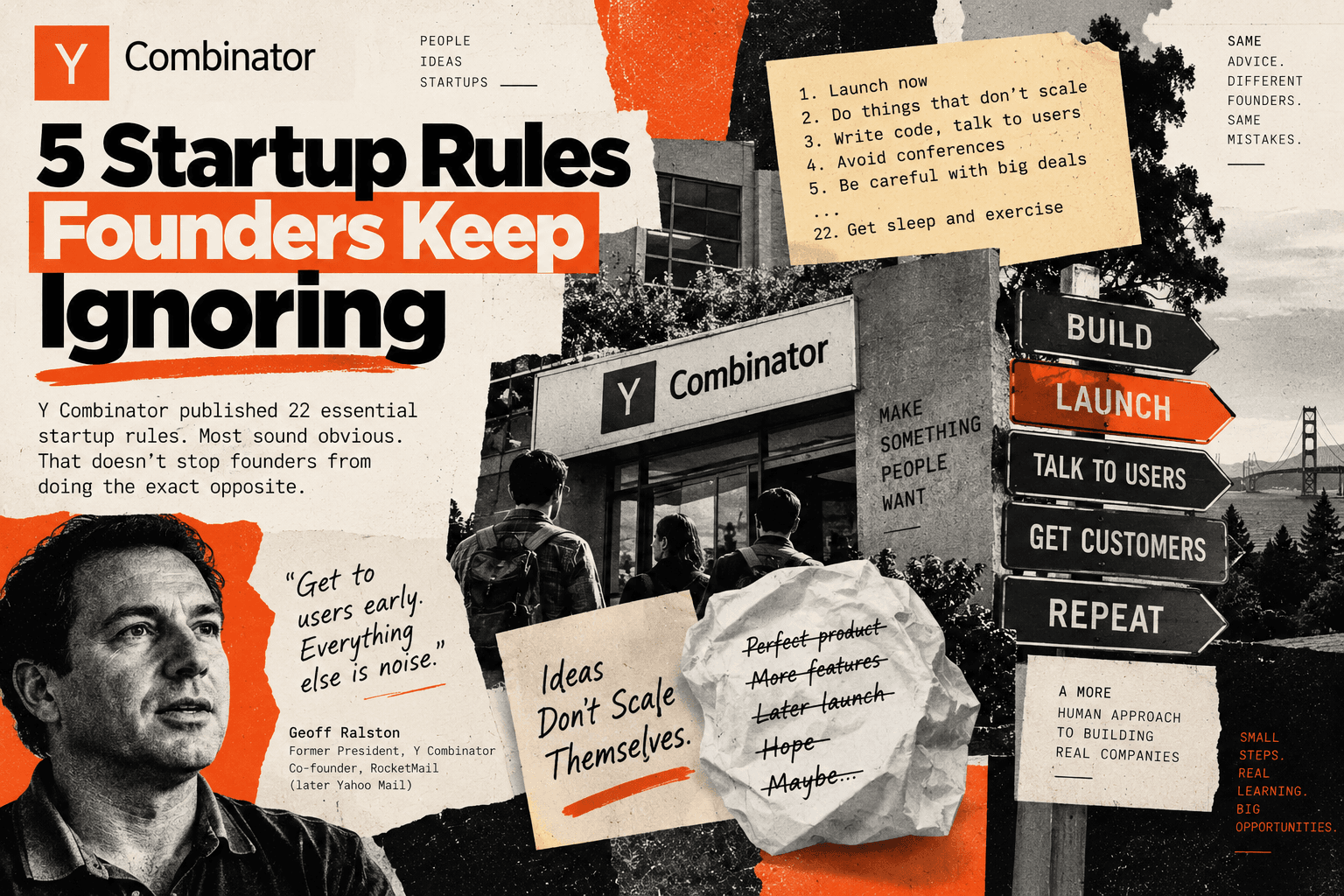
Y Combinator published 22 essential startup rules. Most sound painfully obvious. That doesn't stop founders from doing the exact opposite.
The startup world has a remarkable ability to make simple things complicated.
We have frameworks for finding product-market fit. Frameworks for measuring product-market fit. Frameworks for deciding whether the previous framework was measuring the correct kind of product-market fit.
There are conferences about growth, newsletters about growth, and consultants explaining why your growth strategy requires another strategy.
Meanwhile, Y Combinator published a list of 22 startup rules back in 2017.
Most of them could fit on a single sheet of paper.
And most are still remarkably relevant.
The advice was collected by Geoff Ralston, former president of Y Combinator and one of the people behind RocketMail, which eventually became Yahoo Mail.
You can read the original 22 rules here.
At first glance, the list looks almost disappointingly obvious.
Launch your product.
Talk to customers.
Don't waste money.
Don't hire too early.
Build something people actually want.
Groundbreaking stuff. Next they'll tell us that a business should have customers.
But the interesting thing about these rules isn't that they're particularly clever.
It's how easy they are to agree with and how difficult they are to follow.
Here are five I think deserve particular attention.
1. Launch now. Not when everything is perfect.
This is probably the most frequently misunderstood piece of startup advice.
A founder spends six months building a product.
Then another month improving the interface.
Then discovers that onboarding needs work.
Then decides the pricing page isn't quite ready.
Then comes analytics.
Then a dashboard.
Then an AI feature, because apparently software is now legally required to have one.
And eventually there's a beautiful product that nobody has paid for.
The problem isn't perfectionism itself.
The problem is that product development can become a very comfortable way to avoid market feedback.
Writing code feels productive.
Fixing bugs feels productive.
Adding features feels productive.
Selling an unfinished product to somebody who might reject it feels considerably less pleasant.
Unfortunately, that last activity often produces more useful information than the previous three combined.
YC's advice isn't to release something unusable.
It's to release the smallest version that genuinely solves a problem.
A product doesn't need to be complete to be valuable.
And your first customer doesn't need to arrive through a sophisticated marketing funnel.
Manual onboarding? Fine.
A founder personally handling requests? Fine.
An embarrassingly simple prototype? Also fine, provided it actually works.
Thirty serious conversations with potential paying customers can reveal more than three months of polishing features nobody requested.
The goal of an early launch isn't to impress the market.
It's to discover whether there's a market worth impressing.
2. Do things that don't scale. Yes, deliberately.
This advice sounds almost offensive in an industry obsessed with scalability.
Everything must scale.
The technology must scale.
The sales process must scale.
Customer acquisition must scale.
Preferably before the company has acquired an actual customer.
Which creates an interesting situation.
A startup with twelve users is already designing infrastructure for twelve million.
Why?
At the beginning, the most important resource isn't operational efficiency.
It's information.
And manual work can be an exceptionally efficient way to acquire information.
Suppose you're developing a B2B product.
You could spend weeks building an automated lead qualification system.
Or you could personally research fifty potential customers, understand their businesses, contact them and learn what makes some of them respond.
The second approach doesn't scale particularly well.
That's precisely why it's useful.
You see the exceptions.
You notice patterns.
You discover objections you didn't know existed.
You learn which parts of the process genuinely require automation and which parts shouldn't exist at all.
Once the process works, automate it.
Until then, you're often just automating assumptions.
Scalability is an excellent problem to solve once you have something worth scaling.
Before that, it can become an expensive distraction.
3. Talk to users. But learn to distinguish opinions from demand.
This rule has a hidden trap.
People are generally polite.
Show somebody your startup idea and ask whether they like it.
There's a good chance they'll say yes.
Especially if they know you.
Especially if you've clearly spent six months building it.
Especially if saying no would require an uncomfortable conversation.
Congratulations. Your idea has been validated by human kindness.
Unfortunately, kindness doesn't pay invoices.
There's a fundamental difference between someone appreciating an idea and someone needing the product.
Even a potential customer can give misleading feedback without intending to.
People are surprisingly bad at predicting what they'll use in the future.
They may request features they'll never touch.
They may reject something that later becomes essential.
And they may enthusiastically praise a product they wouldn't pay five dollars for.
This doesn't mean customer interviews are useless.
It means the questions matter.
Instead of asking whether somebody likes your idea, investigate their actual behaviour.
What problem are they dealing with today?
How are they solving it?
How much time does it consume?
What does the problem cost?
Have they already paid for an alternative?
What happens if they don't solve it?
And eventually, the uncomfortable question:
Would you pay for this?
A purchase isn't the only valid form of evidence. Usage, retention and genuine commitment matter too.
But willingness to pay is considerably more informative than a compliment.
There's another problem with customer development: talking to the wrong people.
A hundred interviews with people who will never buy your product can create an impressive research document and very little useful market knowledge.
Talk to people who actually experience the problem.
Ideally, people who can make or influence the buying decision.
Otherwise, customer development risks becoming another elaborate way to avoid selling.
4. Conferences are not a customer acquisition strategy by default.
Startup conferences are wonderful places.
You get a badge.
You drink coffee.
You meet interesting people.
You exchange LinkedIn profiles.
You discuss synergies.
Somebody explains that they're building the infrastructure layer for the next generation of something.
Everybody agrees to stay in touch.
And three months later, the pipeline is still empty.
Conferences can create a powerful illusion of commercial activity.
There are conversations, introductions, meetings and follow-ups.
All the visible signs of business development.
Except, occasionally, the business.
But saying conferences are useless would be equally simplistic.
For some industries, they're extremely effective.
If twenty of your most important potential customers attend the same specialised event, that might be one of the best places to spend your time.
If you're selling complex enterprise infrastructure, relationships developed at industry events can matter enormously.
The real question is much simpler:
Is this the most effective way to reach your actual customers?
Not potential investors.
Not interesting people.
Not other founders.
Customers.
Before booking the ticket, establish what you want to accomplish.
Which specific companies will be there?
Who do you need to meet?
Can you arrange those meetings beforehand?
What commercial outcome would justify the cost?
If there are convincing answers, go.
If not, you may be purchasing an expensive opportunity to feel professionally busy.
5. Be very careful with big enterprise deals.
Enterprise customers are attractive.
Large contracts.
Recognisable names.
Potentially significant recurring revenue.
And the reassuring feeling that a serious company has finally recognised your startup's brilliance.
Then procurement arrives.
Followed by legal.
Followed by information security.
Then compliance.
Then another procurement meeting.
Then a new stakeholder who needs the entire product explained from the beginning.
And suddenly the deal that was supposed to transform your startup has consumed six months.
The problem isn't that enterprise customers are bad.
For some startups, enterprise sales are the entire business model.
The problem is the asymmetry.
A large organisation can spend six months considering a relatively small purchase without suffering much damage.
An early-stage startup may not survive six months of concentrated effort on a deal that never closes.
So before entering a long enterprise sales process, ask a few unpleasant questions.
Does the customer have an actual deadline?
Is there a budget?
Is there a person who can make the decision?
What happens inside the organisation if the deal doesn't close?
Is the problem urgent enough to overcome internal bureaucracy?
That last question matters enormously.
A potential customer saying your product is interesting means very little.
A customer facing a regulatory deadline, an operational failure or a contractual obligation has a reason to make something happen.
In enterprise sales, a compelling event can be more valuable than a hundred enthusiastic meetings.
And if there isn't one?
Be careful about building your company's entire forecast around an organisation that has no particular reason to hurry.
The rule behind all five rules
Look at these five recommendations together.
They're all describing variations of the same problem.
Founders are remarkably good at replacing difficult, commercially important work with easier activities that look productive.
Building more features instead of launching.
Designing automation instead of finding customers.
Collecting compliments instead of testing demand.
Attending conferences instead of selling.
Negotiating impressive contracts instead of closing achievable ones.
None of these activities is inherently wrong.
The problem is timing.
A conference can be valuable.
Automation can be valuable.
Enterprise sales can be valuable.
A beautifully designed product can be valuable.
But being useful eventually doesn't make something useful right now.
Early-stage companies have limited time, money and attention.
Every activity competes with something else.
And the most important task is usually much less glamorous than whatever the startup ecosystem happens to be discussing this week.
Find a real problem.
Build a useful solution.
Get people to use it.
Find out whether they'll pay.
Repeat.
Terribly unexciting.
Which may explain why we keep inventing more sophisticated alternatives.
One more YC rule: founders often kill their own companies
One of the most provocative observations in YC's original list is that startup failure isn't always simply a matter of running out of money.
Cash shortages are real, of course. Sometimes external conditions genuinely make a business impossible.
But running out of cash is often the final symptom of problems that developed much earlier.
Founders lose focus.
They stop learning from customers.
They spend too much time on the wrong things.
They hire before the business is ready.
They disagree about the company's direction.
Or they simply become exhausted and give up before finding a viable path.
That doesn't mean persistence guarantees success. Sometimes shutting down or changing direction is the rational decision.
But it does mean that runway isn't purely a financial concept.
It also depends on judgement, priorities, relationships and the ability to keep making good decisions under pressure.
Which brings us to another recommendation from the YC list.
Take care of your sleep and physical health.
It sounds suspiciously like advice from your mother.
And it may be one of the more commercially relevant recommendations on the entire page.
A founder who hasn't slept properly for weeks is unlikely to make consistently brilliant strategic decisions, no matter how impressive the pitch deck looks.
The uncomfortable startup checklist
So here's a useful exercise.
Forget the fundraising presentation for a moment.
Forget the product roadmap.
Forget the impressive list of features scheduled for the next quarter.
Ask yourself:
Are we postponing the launch because the product genuinely isn't useful yet, or because we're afraid to sell it?
Are we automating a process before we understand whether it works?
Are we talking to actual buyers or just collecting encouraging opinions?
Are our marketing activities producing customers or merely activity?
Are we spending too much time chasing a large deal that may never close?
And perhaps most importantly:
What is the one thing we should stop doing this week?
YC published its essential startup advice in 2017.
The tools have changed enormously since then.
We have AI agents, automated development, sophisticated analytics and the ability to build functional products faster than ever.
But none of that eliminates the underlying problem.
If anything, AI makes it easier to produce an enormous amount of work before discovering that the work wasn't necessary.
You can now build the wrong product faster.
Automate the wrong process faster.
Generate the wrong marketing materials faster.
And produce fifty variations of a strategy that nobody has validated.
That's progress, apparently.
The original YC advice remains useful because it asks founders to distinguish between progress and activity.
Build something people want. Get it into their hands. Learn what happens.
Everything else should earn its place.