
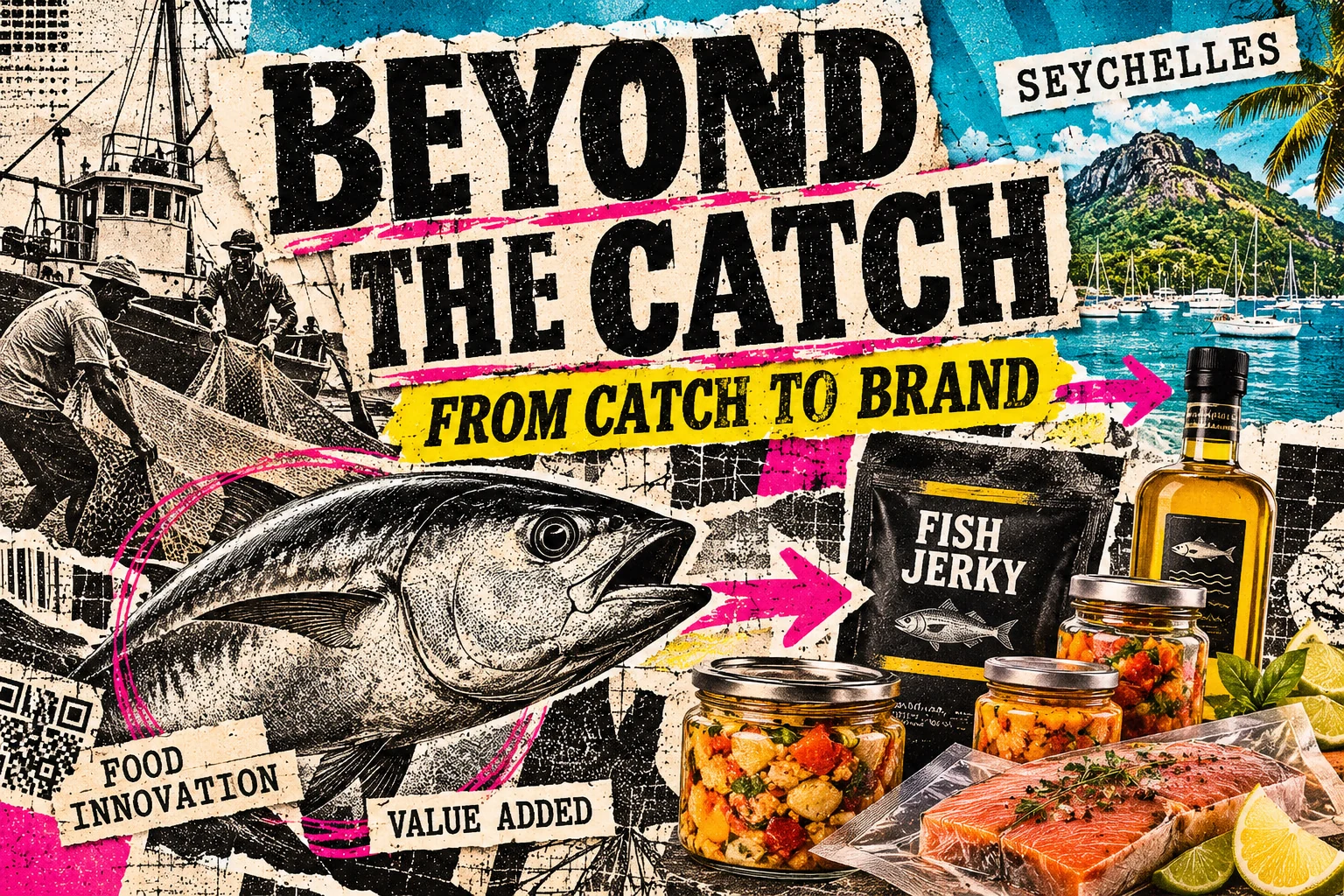
An investor-approved food innovation concept exploring how an existing fishing business in the Seychelles could move beyond selling raw fish and develop a portfolio of premium, value-added seafood products. The proposal was accepted, but the project was not brought into production, as far as I know, following the disruption caused by Russia's full-scale invasion of Ukraine.
Project: Seychelles Seafood Value-Addition Concept Development framework: Alien Technologies, Food Innovation R&D Field: FoodTech / Seafood Processing / Product Strategy Work: Product Portfolio Strategy, Food Innovation Concepts, Manufacturing Direction, Packaging Concepts, Business Model Development Status: Concept accepted by the investor. Commercial implementation not confirmed.
The Fish Was Already There. The Margin Wasn't.
A few years ago, I was working with an investor who had backed a separate food innovation project involving baked pea chips.
Those chips were an interesting product in their own right: a Pringles-like snack made from dried pea purée, shaped and baked rather than traditionally fried, with spices as the only additional ingredients.
That's a different story, and it deserves its own case study.
But the relationship led to another assignment.
The investor also had a fishing business in the Seychelles.
It operated in a very different industry, with a very different problem.
The business was catching fish in the Indian Ocean, but the economics were disappointing.
The margins were low.
The activity wasn't producing the kind of return the investor wanted.
And he asked a relatively straightforward question.
Could we turn the existing fish supply into something significantly more valuable?
Not by catching more fish.
Not by building a larger fleet.
Not by simply finding another wholesaler.
But by processing the catch locally and creating products that could be sold at a premium, stored for longer periods, and distributed to more attractive markets.
That was the assignment.
The result was a proposal for several interconnected seafood product lines.
Some were relatively conventional from a technological perspective but required strong positioning and packaging.
Others involved more complex food-processing systems.
And one direction explored how materials left over from producing premium foods could become the basis for additional products.
The investor accepted the concept.
Unfortunately, it never developed into the production business we had discussed, at least to my knowledge.
The full-scale invasion of Ukraine disrupted the plans before they could progress further.
But the underlying exercise remains interesting.
Because the real problem wasn't how to invent a fish snack.
It was how to redesign the economics of a fishing business.
Stop Thinking About Fish as a Commodity
When a company sells a raw commodity, its commercial possibilities are heavily influenced by the characteristics of that commodity.
Quality.
Quantity.
Seasonality.
Availability.
Transport costs.
Storage requirements.
And the price offered by the buyer.
Fresh fish can be particularly demanding.
It's perishable.
It requires careful handling and temperature control.
And when the catch needs to reach a distant market quickly, logistics can absorb a substantial part of the available margin.
But the same fish can become the main ingredient in a completely different product.
A premium snack.
A ready-made meal.
A prepared restaurant dish.
Or a processed ingredient used in another industry.
In those cases, the customer is no longer purchasing only the raw material.
They are paying for convenience.
Taste.
Consistency.
Brand.
Packaging.
Shelf life.
And sometimes an experience or a specific use.
That doesn't automatically make the business profitable.
Processing adds costs, risks, labour, equipment, packaging, and distribution requirements.
A higher selling price is not the same as a higher net margin.
But it creates the possibility of changing the value proposition.
Instead of asking how much a kilogram of fish can sell for, we began asking what kinds of consumer products could be made from it.
And which of those products could realistically justify the cost of production in the Seychelles.
The Four Product Directions
The presentation developed four main directions.
Premium fish jerky and snacks.
Ready-to-eat preserved seafood dishes.
Vacuum-packed fish dishes prepared for quick finishing.
And fish-derived ingredients for supplements, cosmetics, and related markets.
They were not intended to be four versions of the same recipe.
They represented different production processes, commercial channels, and levels of technical complexity.
The common objective was to make better economic use of the available catch.
The first two categories were particularly interesting because of the potential to reduce dependence on rapid delivery of fresh fish.
The third offered a different kind of value through convenience and a premium dining experience.
And the fourth explored whether appropriate processing by-products could become inputs for other industries.
Together, they suggested a portfolio rather than a single-product factory.
That was one of the most important strategic decisions in the concept.
Different parts of the catch could potentially serve different markets.
But this would only work if the actual species, volumes, processing yields, safety requirements, and production economics supported the proposed allocation.
The presentation identified the opportunities.
Those operating assumptions still required validation.
1. Premium Fish Jerky: A Small Product with a Different Price Logic
The first direction was premium fish jerky and seafood snacks.
Imagine a small package of concentrated, savoury fish.
Something positioned closer to a premium protein snack than a conventional seafood product.
The proposal included small packs of approximately 20–35 grams.
Different flavour profiles.
A convenient grab-and-go format.
And an alternative elongated presentation described in the original materials as a cigar.
The small format was commercially interesting.
It could fit convenience retail.
Travel retail.
Speciality food shops.
Online sales.
And potentially other channels where customers are accustomed to buying snacks rather than fresh fish.
The comparison was no longer with the price of raw fish at the dock.
It was with the retail price of a premium packaged snack.
That's a different competitive environment.
Of course, this also meant entering a highly competitive category where flavour, texture, branding, and consistency matter.
A fish jerky product would need to be genuinely enjoyable.
Not merely an efficient way to dispose of surplus fish.
It would need a clearly defined flavour profile and a reason for customers to choose it over other protein snacks.
The presentation explored existing products as references, including fish jerky and fish-skin snacks.
These examples helped illustrate packaging formats and category possibilities.
They were not original products manufactured by our team.
Why this direction was attractive
Properly processed dried fish can achieve comparatively convenient storage and distribution characteristics.
For an island-based business, that is potentially important.
A product that does not depend on the same cold-chain requirements as fresh fish may be easier to send to distant customers.
But the process must actually produce a safe, stable food.
Drying alone is not enough to guarantee shelf stability.
Water activity, microbial hazards, packaging performance, oxidation, and the characteristics of the fish species all matter.
A shelf life exceeding a year was an objective in the original concept.
It was not a tested result.
The development programme would have needed to establish whether the intended product could meet that requirement.
One production stream, two markets?
The proposal contained another interesting idea.
Materials remaining from the production of premium snacks for people might be suitable for a separate line of pet treats.
For example, certain fish trimmings could be processed into jerky-style snacks for dogs.
The idea was to make more complete use of the raw material while sharing some production capabilities.
But that would require separate quality standards, compliant ingredient handling, appropriate product segregation, and a clear understanding of the applicable pet-food requirements.
It would not be safe or commercially credible simply to repackage arbitrary human-food waste as dog treats.
Still, the business logic was worth investigating.
One main seafood operation could potentially supply more than one customer market.
The valuable question was whether usable, traceable secondary material existed in sufficient quantity and quality to justify the additional product line.
2. A Restaurant Dish in a Jar
The second direction was more visually distinctive.
Premium ready-to-eat seafood meals.
Not ordinary cans of fish.
Not cheap convenience food.
But complete prepared dishes built around local seafood and interesting flavour combinations.
The presentation suggested recipes such as red snapper with mango and curry.
Fish accompanied by vegetables, sauces, and spices.
The kind of combination that could connect the identity of the Indian Ocean with contemporary packaged food.
The proposed packaging was particularly important.
We explored the idea of a glass container that could function almost like a serving dish.
The consumer would open it and have something attractive enough to place directly on the table.
A complete meal rather than an ingredient requiring further preparation.
That changes the category.
A conventional can of fish competes largely on the value and usefulness of its contents.
A carefully designed premium preserved meal can also compete on convenience, presentation, flavour, and occasion.
The question becomes whether someone would pay for a restaurant-inspired seafood dish that is convenient to store and serve.
We also explored more unusual packaging concepts, including containers visually inspired by bamboo or coconut shells.
Those ideas were primarily about regional identity and presentation.
They were not validated packaging systems.
In particular, an unusual natural container is not automatically suitable for producing a commercially sterile, shelf-stable seafood meal.
A real manufacturing programme would need validated food-contact materials, closures, thermal processing, and packaging integrity.
The glass-jar concept was more conventional, but it would still require careful engineering.
The production challenge
Fish-based ready meals present a very different technical problem from dried snacks.
To achieve genuine ambient shelf stability, especially for low-acid seafood products, a manufacturer needs a validated preservation process and suitable hermetically sealed packaging.
The recipe affects the process.
So do the container's shape, material, filling conditions, and sealing system.
A visually attractive glass vessel cannot simply be assumed suitable for industrial thermal sterilisation.
The original concept identified a potentially appealing product and packaging direction.
It did not include validated processing parameters, shelf-life studies, or costed industrial trials.
Those would have been the next steps.
And they might have determined whether a technically simpler container was preferable to the more distinctive presentation.
3. The Almost-Ready Seafood Restaurant
The third direction began with a different consumer problem.
People like good fish.
But many don't particularly enjoy preparing it.
They may not know how long to cook a particular species.
They may be worried about overcooking it.
They may not have the ingredients to prepare a complete dish.
Or they may simply want dinner without spending half an hour preparing everything.
The proposal was to offer premium fish dishes in vacuum packaging, with accompanying ingredients.
The fish would undergo a controlled cooking process, potentially using sous-vide techniques.
The customer or food-service operator would then complete the dish with minimal effort.
The objective was convenience without reducing the product to something that felt like an ordinary microwave meal.
This was a different product proposition from shelf-stable jars.
Instead of prioritising long-distance ambient distribution, it prioritised ease of preparation and a premium eating experience.
And there was an important technical distinction.
Vacuum packaging and sous-vide cooking do not automatically make seafood safe to store at room temperature.
Such products may require refrigeration or freezing, validated heat treatment, strict temperature controls, and a shorter shelf life than conventional sterilised canned foods.
The original presentation grouped several product ideas under the broader ambition of extended storage.
But this particular direction would need its own shelf-life model.
The possibility of a year-long ambient shelf life should not be assumed for vacuum-packed sous-vide fish.
From packaged meals to restaurant operations
The more ambitious part of this concept was what could happen downstream.
If a producer supplied consistent, high-quality fish dishes requiring minimal final preparation, those products could potentially support a new type of food-service operation.
A small premium seafood outlet.
Limited kitchen complexity.
Standardised menu items.
Fast service.
Predictable portions.
Potentially, a repeatable operating format.
The presentation explored the possibility of developing a premium seafood fast-food concept and expanding it through franchising.
This wasn't a restaurant chain that had been launched.
It was a future business model built on the possibility of standardising the product and the finishing process.
The logic was interesting.
Instead of treating seafood processing and restaurant operations as separate opportunities, the same production base might eventually support a branded food-service network.
But that would have been a later stage.
First, the product would need to work.
Then the supply chain.
Then the restaurant economics.
Only after that could franchising become a meaningful discussion.
4. Can the By-Products Become Another Business?
The fourth direction was concerned with materials left over after processing.
A fish is not composed entirely of premium fillets.
Depending on the species and product, processing can generate heads, skin, frames, trimmings, viscera, and other fractions.
Some of these materials may be suitable for additional uses.
Others require disposal or specialised treatment.
The proposal explored fish oil, fishmeal, and related ingredients as potential foundations for products in other markets.
Dietary supplements.
Cosmetics.
And other fish-derived commercial products.
This was a more complex industrial proposition.
There is an enormous difference between recovering crude fish oil from processing material and manufacturing a compliant consumer supplement.
The latter may require refining, contaminant testing, oxidation controls, formulation, documentation, and market-specific regulatory approval or notification.
Likewise, fishmeal is not automatically a premium cosmetic ingredient.
It may serve as a feed ingredient or require substantial further processing to become another type of usable material.
But the broader idea was commercially relevant.
If the main processing operation generated a consistent stream of suitable by-products, perhaps some of those materials could support additional revenue.
The original presentation also considered possible distribution channels.
Established online marketplaces.
Specialist supplement retailers.
Performance-marketing channels.
And direct-sales networks.
These were proposed channels, not secured commercial partnerships.
The economic question would be whether the volumes, processing yields, quality requirements, and market prices justified developing another product line.
A by-product doesn't become valuable merely because it can be put into a bottle.
But a carefully designed recovery process can sometimes transform a disposal cost into an additional source of revenue.
That was the opportunity we wanted to examine.
The More Interesting Idea Was the Portfolio
Any one of those products could have been developed as a separate business.
Fish jerky.
Premium preserved meals.
Convenient sous-vide seafood dishes.
Fish-derived ingredients.
But the real appeal of the concept was how those directions might complement one another.
Imagine a fish-processing operation that allocates suitable raw materials across different uses.
Some fish becomes a premium packaged snack.
Other material is selected for prepared meals.
Certain cuts are used in ready-to-finish dishes.
And eligible processing by-products are recovered for secondary applications.
The objective would be to improve the economic value obtained from the catch as a whole.
This is not as simple as dividing a fish into four piles.
Different products need different species, cuts, quality grades, production technologies, and safety controls.
The same facility cannot necessarily handle every category economically.
Pet treats and consumer supplements may also require very different equipment, procedures, and compliance systems.
But thinking in terms of a portfolio creates additional options.
Instead of committing the entire business to one new product, the investor could examine where different forms of processing might produce the highest contribution margin.
The correct allocation would depend on real data.
Species availability.
Seasonal volumes.
Raw-material costs.
Yield after processing.
Energy consumption.
Labour.
Packaging.
Storage.
Distribution.
Market demand.
And the selling price that could actually be achieved.
The concept proposed directions worth investigating.
A commercial feasibility study would need to determine which of them should be prioritised.
Why the Seychelles?
The location mattered.
This was not a hypothetical seafood company without access to raw materials.
The investor already had a fishing operation in the Seychelles.
That provided a potential starting advantage.
An existing relationship with the supply side.
Knowledge of the catch.
Access to operating information.
And an opportunity to explore whether more processing could take place closer to the source.
It also created constraints.
An island-based production operation needs to account for equipment imports, packaging availability, energy and water requirements, skilled staff, storage, port logistics, and international transport.
A high-margin retail product can still be commercially unattractive if production costs and logistics absorb the difference.
The business therefore needed to be built around the specific advantages and limitations of the location.
There was also a branding opportunity.
The Seychelles and the Indian Ocean have a recognisable geographical identity.
For premium products, origin can be part of the proposition.
But only if it is authentic.
A fish snack made from traceable local catch has a more credible regional story than a generic snack with tropical imagery added to its packaging.
For a serious product line, origin would need to be supported by supply-chain records, consistent quality, and the actual ingredients used.
The objective was not simply to print Seychelles on a premium box.
It was to explore whether the existing fishing business could become the foundation of distinctive manufactured products.
The Role of Alien Technologies
The proposal was developed within the broader concept of Alien Technologies, a food innovation R&D operation.
The presentation described a laboratory and development platform capable of working on both independent product ideas and commissioned projects.
Its proposed services covered the complete product-development process.
Market and technology research.
Formulation.
Production methods.
Regulatory preparation.
Branding.
Packaging.
Supplier selection.
Manufacturing arrangements.
And subsequent product optimisation.
The Seychelles assignment was one possible application of that model.
An investor arrives with an existing business and a commercial problem.
Rather than suggesting a generic marketing campaign, the development team investigates ways to change the product itself.
The objective was to connect R&D with business strategy.
What can we manufacture?
Who might buy it?
What equipment would be needed?
How should it be packaged?
Where could it be distributed?
And how might the resulting product improve the economics of the original business?
The presentation also discussed a separate laboratory investment model.
Those figures should not be confused with a budget for developing a seafood-processing facility in the Seychelles.
The materials do not contain a complete plant-level capital expenditure estimate, costed recipes, or validated production economics for the proposed fish products.
Those would have required further work.
What the Seychelles section provides is a product-portfolio direction and a set of manufacturing hypotheses.
That was the scope of the investor proposal.
The Investor Accepted the Concept
The project was prepared in response to a real business request.
It wasn't an exercise in inventing a fictional startup for a pitch competition.
There was an investor.
There was an existing fishing business.
There was a problem with its economic performance.
And there was a request to identify potentially higher-value products that could be manufactured from the available raw material.
We presented the proposed directions.
The investor accepted the concept.
That is where the documented result ends.
The surviving presentation does not establish that processing equipment was purchased, recipes were finalised, production trials were completed, or branded products entered the market.
And as far as I know, the project was never implemented.
Russia's full-scale invasion of Ukraine in February 2022 disrupted the plans and made further development impractical.
I don't have a complete record of every subsequent decision made by the investor.
So I wouldn't present the absence of a launch as the result of a failed commercial test.
There was no documented commercial test of the proposed product portfolio.
The strategy was accepted.
The production business did not follow.
Those are two different facts.
What I Would Validate First
Looking back, I would still begin with a portfolio of possibilities.
But I would not try to develop all four directions simultaneously.
The first step would be to examine the actual catch.
Which species were available?
In what quantities?
How consistent was the supply?
What were the current selling prices?
How much edible yield could be obtained?
And which parts of the catch, if any, were commercially underused?
The second step would be a preliminary technical and economic screening of the product categories.
For fish jerky, I would investigate texture, drying yield, flavour, water activity, packaging, and customer acceptance.
For preserved meals, I would test recipe concepts against the costs and constraints of a validated sterilisation process.
For sous-vide products, I would examine the cold-chain requirements and identify a viable regional or food-service distribution model.
And for fish oil or other by-products, I would begin by measuring actual recoverable quantities and their quality before making assumptions about the value of finished supplements or cosmetics.
Then I would compare the economics.
Not simply retail prices per kilogram.
Contribution margins after processing.
Equipment requirements.
Production volumes.
Storage and transport costs.
Regulatory compliance.
Sales acquisition costs.
And expected working-capital requirements.
The most attractive product in a presentation is not necessarily the best first investment.
My initial hypothesis would be that premium dried snacks deserved early feasibility testing, because small portions and potentially shelf-stable packaging aligned closely with the original objective of reaching distant markets with less dependence on refrigerated distribution.
But that is a hypothesis, not a conclusion established by the deck.
If the catch composition or processing yield were unsuitable, another category could prove more attractive.
The point of the next stage would be to find out.
A Higher Selling Price Is Not a Business Model
There is one lesson from this kind of assignment that I consider particularly important.
When an existing business has low margins, it's tempting to look at finished consumer products and imagine capturing the entire difference between raw-material prices and retail prices.
A kilogram of fish may have one value at landing.
A series of small branded packages containing that fish may have a dramatically higher combined retail price.
But the difference is not profit.
Between those two numbers are processing losses, labour, energy, equipment depreciation, packaging, distribution, marketing, retailer margins, unsold inventory, and quality assurance.
A premium product is valuable only when the additional revenue exceeds the additional cost and risk.
That's why I think the original investor question was more interesting than simply asking us to invent new products.
It required changing the way the fishing operation could participate in the value chain.
The products had to be designed around the business.
Not the other way around.
The existing supply was an advantage.
But the new product categories would need to earn their place through real economics.
An Unfinished Concept with a Practical Starting Point
This project never became a documented production business.
There are no commercial product sales to report.
No factory performance figures.
No finished brand portfolio.
And no validated increase in the investor's fishing margins.
What remains is a product-development proposal prepared for an actual investor with a specific operating problem.
It identified several ways to move from selling raw fish toward products with greater potential added value.
Premium protein snacks.
Prepared seafood meals.
Convenient dishes for food service.
And secondary products derived from suitable processing materials.
Some directions were relatively focused.
Others were more ambitious.
All required further validation.
But the underlying strategy was clear.
Instead of trying to make a low-margin fishing business profitable by selling more of the same raw material, investigate how much additional value could be created from the catch already available.
That's a question worth asking in many industries.
Agriculture.
Food processing.
Manufacturing.
Any business where the primary product is sold early in the value chain and most of the consumer-facing value is created somewhere else.
The answer isn't always to build a factory.
Sometimes the economics won't work.
Sometimes the right model is contract manufacturing.
Sometimes a single specialised product makes more sense than an entire portfolio.
And sometimes the opportunity is in designing a better supply relationship rather than entering retail at all.
But those conclusions should follow investigation.
They shouldn't be assumed in advance.
I still think the Seychelles concept provides a useful starting point for a discussion with an existing seafood business, food manufacturer, or investor interested in value-added processing.
The original proposal could be revised around current production costs, market conditions, available species, and modern manufacturing technology.
And the portfolio could be narrowed to the products that offer the strongest evidence of genuine commercial potential.
I'd be interested in working with a suitable partner to explore that possibility.
Because the most valuable part of the project wasn't a particular fish jerky flavour or an unusual glass jar.
It was a change in perspective.
A fishing business doesn't necessarily have to remain only a fishing business.
With the right technology, product strategy, partners, and economics, it may be able to participate in a much larger part of the value created from its catch.
That was the idea behind the Seychelles proposal.
The investor accepted it.
The project never reached the production stage, as far as I know.
But the strategic question remains worth exploring.