
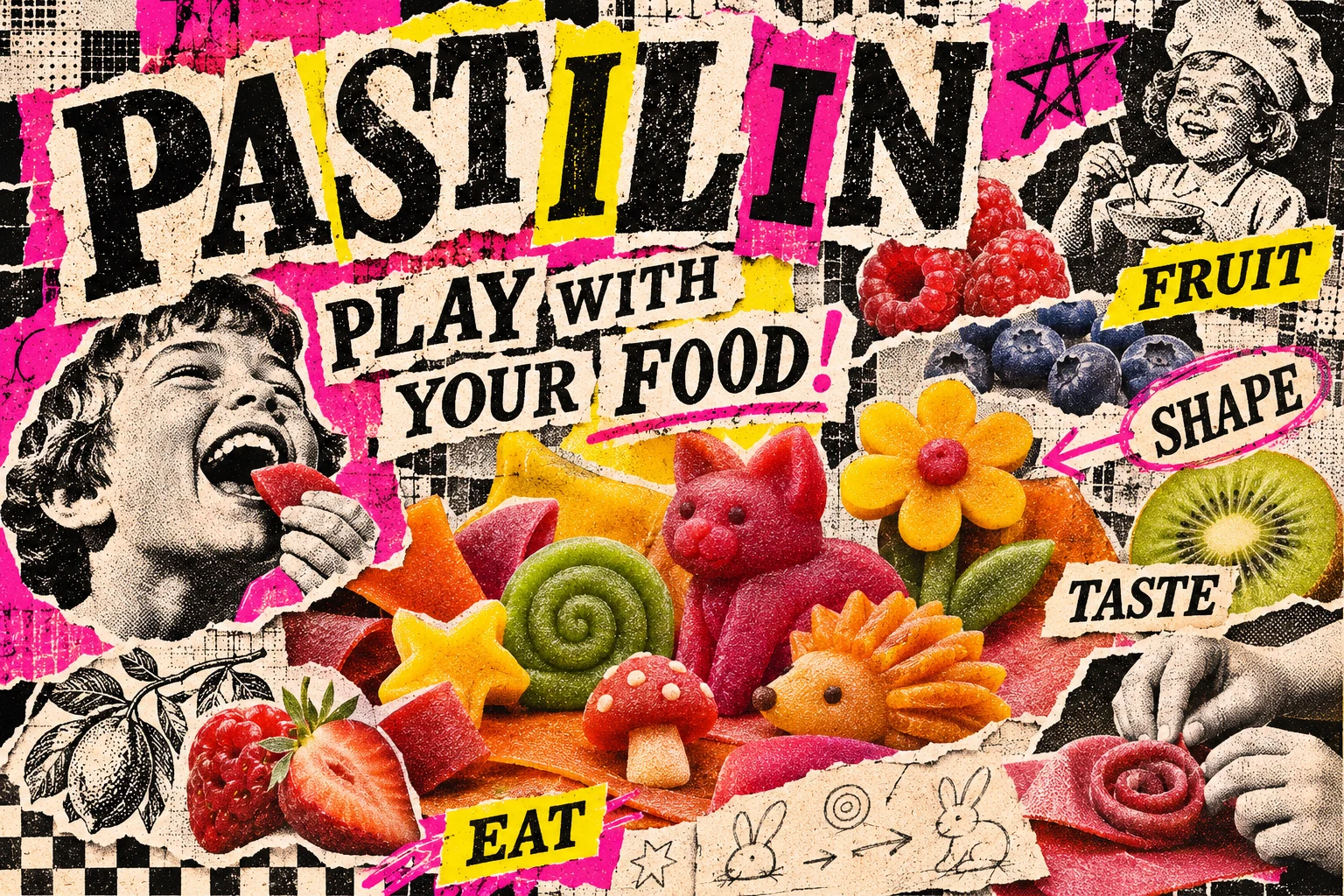
An experimental food-product concept that combined children's creativity with fruit confectionery. Instead of making modelling clay merely non-toxic, Pastilin proposed a snack children could shape, play with, and genuinely enjoy eating.
Project: Pastilin (Пастилин) Field: Food Innovation / Children's Products / FMCG Work: Product Concept, Category Research, Product Positioning, Packaging Strategy, R&D Planning, Go-to-Market Concept Status: Product concept and development proposal. No completed formulation or commercial launch documented.
The Product That Looked Good Enough to Eat
Sometimes a product idea begins with a complicated market analysis.
Sometimes it begins because somebody looks at a piece of modelling clay and wants to eat it.
Pastilin belongs to the second category.
While exploring opportunities for new food products, we were looking at children's modelling materials.
One of the most interesting examples was Hey Clay.
It was colourful, soft-looking, attractively packaged, and presented in combinations that could easily be mistaken for sweets.
We brought a sample of the pink material into the office.
People wanted to taste it.
When we explained that it wasn't edible, the reaction was almost disbelief.
How could something that looked so much like a sweet not be something you were supposed to eat?
That little observation became the starting point for an entirely different product.
What if the material really were food?
Not modelling clay that happens to be non-toxic if a child accidentally swallows a little.
Not coloured dough that is technically edible but tastes like something nobody would voluntarily put in their mouth.
A genuinely enjoyable fruit-based confection that could also be shaped and modelled.
Something halfway between a sweet and a creative activity.
We called the concept Pastilin.
The name combined two familiar words: pastila, the fruit-based confectionery product, and plastilin, modelling clay.
The product hypothesis was simple.
Children enjoy playing with colourful, malleable materials.
Children also enjoy sweets.
Could we combine those experiences in one product, while giving parents a more credible reason to choose it than simply allowing another sugary treat?
That question turned into a proposal covering the product itself, its ingredients, packaging, manufacturing, distribution, and development process.
Edible and Actually Worth Eating Are Different Things
At the time, the edible modelling-material category seemed to contain a strange contradiction.
Some products were designed primarily as toys.
Others were based on dough or confectionery compounds that could be consumed.
But the experience of modelling and the experience of eating were not necessarily equally important.
Ordinary Play-Doh is a useful example of why the terminology matters.
It is a modelling compound, not a food product. Although it is described as non-toxic, the manufacturer explicitly states that it is not intended to be eaten.
That is perfectly reasonable.
Play-Doh was designed for creative play.
It doesn't need to taste good.
But what if we deliberately started from the opposite direction?
Instead of taking a modelling compound and trying to make it safe for consumption, take a food product and try to give it the mechanical properties of modelling clay.
The distinction is fundamental.
A toy that resembles food remains a toy.
A food product designed for play needs to satisfy the requirements of food production while also working as a creative material.
This was the real innovation challenge.
Not making something that could be swallowed without immediate harm.
Making something children would actually want to eat.
And that parents could understand as a food product with an additional creative function.
Why Fruit Pastila?
Fruit pastila seemed like an interesting starting material.
Depending on the formulation, fruit confectionery can have a soft, cohesive, flexible texture.
It can contain recognisable fruit ingredients.
It can support different flavours and colours.
And it already belongs to a familiar category of sweets and snacks.
We wanted to investigate whether a suitable formulation could retain enough flexibility to be shaped by hand.
A child might make a small animal.
A flower.
A figure.
An abstract sculpture of remarkable artistic ambition.
Or something that looks like a slightly distressed potato.
Then eat it.
The product could turn snack time into an activity.
But there was an important technical question.
Fruit pastila is not automatically modelling clay.
A material that tastes excellent may be too sticky.
A material that holds shapes well may be too firm to manipulate comfortably.
A flexible material may dry out too quickly.
One formulation may work perfectly at room temperature but behave differently after a week in storage.
And the texture must remain acceptable under the handling conditions for which the product is intended.
These are food-technology problems, not marketing problems.
The concept required research into ingredients, moisture, structure, texture, shelf life, and packaging.
The goal was to create something that belonged naturally in both worlds.
A sweet that could be played with.
And a modelling material designed from the beginning to be food.
The Packaging Was Part of the Invention
One of the more interesting conclusions in the presentation concerned packaging.
Traditional modelling clay is generally sold as a toy.
The packaging communicates creativity, construction, and activities.
We wanted Pastilin to communicate something different.
Something closer to confectionery.
The original concept proposed very small portions.
Approximately five grams for an individual colour.
And sets containing several colours, with a total weight of up to approximately thirty grams.
The smaller packs could resemble individual sweets.
The larger sets could use the proportions of a confectionery bar or compact snack package.
This wasn't merely a packaging preference.
It changed how the product might be purchased.
A parent might encounter it in a supermarket rather than a toy shop.
A child might choose a small pack as a treat.
A family could buy a multicolour set for a creative activity.
The packaging itself would communicate that the product was edible.
The colours, format, and flavour descriptions would make the idea understandable without requiring a long explanation.
The reference to Hey Clay was useful here.
Its visual language already suggested food.
Our intention was not to copy its branding.
It was to understand why its presentation created that expectation, then develop a distinct food-product identity around a genuinely edible material.
The proposed format also had another advantage.
It encouraged portion control.
Instead of selling a large tub of modelling material, the product could be offered in small, clearly defined quantities.
That made sense for a snack.
And it suggested a different retail strategy.
Colour Should Mean Flavour
Another important part of the concept was connecting colour to ingredients and taste.
The original presentation proposed combinations such as:
Green, with kiwi and spirulina.
Pink, with raspberry and açaí.
Blue, with blueberry and butterfly pea flower.
These were illustrative flavour and colour directions, not tested recipes.
But the principle was interesting.
In ordinary modelling clay, colour is primarily visual.
A red piece and a blue piece are different because they look different.
In Pastilin, colour could also communicate flavour.
A child might choose a pink piece because they liked raspberry.
Or combine several colours to create something that was both visually and gastronomically different.
This offered an additional dimension to the play experience.
The shape mattered.
The colour mattered.
The taste mattered.
But there's an important distinction between using recognisable fruit ingredients and making a substantiated nutritional claim.
Fruit-based does not automatically mean healthy.
The final product's nutritional value would depend on its actual composition, sugar content, portion size, and processing.
Similarly, botanical colour ingredients are not automatically approved for every food application simply because they occur in nature.
A commercial formulation would need to use permitted ingredients and comply with the applicable food regulations.
Those questions belonged to the research-and-development phase.
The original pitch explored the positioning.
It did not establish a final nutritional profile or certified formula.
One Product, Two Customers
Pastilin was designed around a familiar problem in children's products.
The person who wants the product is often not the person paying for it.
A child wants something colourful, playful, and tasty.
A parent wants something appropriate, safe, reasonably priced, and preferably less concerning than yet another brightly packaged confection.
A successful product needs to satisfy both.
For children, the appeal was immediate.
Choose a colour.
Make something.
Eat it.
For parents, the proposed appeal was different.
A small portion.
A fruit-based confectionery concept.
A creative activity rather than simply passive snacking.
And a product whose food safety and ingredients would be designed around intentional consumption.
This dual proposition was central to the concept.
The product needed to be desirable to children without depending entirely on persuasion directed at parents.
And it needed to be acceptable to parents without becoming so serious and educational that children lost interest.
There is a narrow space between those two expectations.
Many children's products struggle to occupy it.
Pastilin was an attempt to build the business around that space.
From the Toy Shelf to the Checkout
The choice of retail channel followed directly from the product definition.
If Pastilin were primarily a toy, the obvious channels would include toy stores, creative-play retailers, and children's activity products.
But if it were primarily a food product, the commercial opportunity could be broader.
Supermarkets.
Convenience stores.
Confectionery sections.
Snack shelves.
Checkout displays.
The original concept specifically considered small impulse-purchase formats.
This was one of the more important commercial implications.
A product that combines a snack with a playful activity might attract attention in a place where shoppers normally choose conventional sweets.
And a small individual pack could fit a low-commitment purchase.
The price would still need to work.
The shelf life would need to be compatible with food retail.
The packaging would need to protect the product's texture.
And stores would need evidence that customers actually understood and wanted the product.
But the route to market was potentially different from that of a traditional creative-play brand.
The product could compete for a small part of the confectionery purchase rather than requiring consumers to make a separate trip to buy a toy.
That was the commercial hypothesis.
Not that supermarket distribution had been secured.
But that the product's format might allow it to enter a much larger retail environment.
The Research Problem Hidden Inside a Simple Idea
It's easy to imagine Pastilin as a few brightly coloured pieces of fruit dough in a nice package.
But a real product would require considerably more development than the concept initially suggests.
The first problem is texture.
A modelling material must be workable.
It must tolerate shaping and pressure.
It needs sufficient cohesion to hold simple forms.
But it also needs to be pleasant to eat.
The second problem is stability.
Fruit-based confectionery products respond to moisture, temperature, and storage conditions.
A material that remains soft enough to model may require careful formulation and packaging to avoid drying, excessive stickiness, or microbial spoilage.
The third problem is colour and flavour.
Different fruit ingredients can influence acidity, moisture, texture, and stability.
A formula that works with raspberry may not behave identically when prepared with kiwi.
The fourth problem is hygiene.
A product designed to be handled before eating needs clear instructions and appropriate age guidance.
It also requires careful consideration of contamination from hands, surfaces, reusable tools, and other toys.
Food-grade ingredients alone do not make every method of play hygienic.
The fifth problem is classification.
A commercially produced edible modelling product aimed at children would need an appropriate regulatory assessment covering food requirements and any applicable toy-related obligations arising from its presentation and intended use.
These questions would have shaped the actual development programme.
And they are why the original idea couldn't simply be implemented by taking an existing fruit snack and changing the packaging.
The concept was straightforward.
The engineering was not.
The Alien Technologies Development Proposal
The presentation was developed in the context of Alien Technologies, a food-innovation and product-development proposition.
The intended offer went beyond the initial idea.
It proposed a complete development path, including market and technology research, formulation, production methods, brand design, packaging, regulatory work, supplier selection, manufacturing arrangements, and retail launch support.
The materials also referred to the possibility of using partner production capacity for initial test batches.
This was an important part of the business proposition.
The goal was not necessarily to create and operate a confectionery factory ourselves.
It was to offer a product concept that could be developed with an appropriate manufacturing or commercial partner.
A company with experience in fruit confectionery might provide the production expertise.
A food-technology team could work on the material's physical properties.
Designers could develop the packaging and visual identity.
And a retail partner could help test consumer response.
The concept was therefore relevant to several potential kinds of partner.
An existing confectionery manufacturer.
A children's food brand.
A food-innovation business.
Or a company operating in the creative-play market that wanted to enter a genuinely edible category.
The development proposal aimed to connect those capabilities.
What the surviving presentation establishes is the proposed work programme.
It does not establish that all those activities were completed for Pastilin.
A Two-Stage Development Plan
The original timeline separated product development from market preparation.
The proposed first stage was approximately two to three months.
It included research, formulation work, technology development, and a test product.
The second stage was conceived as approximately three additional months.
This would cover further preparation for commercial testing, including relevant documentation, packaging, branding, supplier arrangements, and the placement of test production orders.
The source document did not provide a final monetary budget.
The cost fields remained placeholders.
And the dates were estimates rather than a confirmed project schedule.
Still, the two-stage model was useful.
It recognised the difference between proving the product could be made and proving that it could become a commercial offer.
A workable formulation would answer only the first question.
A marketable product would also require reliable production costs, packaging, safety documentation, positioning, distribution, and consumer demand.
The stages would ideally be connected through a clear decision.
Does the test formulation achieve the required properties?
Does it taste good?
Does it hold shapes?
Can it be stored safely?
Can it be produced consistently?
If not, there is little reason to begin spending money on a retail launch.
In retrospect, that validation gate is the part I would make even more explicit.
What Was Actually Developed
Pastilin reached the stage of a structured product and development proposal.
The surviving presentation contains the original product idea, competitor references, the observation that inspired the concept, suggested ingredients and flavour directions, packaging formats, retail positioning, anticipated advantages, and a proposed development programme.
It also describes the services intended to support research, manufacturing, and commercialisation.
Those are meaningful elements of early-stage product development.
But the materials do not document a completed edible modelling formulation.
They do not establish that a Pastilin prototype was manufactured.
There are no results from texture tests, taste panels, shelf-life studies, safety assessments, or retail trials.
And there is no evidence of a commercial launch.
That distinction is worth preserving.
A product-development proposal is not a finished product.
But a good proposal can still contain a valuable insight about an existing market.
In this case, the insight came from the unusual relationship between appearance, expectation, and actual use.
A modelling compound looked so much like confectionery that people wanted to eat it.
Could we develop a confectionery product designed to satisfy that expectation?
That was the question.
Everything else in the presentation was an attempt to determine how the answer might become a business.
What I Would Change Today
If I were returning to the concept today, I would begin with a much narrower test.
One formulation.
One or two flavours.
A few basic shapes.
A small, supervised consumer study under appropriate safety conditions.
The first objective would not be to create a complete multicolour brand.
It would be to establish whether fruit-based confectionery can provide the right combination of taste, flexibility, and stability.
Only then would I test packaging and brand positioning.
I would also place greater emphasis on the intended age range.
A product for children who can reliably follow food-handling instructions presents different design questions from a product intended for toddlers.
Small pieces, choking risks, allergens, reusable modelling tools, and hygiene would all require careful attention.
And I would avoid leading with the claim that the product is healthy.
A stronger proposition would be specific.
Made from a defined fruit-based formulation.
Clear nutritional information.
Appropriate portion sizes.
No misleading claims about ingredients.
Safe when used according to the validated instructions.
The creative-play benefit could remain a central part of the experience.
But it should not become a substitute for evidence about the food itself.
Finally, I would test where customers actually expect to find the product.
A supermarket checkout might work.
A confectionery aisle might work better.
A toy retailer might be surprisingly effective despite the edible positioning.
Or the strongest initial channel might be a controlled gift or activity set.
That is not something a concept presentation can decide.
It requires real consumer behaviour.
The Opportunity Was in the Category Boundary
What still interests me about Pastilin is how it challenged a familiar division between products.
Modelling clay belongs to toys.
Fruit confectionery belongs to food.
The two markets have different customers, regulations, retailers, and product-development practices.
But the way children experience them can overlap.
Colour.
Texture.
Touch.
Imagination.
Pleasure.
The concept came from noticing that overlap and asking whether the physical properties of one category could be combined with the purpose of another.
That is often where interesting product ideas begin.
Not necessarily with a revolutionary new ingredient.
Sometimes with an existing material used in an unfamiliar way.
Sometimes with a familiar product redesigned around a different moment of consumption.
And sometimes with a small observation that reveals a contradiction nobody has bothered to resolve.
In this case, the contradiction was almost comically simple.
People wanted to eat something that wasn't food.
Why not investigate whether we could make something that was?
The commercial answer remained untested.
But the product question was clear enough to support a development programme.
An Unfinished Product Concept Worth Sharing
Pastilin did not become a documented commercial product.
The surviving materials describe an opportunity, a proposed formulation direction, a packaging strategy, and a route toward R&D and test production.
They do not demonstrate that those stages were successfully completed.
But I think the concept is still worth sharing.
It explored a different way of thinking about confectionery.
Not just another flavour.
Not just another colourful package.
A product in which eating and making something become parts of the same experience.
There are obvious technical and regulatory challenges.
Those challenges are exactly why the idea would need a serious food-development partner rather than an enthusiastic afternoon in a home kitchen.
But that doesn't make the underlying observation any less interesting.
If a confectionery manufacturer or food-innovation team sees potential in the idea, I would be interested in discussing how it could be developed, tested, and positioned properly.
Perhaps the right result would be a fruit-based modelling snack.
Perhaps a different confectionery material would prove more suitable.
Perhaps consumer testing would reveal an entirely different product format.
That's what product research is for.
An early concept is not supposed to know every answer.
It's supposed to identify a question worth investigating.
Pastilin began with a material that looked delicious but wasn't edible.
The idea was to reverse the problem.
Make something that tastes good first, then discover whether it can also become a creative medium.
It sounds almost too simple.
Which is often how the most interesting product-development problems begin.