
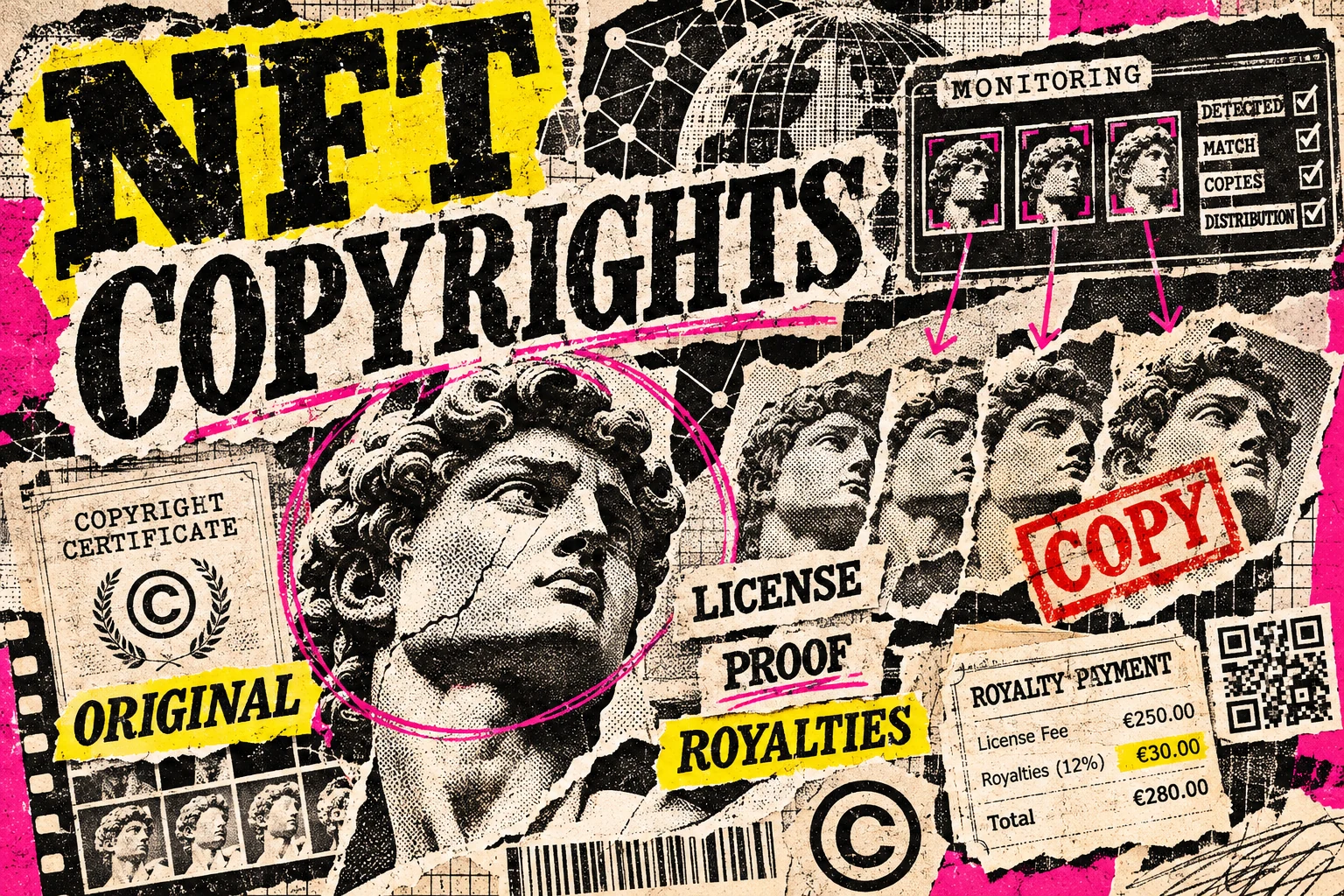
An unrealized Web3 platform concept connecting intellectual property verification, blockchain records, online infringement monitoring, licensing, and royalty recovery. The central idea was to move beyond documenting ownership and build a system that could help rights holders discover, manage, protect, and monetize their intellectual property.
Project: NFT Copyrights Field: LegalTech / IPTech / Web3 / Digital Rights Management Work: Product Concept, Platform Architecture, Business Model, Monetization Strategy, MVP Planning, Go-to-Market Strategy Status: Product and technical concept developed. Commercial implementation not documented.
Owning Something Is Not the Same as Protecting It
The internet has made copying almost everything extraordinarily easy.
A photograph can appear on another website within seconds.
An illustration can be reproduced in a commercial advertisement.
A piece of writing can be republished without attribution.
A brand's visual identity can be used by an unrelated business.
And a video can be downloaded, edited, and distributed across platforms without its original creator ever knowing.
The technical cost of copying digital content is practically zero.
The cost of discovering, documenting, and responding to unauthorized copying can be considerably higher.
For large companies, this is a familiar legal and operational problem.
They may have lawyers, compliance departments, brand-monitoring systems, and dedicated budgets for protecting intellectual property.
But independent creators and smaller businesses often have fewer resources.
A photographer may discover an image in someone else's advertising campaign.
A writer may find their work reproduced on a commercial website.
A small business may discover that another company is using a confusingly similar brand.
What happens next?
The rights holder needs to establish what they own.
Collect evidence.
Determine whether the use is actually unauthorized.
Identify the responsible party.
Decide what action is appropriate.
And, if possible, obtain compensation.
These are separate activities, usually handled through separate services.
That fragmentation was the starting point for NFT Copyrights.
We wanted to explore whether the entire process could be connected inside one platform.
Not simply creating an NFT for a piece of content.
But building infrastructure around the continuing life of intellectual property.
The Original Idea: From a Record to a Working Service
The concept began with a relatively straightforward proposal.
A rights holder registers on the platform and submits an intellectual property object.
That might be a photograph, literary work, design, video, or another supported category.
The system helps verify the identity of the person or organisation submitting it.
It records relevant evidence of the claimed rights.
A linked digital record is created using blockchain infrastructure.
And the object becomes part of a catalogue that the platform can monitor.
From there, the service becomes much more interesting.
It searches for potential uses of the protected material.
When it finds a match, the rights holder receives a notification.
The case can then be reviewed to determine whether the use is authorised, licensed, permitted by law, or potentially infringing.
Where appropriate, the system supports a request to remove the material, obtain a licence, or negotiate compensation.
If the parties agree on payment, the platform can facilitate the transaction and distribute the proceeds.
The original concept also included the possibility of selling intellectual property rights through a connected marketplace.
In other words, the platform was intended to cover an entire process:
Verify the claimant. Document the object. Monitor its use. Review potential infringements. Manage claims. Collect agreed payments.
The NFT was a component within that process.
It was not the process itself.
Why We Considered Blockchain
At the time, NFTs were attracting enormous attention.
Most public discussion revolved around digital art, collectibles, and speculative trading.
But blockchain technology also suggested other possible applications.
A tamper-evident record could document that particular information was submitted at a particular time.
A token could reference an object and its associated metadata.
A transaction history could record changes in control over a digital asset.
And smart contracts could support selected automated operations.
We wanted to explore whether these capabilities could contribute to intellectual property administration.
The idea was not that uploading a photograph to a blockchain would suddenly make its creator the legally recognised owner.
Copyright generally arises under applicable law rather than through minting a token.
Likewise, registering an NFT associated with a trademark does not replace official trademark registration.
And purchasing a token does not automatically transfer copyright, patent rights, or contractual licences.
These distinctions are fundamental.
The blockchain record would be an additional documentation layer.
It could refer to the object, the person claiming rights, supporting documents, and relevant events in the object's history.
But the legal validity of the underlying entitlement would still depend on evidence, contracts, registers, and applicable law.
This made verification one of the most important components of the proposed architecture.
Without it, the platform risked becoming a very efficient system for recording unverified ownership claims.
And that would have solved remarkably little.
An Intellectual Property Profile
The proposed user experience began with registration.
Individuals and companies would create accounts and complete identity verification appropriate to their situation.
They could then add an intellectual property object.
The original documentation considered a wide range of categories.
Literary works.
Photographs and illustrations.
Videos and audio.
Logos and other brand assets.
Certain technical documents.
Patents.
Domain names.
The ambition was to provide one interface for managing different kinds of rights.
But the legal mechanisms behind these categories are not interchangeable.
Copyright, trademarks, patents, and contractual domain-name interests involve different rules.
Some rights arise automatically.
Others require formal registration.
Some can be assigned.
Others may be restricted by licences, contracts, or jurisdiction-specific requirements.
A viable product would therefore need separate verification and management procedures for each supported category.
The concept anticipated that.
It included checking ownership documents through official databases or APIs where available, with manual procedures where automation was not possible.
For objects requiring formal registration, the platform could help initiate the appropriate process.
Once the necessary information had been assembled, the system could create a digital profile for the object.
This profile would become the centre of its ongoing management.
Instead of repeatedly reconstructing the ownership history whenever a problem appeared, the rights holder would have a structured record connecting the object, relevant evidence, and subsequent activity.
The Real Product Begins After Registration
A digital record is useful.
But for many creators, the more immediate problem is discovering where their work has appeared.
A photographer does not necessarily need another certificate saying they created a photograph.
They need to know when the photograph is used in an advertising campaign without permission.
A publisher may need to discover unauthorised copies of an article.
A brand owner may want to identify suspicious uses of its identity.
So NFT Copyrights proposed a monitoring system.
The broader architecture covered text, images, video, and other digital material.
The planned monitoring channels included websites, social networks, traditional media, and specialised online environments.
The intended service depth would depend on the customer's subscription and the type of content.
This was a substantial technical ambition.
Searching for exact copies of text is one problem.
Finding paraphrased material is another.
Recognising a photograph that has been cropped, resized, recoloured, or incorporated into a larger composition requires different techniques.
Detecting video fragments involves another set of tools.
And identifying potentially infringing use of a brand name involves contextual interpretation that cannot be reduced to finding matching words.
The platform would have needed different detection systems for different media types.
More importantly, it would have needed to distinguish a technical match from a legal conclusion.
A match is evidence that deserves examination.
It is not automatically evidence of infringement.
A Match Is Not a Violation
This is one of the most important distinctions in the entire concept.
Suppose the system finds a photograph reproduced on another website.
Several explanations are possible.
The website owner may have purchased a licence.
The photographer may have authorised the use.
The material may fall within a relevant legal exception.
The image may be distributed under terms allowing the particular use.
Or the reproduction may genuinely be unauthorised.
The detection system can identify similarities.
It cannot determine all the applicable legal circumstances merely from those similarities.
That is why a production version would need a review process between detection and enforcement.
The system could assemble evidence.
Identify the apparent use.
Check information about existing licences.
Flag relevant concerns.
And prepare a potential case.
But consequential legal action should depend on appropriate verification.
This distinction matters even more when automation becomes inexpensive.
A system capable of sending thousands of infringement notices can generate enormous administrative pressure.
If the underlying judgments are wrong, it can also cause significant harm.
The objective should not be to automate accusations.
It should be to reduce the work required to identify and resolve legitimate rights issues.
That was the valuable direction behind the monitoring component.
From Detection to Royalty Recovery
The original proposal did not stop at notifying users.
It explored a process for helping rights holders respond to unauthorised use.
Once a potentially problematic case was identified, the platform could support preparation of a notice, licensing proposal, or request for compensation.
The commercial idea was to make resolution easier.
Sometimes a business uses material without obtaining the appropriate licence.
The rights holder may prefer to regularise the use through payment rather than pursue immediate litigation.
The platform could provide an organised channel for that discussion.
Identify the object.
Present the claim and supporting evidence.
Specify the proposed terms.
Allow the other party to respond.
Document any agreement.
And collect payment through an integrated service.
The payment would then be allocated according to the agreement and the platform's fee structure.
The intended result was a more accessible process for creators who lacked the resources to manage every case manually.
There was also a possible benefit for legitimate users of intellectual property.
Instead of navigating an unclear ownership dispute, they could receive a structured request and a way to obtain appropriate authorisation.
Of course, not every disputed use should be settled through a royalty payment.
Some claims should be rejected.
Some require removal.
Some involve legal exceptions.
And some require professional representation or court proceedings.
The platform would need to support these different outcomes rather than assuming every detected use was an unpaid invoice.
The Marketplace: A Second Life for Intellectual Property
Another part of the concept involved a marketplace for rights.
A rights holder could indicate that certain intellectual property was available for sale.
The corresponding digital profile could display the object, ownership information, and proposed commercial terms.
A potential buyer could discover the asset and express interest.
Blockchain infrastructure might help document the transaction.
But a legally effective transfer would still require the appropriate agreements and formalities.
This was particularly important for intellectual property.
Selling a token is not the same as selling the underlying rights.
A photograph can be sold as a physical print without transferring copyright.
A digital artwork can be distributed as an NFT without granting unrestricted commercial use.
A company can license a trademark for a particular purpose without assigning ownership.
And different rights may be transferred separately.
A genuine IP marketplace therefore needs to answer specific questions.
What exactly is being sold?
Ownership of which rights?
For which territories?
For what duration?
With what restrictions?
Are existing licences still valid?
Does the seller have authority to make the transfer?
The original documentation recognised the need for separate legal formalisation of rights transfers following marketplace transactions.
That was the correct direction.
The blockchain could support the transaction history.
The legal agreement would define the rights being transferred.
The two layers would need to work together.
The Platform Architecture
The project materials developed the concept into a set of connected technical modules.
Identity and organisation verification.
Document verification.
Access to relevant intellectual property registries.
Digital record creation.
Blockchain integration.
Monitoring services.
Notifications and claims management.
Payment processing.
And marketplace operations.
The proposal considered using available APIs where appropriate rather than developing every subsystem independently.
For example, blockchain operations could be handled through an established network such as Polygon.
Identity checks could potentially connect with suitable government or commercial verification systems.
Monitoring might combine existing search services with specialised detection technology.
Payment processing would rely on appropriately authorised providers.
And the marketplace could integrate with compatible trading infrastructure.
This modular design was important.
The value of the product did not depend on building a proprietary blockchain.
It depended on organising different capabilities around a coherent workflow.
However, the integrations were proposed architectural components.
The surviving documentation does not establish that the APIs were connected or that a working platform was deployed.
The project had reached the stage of identifying the required systems and their relationships.
That is a meaningful stage of product architecture.
It is not yet evidence of technical implementation.
Why the MVP Started With Text
The full concept was ambitious.
Perhaps too ambitious to develop in one step.
So the proposed MVP was deliberately narrower.
It would focus on textual intellectual property.
The first version would support verified users, the creation of linked digital records, monitoring of text on internet resources, notifications, claims-related communication, and payment collection for agreed royalties.
It would not initially include the marketplace.
Nor would it attempt to monitor every type of media across every possible channel.
The objective was to establish a working service around one class of content before expanding.
The planning documents estimated approximately four to six months for MVP development, with a proposed development budget of around $70,000.
That figure excluded additional organisational, registration, legal, and marketing costs.
It was a planning estimate, not an actual expenditure or independently validated implementation cost.
The MVP strategy was sensible in one important respect.
It separated the core workflow from the wider ambition.
The first product needed to demonstrate that rights holders would register their materials, use monitoring, review identified cases, and find the resulting service valuable.
Only then would it make sense to expand into more expensive content categories and additional legal and commercial functions.
There was still a significant challenge.
Text detection may be technically easier in some circumstances than video monitoring, but the legal classification of text is not necessarily simple.
A copied paragraph, a quotation, a paraphrase, a trademark reference, and an alleged patent infringement are very different matters.
A viable MVP would need to focus on a clearly defined legal and content category rather than treating all text as one interchangeable form of intellectual property.
But the overall principle was sound.
Start with a manageable scope.
Validate the complete process.
Expand only after the essential assumptions are tested.
The Commercial Model
NFT Copyrights explored several revenue streams.
The first was subscription-based monitoring.
Different packages would cover different content types and monitoring channels.
Additional fees could apply to claims-related services.
The second was a commission on royalties successfully collected through the platform.
The documents considered a range of 10–20%.
The third was a commission on marketplace sales of rights, with an initial proposal of 30%.
There were also potential fees for assistance with formal rights registration and other document-related services.
These were historical pricing hypotheses.
They were not tested prices or evidence of customer willingness to pay.
Still, the model showed an attempt to connect revenue to the different forms of value delivered by the platform.
Monitoring creates ongoing utility.
Claims processing creates transactional value.
Licensing and settlements can generate outcome-related revenue.
And a marketplace could generate commissions from completed transfers.
There was a plausible commercial structure behind the idea.
But its economics would depend upon several difficult variables.
The cost of identifying relevant matches.
The percentage of matches that turn out to involve genuinely unauthorised use.
The cost of legal review.
The willingness of rights holders to pay for monitoring.
The proportion of claims resolved successfully.
And the cost of operating across different jurisdictions.
A platform could discover a million potential matches and still be commercially unsuccessful if almost none required meaningful action.
The value would need to come from verified, useful outcomes rather than detection volume alone.
The Market Was Not Empty
One weakness of the original presentation was an overly broad view of the competitive landscape.
The documents suggested that comparable monitoring and rights-protection services were largely absent.
In reality, specialised companies had already developed parts of this market.
Image-monitoring businesses offered copyright infringement detection and recovery services.
Brand-protection companies monitored unauthorised online activity.
Other providers focused on content identification, licensing, takedowns, or rights administration.
So the opportunity was not the absence of competition.
It was the possibility of connecting several traditionally separate functions.
This is a much more defensible proposition.
Existing companies demonstrated that customers had real problems worth solving.
The strategic question was whether a broader, integrated workflow could reduce friction or create additional value.
For example, a creator might currently use one system to document rights, another to monitor content, a lawyer to assess potential infringements, and a separate service to collect payments.
Could those processes become easier to manage through one interface?
And could digital records make the history of the object, its licences, and its commercial use easier to trace?
That was the interesting product hypothesis.
Not that nobody had thought about copyright monitoring before.
The Legal Layer Was the Real Challenge
The surviving project notes show that the team recognised the need to investigate legal procedures across multiple jurisdictions.
That would have been essential.
Intellectual property law is not one globally uniform system.
Copyright, trademarks, patents, and contractual rights operate under different rules.
Registration procedures differ.
Available remedies differ.
And the validity of transfers or licences depends upon the applicable law.
A platform operating internationally would need far more than technical integrations.
It would need jurisdiction-specific procedures and professional expertise.
For some activities, it might need to work with licensed legal practitioners.
For payment collection, it would need compliant payment and settlement arrangements.
And when handling rights documents, identity data, and potentially confidential works, it would need appropriate privacy and security controls.
None of these issues makes the concept impossible.
But they define where the difficult work would actually be.
The platform could automate documentation and support case management.
It could reduce repetitive administrative tasks.
It could make the process more accessible.
But it could not automatically turn every disputed claim into an enforceable legal right.
And it could not replace every required judgment with a smart contract.
One of the most useful lessons from reviewing the project today is how clearly it demonstrates that the hardest part of an IP technology platform is not recording an object. It is establishing what the record means and what can legally be done with it.
What We Developed, and What Remained Open
NFT Copyrights progressed through product and business planning.
The materials include the service proposition, user workflow, content categories, monitoring scope, proposed integrations, revenue streams, MVP boundaries, and staged roadmap.
They also identify areas requiring additional legal and organisational work before implementation.
The roadmap anticipated MVP development, testing with early customers, further investment, and the subsequent expansion of the platform.
Some of the original financing scenarios were extremely optimistic, particularly those connected to valuations and fundraising expectations in the Web3 market.
Those figures were projections, not achievements.
The documentation does not establish that funding was raised, the MVP was developed, or the platform acquired paying customers.
Nor does it identify a definitive reason why the project did not progress to launch.
So this should be presented for what it was.
An advanced product concept with defined architecture, an initial commercial model, and a proposed implementation plan.
Not a deployed service.
And not a commercially validated startup.
That distinction matters for a case study.
I don't think an unrealised project becomes more convincing when we make its status ambiguous.
The interesting work is already there.
There is no need to invent additional results.
What I Would Build Differently Today
If I were revisiting the concept today, I would simplify it in several ways.
First, I would stop trying to support every type of intellectual property from the beginning.
I would select one customer segment with a clear and expensive problem.
For example, independent photographers and small image libraries.
Or publishers managing text reuse.
Or brands monitoring a specific category of unauthorised use.
Each market has different technical and legal requirements.
A focused product could validate the complete process with considerably less complexity.
Second, I would move the emphasis away from NFT issuance.
Blockchain might remain useful for selected records or auditable events.
But the central product should be rights intelligence and case management.
Customers should not need to understand token standards to protect their work.
Third, I would use AI where it provides a measurable operational advantage.
Image similarity detection.
Text comparison.
Entity identification.
Evidence collection.
Classification of potential matches.
Preparation of case summaries.
And assistance with standard documentation.
But the system would still require controls preventing unverified claims from becoming automatic legal demands.
Fourth, I would build stronger connections between monitoring and licensing.
The most attractive outcome is not always removing content or initiating a dispute.
Sometimes the better outcome is an authorised licence and a new customer relationship.
A platform that helps rights holders discover commercial uses and convert appropriate cases into legitimate licensing opportunities may create value for both parties.
Finally, I would ensure that the system treats provenance carefully.
A blockchain timestamp can help document when certain information was recorded.
It cannot independently establish who created a work.
Any claim to ownership would need appropriate evidence and verification.
That should be a basic product principle, not a footnote.
The AI Question Makes the Idea More Relevant
The landscape has changed considerably since the original concept was developed.
Digital content is now being produced, transformed, distributed, and reused with the assistance of increasingly capable AI systems.
The volume of material that can be generated or modified has grown.
So has the difficulty of determining provenance, identifying original sources, and understanding how material is being used.
This does not automatically create additional copyright protection for every piece of AI-generated content.
Legal treatment varies.
And the presence of AI in a workflow can complicate questions of authorship and ownership.
But it makes the operational problem of rights management more visible.
Creators and companies increasingly need systems that can distinguish between an object, the evidence associated with it, the claims made about it, and the permissions governing its use.
That is precisely the kind of infrastructure NFT Copyrights was attempting to conceptualise.
The original solution was framed through Web3.
A contemporary version might rely more heavily on AI-based monitoring, established registries, verifiable provenance records, and traditional licensing infrastructure.
The technology stack could change substantially.
The underlying business problem remains.
An Unfinished Platform Worth Revisiting
NFT Copyrights did not become a working commercial platform.
There are no launched-product metrics, customer revenues, completed royalty recoveries, or marketplace transactions to report.
What remains is a developed product architecture for a complex problem.
How can intellectual property be documented, monitored, managed, and monetised through a more connected process?
The original concept combined several distinct functions.
Verification.
Digital records.
Monitoring.
Claims management.
Payments.
And transfers of rights.
Some assumptions would need revision.
The legal mechanisms require more careful differentiation.
The market already contains specialised competitors.
And NFTs should not be confused with the legal entitlements they reference.
But the central architectural question remains useful.
What if protecting intellectual property were a continuous service rather than a collection of disconnected legal and administrative tasks?
That is a product opportunity worth discussing.
Perhaps the best implementation would not be a new global marketplace.
Perhaps it would be a specialised platform for one category of creators.
An integration layer for existing rights-management businesses.
A tool for legal professionals handling infringement cases.
Or a licensing and monitoring service built around a particular industry.
I would be interested in revisiting the concept with legal, technology, or content-industry partners who understand those markets and want to explore a practical implementation.
Because the most interesting part of NFT Copyrights was never the ability to create an NFT.
It was the possibility of making intellectual property management more accessible, transparent, and operationally useful.
A creator should not need to become a legal department to understand where their work is being used.
A small business should not need several disconnected systems to organise its rights.
And the process of licensing or resolving a legitimate dispute should not be more complicated than the technology that made the original copying possible.
NFT Copyrights was our attempt to imagine a connected system for that problem.
It remained a concept.
But the problem it addressed is still very real.
And the opportunity to design a better solution is still open.