
What if you could earn digital assets by meditating rather than running expensive mining hardware? MINDMINE was an ambitious attempt to combine mindfulness, neurotechnology, gamification, and Web3 into one platform. It never reached commercial launch, but the concept progressed through substantial product design, technical architecture, and neural-interface development.
Project: MINDMINE Concept: Calm-to-Earn / Neurotechnology / Web3 My role: Co-founder, concept and marketing strategy Work: Product Concept, Research, Product Architecture, UX/UI, Wearable Device Concept, Tokenomics, Business Model Status: Advanced pre-launch development. Not commercially launched.
What If Calmness Had an Economic Value?
Cryptocurrency mining has traditionally involved a rather strange competition.
Thousands of computers consume electricity to perform computational work.
The more resources you control, the more competitive your mining operation may become.
Meanwhile, millions of people around the world are trying to accomplish something almost opposite.
They want to slow down.
Reduce stress.
Improve concentration.
Meditate.
And spend a little less time being stimulated by everything around them.
At some point, we began asking an absurd question.
What if meditation could become a form of mining?
Not mining through GPUs.
Not through proof-of-work hardware.
But through a neural interface that reads electrical activity associated with the brain and converts selected signal characteristics into a system of digital rewards.
The idea became MINDMINE.
Our working slogan was simple:
Calm to Earn.
Or, slightly more provocatively:
Mine Your Mind.
We wanted to explore whether mindfulness practice could become the foundation of a digital economy involving applications, wearable neurotechnology, communities, and crypto assets.
This was not a small product idea.
It combined several fields that were developing rapidly but rarely appeared together in one consumer proposition.
Meditation applications.
Consumer brain-computer interfaces.
Move-to-Earn economics.
NFTs.
Blockchain-based incentives.
And digital communities organised around a shared activity.
The result was an ambitious concept that required much more than an attractive pitch deck.
The Idea Behind Calm-to-Earn
The immediate commercial inspiration came from the rise of activity-based reward systems.
Move-to-Earn applications had demonstrated that people were interested in connecting everyday activities with digital incentives.
Walk.
Run.
Complete a challenge.
Receive a reward.
But physical movement was only one category of human activity.
What about mental practices?
Meditation was particularly interesting because it already had an established consumer market.
Millions of people used applications to learn mindfulness techniques, follow guided sessions, or build daily habits.
These applications traditionally relied on subscriptions, content, and wellness-related services.
We wanted to explore a different participation model.
A user would open MINDMINE.
Select a meditation session.
Complete the activity.
And receive a digital reward within the platform.
That was the first step.
The second was more experimental.
Instead of relying entirely on a timer or user-declared completion, the system would incorporate information from a wearable neural interface.
The device would record brain-related electrical signals during a session.
Software would interpret selected features of those signals.
And the platform would attempt to use the resulting information as part of its reward mechanism.
This was the concept we called neuromining.
It was not an established technical category.
It was our proposed combination of physiological data and token-based incentives.
And the fundamental research challenge was whether we could turn that idea into something scientifically meaningful, technically reliable, and commercially viable.
Two Stages, Two Different Products
One important architectural decision was to separate the project into two stages.
The first stage would not require a neurotechnology device.
It would begin as a meditation and rewards application.
Users could participate in sessions, earn internal credits, interact with other participants, and spend rewards within a digital marketplace.
This allowed the consumer product and community proposition to be developed independently of the more difficult hardware challenge.
The second stage would introduce the neural interface.
Users wearing the device could participate in sessions where physiological signals influenced the digital reward process.
The more advanced concept also included crypto assets and NFTs derived from selected signal features.
That separation was essential.
If the entire product depended on successfully solving the neural-interface problem before anything else could launch, the project would carry an enormous amount of scientific and technical risk from day one.
A staged approach allowed us to explore user behaviour, application design, and marketplace mechanics while the neurotechnology component continued developing.
The intention was to build a consumer ecosystem first, then introduce the more experimental capabilities.
Of course, the first-stage reward economy would still need to demonstrate that it could create genuine value without depending upon unsustainable token incentives.
That commercial question remained open.
But the two-stage structure was a deliberate attempt to separate product-development risk from research risk.
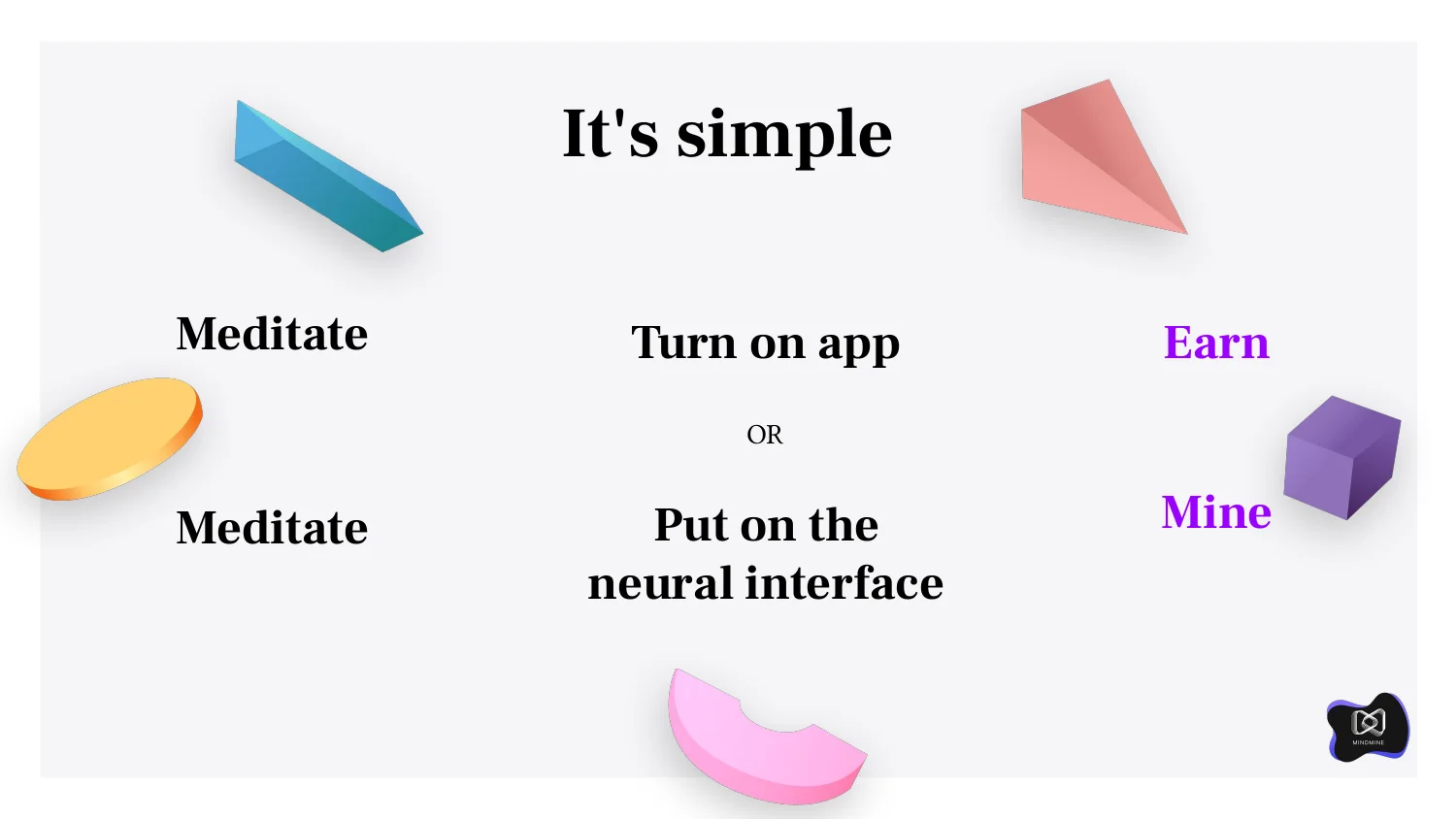
Two-stage user journey, Newlook slide 8. Planned concept; Slidesgo template elements.
From an Idea to an Application Architecture
The project progressed well beyond a verbal concept.
We developed a substantial application design, including screens for meditation activities, rewards, account balances, marketplace interactions, and community features.
The interface was designed around accessible participation.
The user should not need to understand blockchain infrastructure to begin meditating.
They would see familiar app interactions.
Activities.
Progress.
Rewards.
Products.
Community options.
The more complex technology would operate underneath.
This mattered because the intended audience was broader than cryptocurrency enthusiasts.
We wanted to connect the familiarity of wellness applications with new forms of digital participation.
The application also explored the role of social interaction.
Group meditations.
Community-led sessions.
Spontaneous meditation events.
A marketplace for related products and services.
The long-term possibility was to create a platform where meditation became not only a private practice but also a shared digital activity.
And rewards could provide another layer of engagement.
The UX question was straightforward.
Could we make an unfamiliar technical proposition feel like a natural extension of something people already understood?
The presentation materials show how far this part of the project progressed.
The interaction model, visual design, marketplace concept, and product structure had been developed in enough detail to describe a recognisable application.
That does not mean the app was commercially operational.
It means we had moved from positioning into concrete product design.
And that distinction is important.
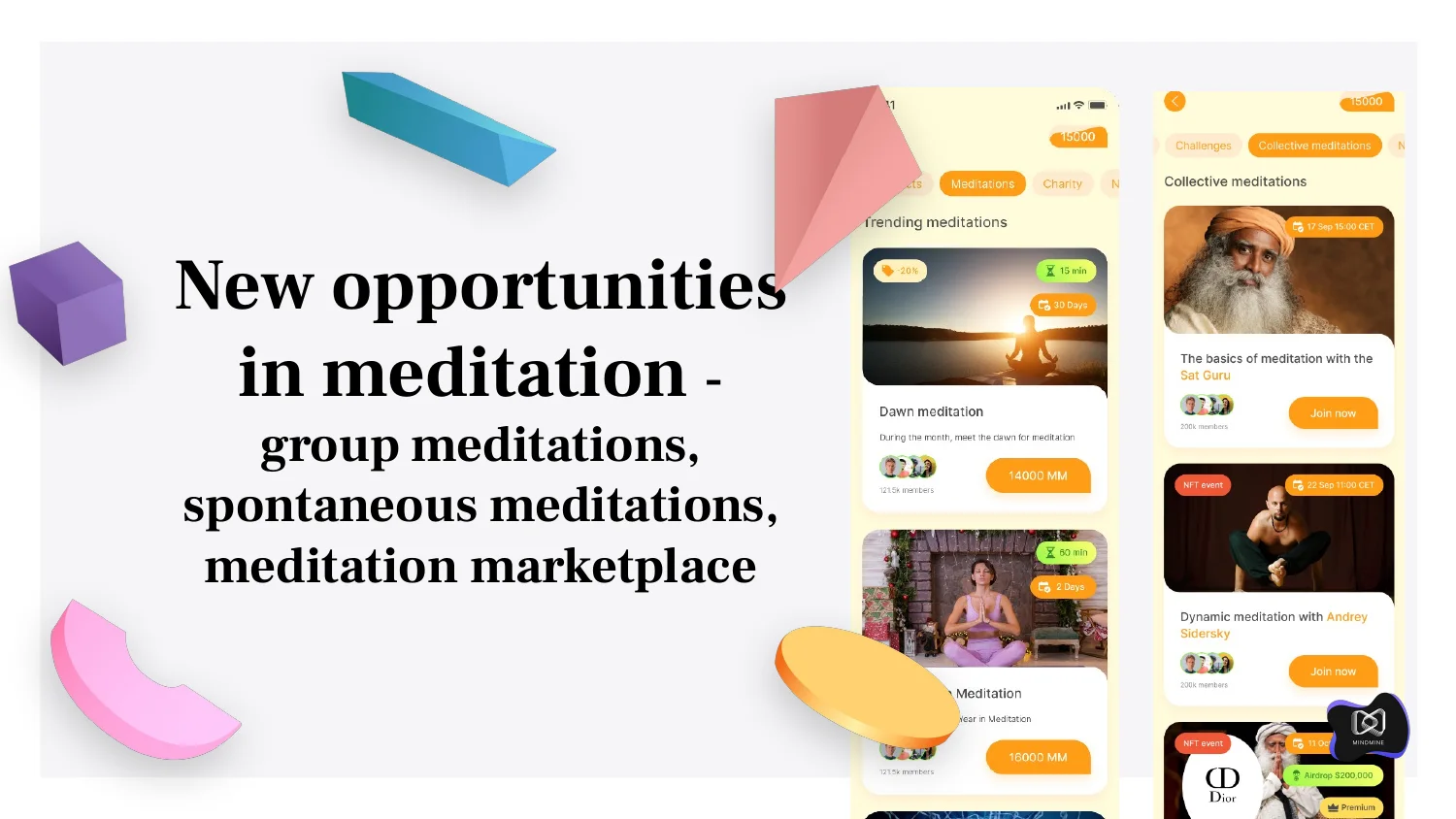
Group meditation and marketplace concepts, Newlook slide 12; Slidesgo template elements.
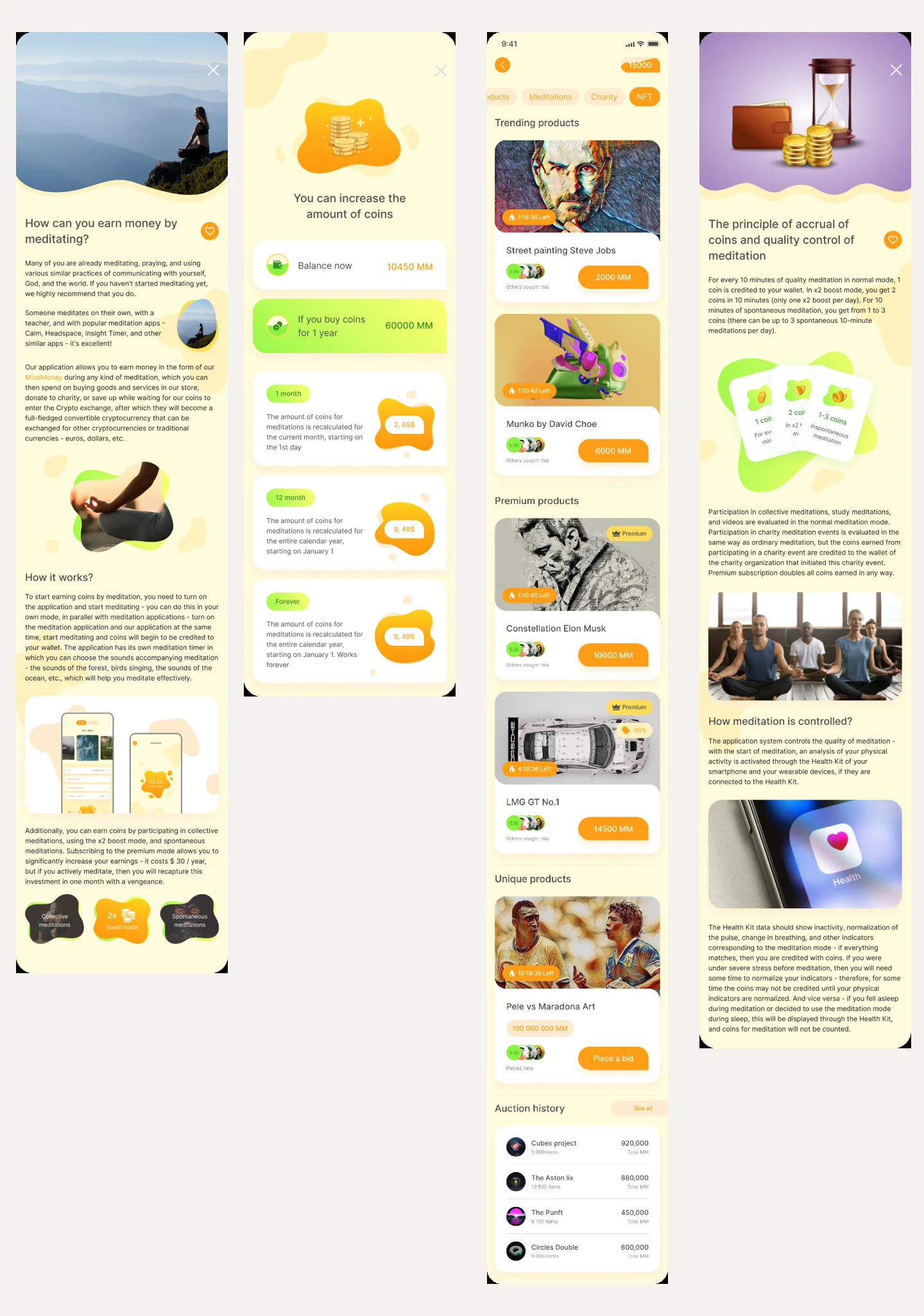
Original application mockups extracted from MindMine X slide 10; no commercial launch is documented.
The Research Question Was Much Harder Than the App
The software interface was only the visible layer.
The real technical challenge was neurotechnology.
Our proposed mechanism depended on measuring electrical signals associated with brain activity during meditation and extracting characteristics that could influence a reward system.
Consumer EEG devices already existed.
Companies such as NeuroSky and others had demonstrated that relatively compact head-worn devices could record certain physiological signals outside traditional laboratory settings.
This made the hardware direction plausible enough to investigate.
But a device recording EEG data is not the same as a system that can reliably measure meditation quality.
And neither is automatically a secure system for issuing economic rewards.
Those are three separate problems.
First, acquire usable signals.
Second, interpret the signals in relation to the intended psychological activity.
Third, establish a trustworthy method for determining rewards.
The first involves electronics, electrode placement, signal quality, noise reduction, and communication with software.
The second involves neuroscience, experimental design, individual differences, and statistical validation.
The third involves security, fraud resistance, incentives, and economic design.
The original project brought these problems together under the term neuromining.
Looking back, I think the most important research question was whether those three layers could be connected reliably enough for a real consumer product.
Designing the Neural Interface
We explored a custom wearable device rather than treating an existing EEG headset as the complete product.
The presentations contain a detailed three-dimensional design of the proposed neural interface.
It was conceived as a lightweight head-worn structure with multiple contact points, an adjustable frame, and integrated electronic components.
The design materials identify elements such as the electronics module, power-related components, and mechanisms for fitting the structure to the head.
Several views show the device from different angles, including its intended placement on a human head.
This was meaningful development work.
It required thinking about how the device would fit, how its components would be arranged, and how the hardware might become a recognisable consumer product rather than a laboratory instrument.
The aesthetic direction also mattered.
We were not proposing a medical EEG cap covered with wires.
We wanted a device that could plausibly belong to the consumer wellness market.
Something visually associated with meditation, personal technology, and a premium digital product.
The presentation described the work as a neural-interface prototype.
The surviving visual evidence shows a developed 3D hardware concept and component layout.
It does not establish that a complete functioning device had passed signal-acquisition tests, independent validation, or manufacturing qualification.
Those would have been separate milestones.
But the fact that we reached detailed device design is precisely why I consider MINDMINE more than an ordinary speculative startup idea.
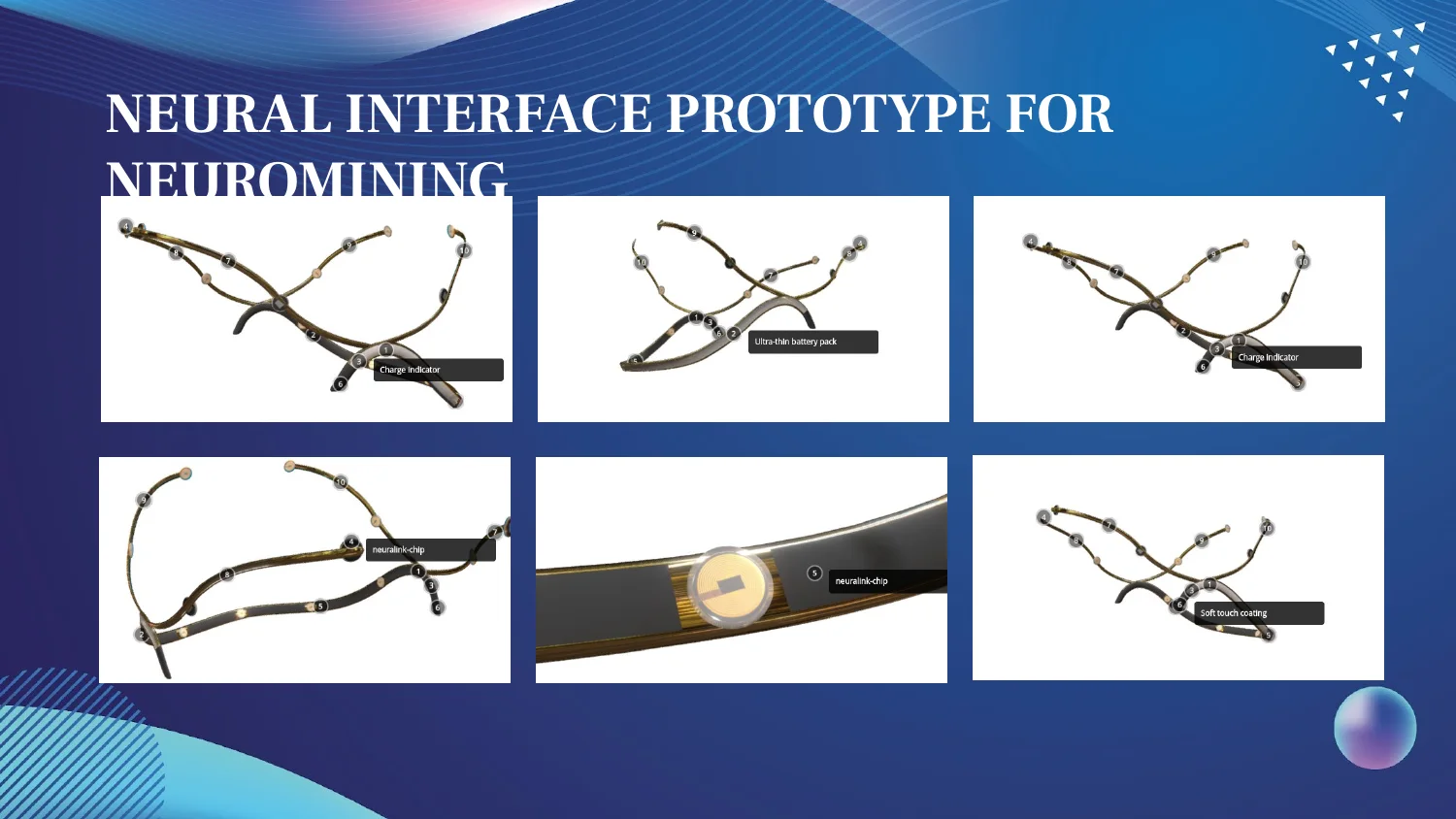
3D hardware design, MindMine X slide 13; not evidence of a clinically validated device.
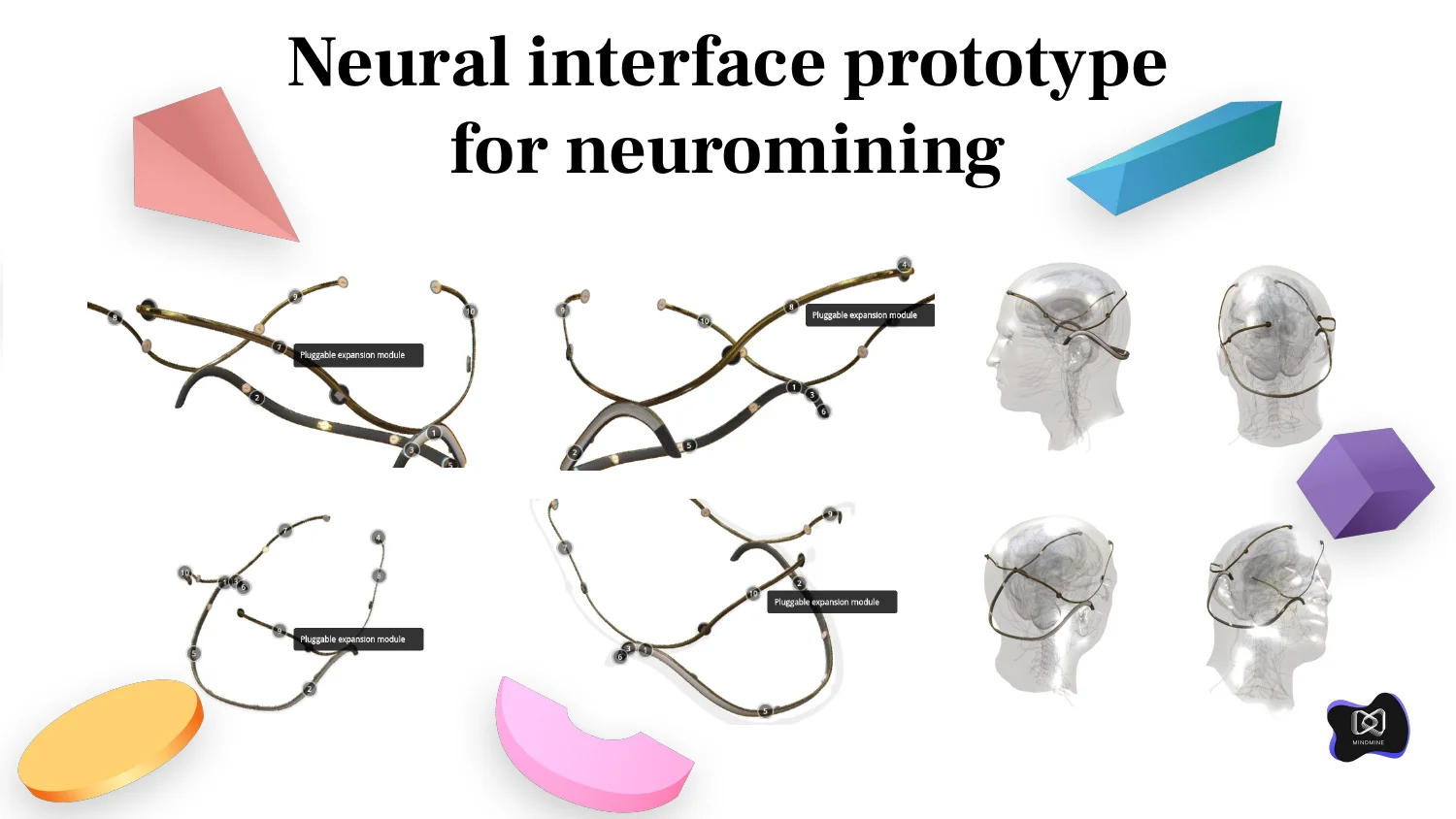
Proposed neural interface and placement, Newlook slide 18; Slidesgo template elements. Design only.
The Scientific Challenge of Measuring Calm
The original concept assumed that meditation could produce measurable patterns in neural activity.
That general direction is scientifically legitimate.
EEG has long been used in research into attention, meditation, and changes in brain states.
But there is no universally reliable EEG number that simply means this person is now 87% calm.
Different meditation practices involve different cognitive processes.
Signals vary between individuals.
Electrode placement matters.
Movement, eye activity, and muscle tension can affect recordings.
And even a technically clean EEG signal does not automatically provide an unambiguous measurement of mindfulness.
This is a particularly important distinction for a product involving financial incentives.
A consumer application can offer approximate feedback as part of a wellness experience.
But a system that issues tradable tokens according to measured mental states needs a much stronger standard of validation.
Otherwise, the reward might reflect noise, individual physiological differences, or behaviour unrelated to genuine meditation.
The project intended to build on neurotechnology experience within its wider team and scientific network.
The presentations identified specialists in psychology and neuropsychology as scientific resources for the concept.
However, the materials available for this retrospective do not include published study protocols, validated datasets, or experimental results demonstrating a reliable meditation-to-reward mechanism.
That is where the boundary lies.
We developed the concept and hardware direction.
The scientific proposition still required formal validation.
And no amount of attractive product design could eliminate that requirement.
Could Brain Signals Really Produce Cryptocurrency?
This is the most provocative part of the project.
And it deserves a precise explanation.
In the original promotional language, we described neuromining as using the computational power of the brain instead of conventional mining hardware.
That was an effective metaphor.
But it should not be treated as a literal description of cryptographic computation.
An EEG headset records voltage differences associated with neural and other physiological activity.
It does not turn the user's brain into a GPU.
And recorded electrical activity does not automatically constitute proof of work in the blockchain sense.
A technically credible implementation would need to define an alternative reward protocol.
The system would collect signals.
Extract selected features.
Evaluate the results according to validated criteria.
Apply fraud-resistant rules.
And determine whether a reward should be issued.
For a cryptocurrency-based economy, there would also need to be a trustworthy relationship between the evidence supplied by the device and the rules governing token issuance.
That raises difficult questions.
Could a signal be replayed?
Could software simulate a plausible EEG stream?
Could a user manipulate the device to generate rewards without performing the intended activity?
How would the system distinguish individuals?
Could differences in brain physiology create systematic advantages for some participants?
Would rewards encourage genuine mindfulness, or simply encourage people to optimise whatever signal the device measured?
These were not minor implementation details.
They were fundamental requirements for turning an experimental mechanism into a defensible economic system.
The project did not reach the stage at which those questions could be considered resolved.
But identifying the technical architecture was a meaningful part of exploring whether the product could exist.
NFTs Generated from Brain Activity
Another proposed feature involved creating NFTs from information derived from neural signals.
The idea was to transform part of a meditation experience into a digital artefact.
An individual session could influence an artwork, pattern, or collectible.
Instead of purchasing a generic image, a user could receive something linked to their own participation.
This connected several ideas.
Personalisation.
Generative art.
Physiological data.
Digital ownership.
And the desire to give users something tangible, or at least digitally persistent, in return for an otherwise internal experience.
The interface concepts included examples of how NFT-related products might appear within the platform.
But there was an important technical question here too.
A signal-derived artwork is not automatically unique, secure, or scientifically meaningful simply because its input came from an EEG device.
Those properties depend on how the data is processed and how the resulting asset is created.
Still, the broader concept was interesting.
We were exploring whether an internal experience could become the source material for a personalised digital object.
And whether that object could have a role in a community or marketplace.
The NFT layer was therefore part of the product hypothesis, not evidence that neural-signal NFTs had been issued or traded.
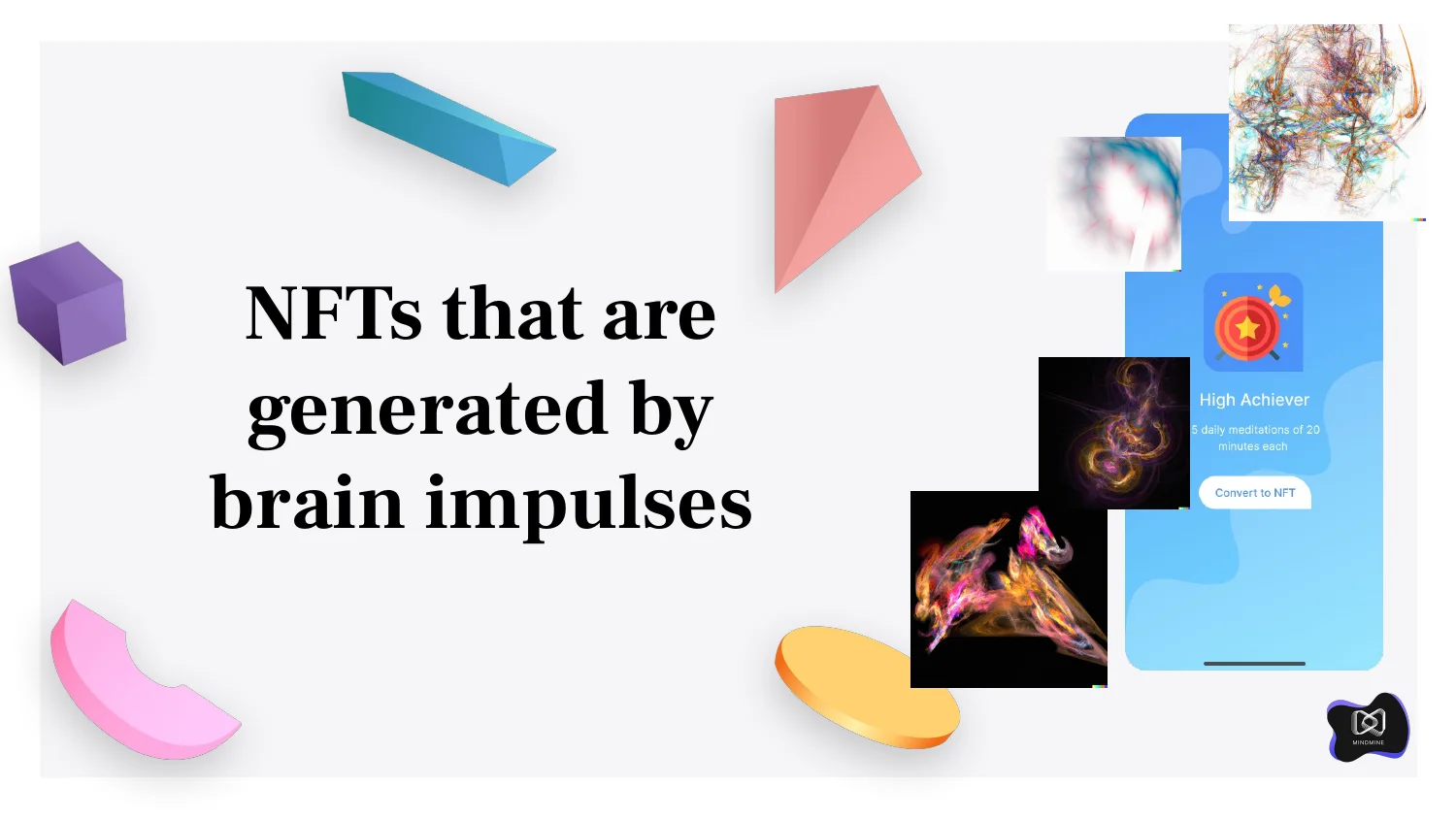
Conceptual NFT examples, Newlook slide 11; no operational token issuance is claimed. Slidesgo template elements.
Designing the Platform Economy
MINDMINE was conceived as more than a meditation timer with rewards.
The business architecture included several potential revenue streams.
Premium subscriptions.
Advertising and collaborations.
Sales of meditation courses and related products.
Marketplace commissions.
Sales of wearable devices.
And, in the more advanced phase, cryptocurrency transactions and NFT-based mechanisms.
The proposed token architecture also separated different functions.
An internal utility coin would support ordinary activities and rewards within the application.
A later cryptocurrency was proposed for broader use, including the neuromining mechanism.
And a separate governance token would support participation in platform governance.
The presentation specified a planned supply of 10 billion coins for the cryptocurrency and 200,000 governance tokens, with an associated allocation and vesting structure.
These were economic design parameters.
Not issued assets.
No live token market, production mining network, or demonstrated token distribution is established by the materials.
And the tokenomics would have required substantial additional modelling.
A reward mechanism is relatively easy to describe.
A sustainable economy built around that mechanism is much harder.
Where does demand for the token come from?
What makes the reward valuable beyond the expectation that someone else will buy it?
How is issuance controlled?
What happens when participation increases?
What happens when users sell their rewards rather than spend them?
How does the platform avoid incentives that encourage fraudulent or superficial participation?
Those are essential questions for any Earn-to-Participate model.
The fact that MINDMINE explored several token categories and marketplace functions demonstrates the breadth of the business concept.
It does not mean that the economic mechanism had been validated.
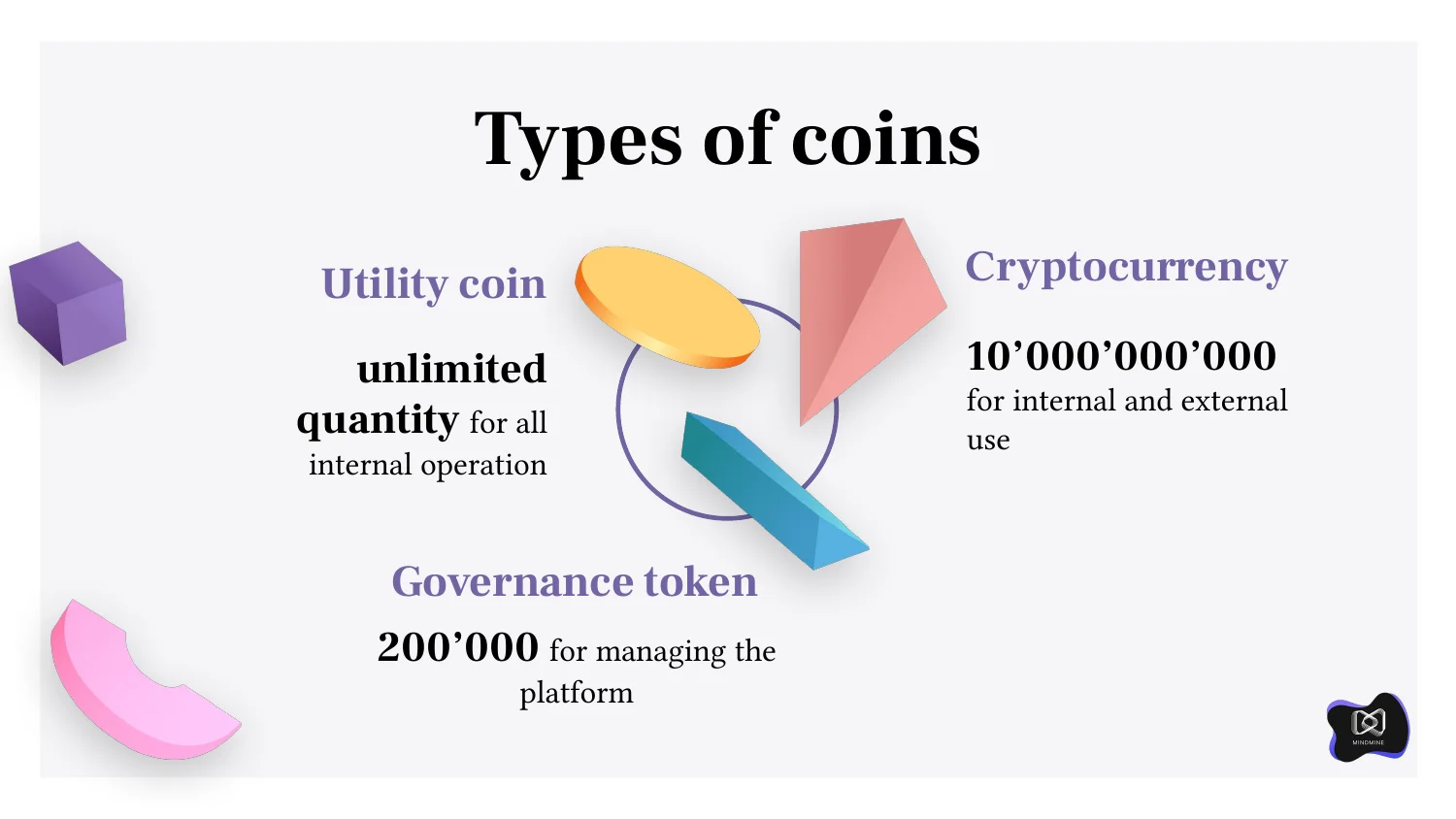
Historical token plan, Newlook slide 19. Figures are design assumptions, not issued tokens; Slidesgo template elements.
A Different Type of Wellness Platform
What interested me about MINDMINE was the attempt to connect several kinds of value.
Meditation is usually an individual activity.
Its benefits, when they occur, are experienced by the participant.
A conventional meditation app provides content and tools to support that activity.
We were asking whether a platform could add other dimensions.
Community participation.
Digital identity.
Personalised artefacts.
Wearable technology.
An internal marketplace.
And a reward system that made the activity part of a larger digital experience.
This was also a product-design challenge.
The financial incentives had to remain compatible with the underlying practice.
There is a possible contradiction in rewarding meditation according to a performance metric.
Meditation practices often involve reducing compulsive striving and becoming more attentive to experience.
A competitive system that constantly tells users to achieve a higher score could encourage precisely the opposite behaviour.
That tension would have needed careful testing.
The technology should support the activity, not turn it into another source of performance anxiety.
Looking back, I think this is one of the more interesting questions the project raised.
Could a digital reward make a healthy habit more accessible and engaging?
Or would it change the psychological nature of the activity?
The answer could not be established through a business model alone.
It would require studying users.
What We Actually Developed
The project never reached commercial launch.
There was no operating public Calm-to-Earn platform.
No verified production cryptocurrency mining through the proposed headset.
And no demonstrated customer or token-market results.
But we did develop a substantial body of pre-launch work.
The project materials included:
- A product vision and development strategy
- Market and competitive research covering meditation, neurotechnology, and Move-to-Earn products
- A two-stage application and neural-interface concept
- UX/UI designs and user-facing interaction flows
- Community and marketplace scenarios
- A detailed 3D wearable-device concept
- Technical hypotheses for interpreting neural signals
- An NFT and token architecture
- A monetisation model and preliminary governance tokenomics
- A proposed founding and scientific team structure
Those are meaningful deliverables.
They demonstrate that the project progressed beyond the initial idea and into product design, technical exploration, and operational planning.
But they also define the limits of what can be claimed.
The design work was advanced.
The scientific mechanism was still experimental.
The business model was still a hypothesis.
And the intended product never reached the stage at which all three could be validated together.
That distinction is the reason I consider the project worth documenting.
Not because it became a successful company.
But because it shows what serious exploration of an unconventional product can involve before commercial viability has been established.
What I Would Do Differently Today
If I were revisiting MINDMINE today, I would preserve the central research question but simplify the initial product considerably.
I would begin with the neural-signal research.
Before designing a token economy, I would want to establish what the hardware can reliably measure.
That would require a clear experimental protocol.
A suitable reference system.
Repeated measurements.
Tests across different participants and sessions.
Noise and motion-artifact analysis.
And independent evaluation of whether the selected signal features correspond meaningfully to the intended mental activity.
Only after establishing those foundations would I connect measurements to a reward system.
And I would initially avoid making rewards financially transferable.
A non-financial participation system could test engagement without immediately creating incentives for manipulation.
The product could still have an application.
Sessions.
Progress.
Communities.
Personalised visualisations.
But the economic architecture would follow evidence rather than precede it.
The wearable-device concept would also need to go through the normal engineering process.
Electrical design.
Sensor selection.
Prototype fabrication.
Signal acquisition.
Calibration.
Fit testing.
Comfort.
Battery safety.
Manufacturing feasibility.
And data protection.
The 3D designs were a useful starting point.
They would not be the end of hardware development.
Finally, I would treat neural data as highly sensitive information.
Any real product would need strong consent controls, secure processing, limited retention, and clear rules preventing raw physiological data from becoming a commercial asset without the user's informed agreement.
The original ambition was to create economic value from meditation-related data.
A responsible implementation would have to ensure that this did not come at the cost of the user's privacy or autonomy.
Why an Unlaunched Project Still Matters
There is a common temptation in startup portfolios.
Show the idea.
Show the beautiful screens.
Show the most ambitious numbers from the pitch deck.
Then quietly skip the part where the company never launched.
I don't think that is particularly useful.
Not every project becomes a company.
And not every technically interesting idea can be converted into a commercially viable product.
Some fail because the technology isn't ready.
Some because the economics don't work.
Some because of timing, capital, regulation, or the decisions of the people involved.
The supplied MINDMINE materials do not establish a single definitive reason the project stopped.
So I won't invent one.
What they do show is a substantial effort to turn an unusual idea into a system with identifiable components.
A consumer product.
A hardware concept.
A research direction.
A token economy.
A community platform.
And a business model.
The project tried to connect fields that were rarely treated as parts of the same product.
Some of the original assumptions were optimistic.
Some technical claims would require much stronger scientific support than the pitch language suggested.
And the whole concept was exposed to the difficult economics of token-based reward platforms.
But the underlying work remains interesting.
In particular, the neural-interface design and application architecture show how far the team moved beyond the initial slogan.
MINDMINE was not simply a joke about meditating for cryptocurrency.
It was a serious attempt to explore what such a product would require.
And perhaps the most useful lesson is that the difficulty was never going to be creating a token.
Or designing an attractive meditation app.
The real difficulty was building a trustworthy bridge between an internal human experience, a measurable physiological signal, and an external economic system.
That is a much harder problem.
It is also a much more interesting one.
MINDMINE never became the business we imagined.
But it remains an example of the kind of project I enjoy most: an idea that begins with a slightly unreasonable question and forces you to explore several unfamiliar technical and commercial territories before you can even determine whether it is possible.
Sometimes the result is a company.
Sometimes it is a body of research, design, and technical work that never reaches the market.
Both can be worth revisiting.
Especially when the original question is still interesting.
Can we build technology that recognises and rewards an internal human activity without reducing that activity to a meaningless score?
We didn't finish answering it.
But we got far enough to understand how difficult, and potentially interesting, the answer would be.
Research and visual attribution
The following research offers retrospective context and does not validate the MINDMINE project or its proposed reward mechanism.
- Consumer-Grade Neurofeedback With Mindfulness Meditation: Meta-Analysis (2025)
- Evaluating a Consumer-Grade EEG Headband for Mindfulness (2021)
- A Systematic Review of Artifact Detection in Wearable EEG (2025)
- Using EEG to Advance Mindfulness Science
Historical project presentation visuals use template elements by Slidesgo; the project images are reproduced from the supplied presentations.