
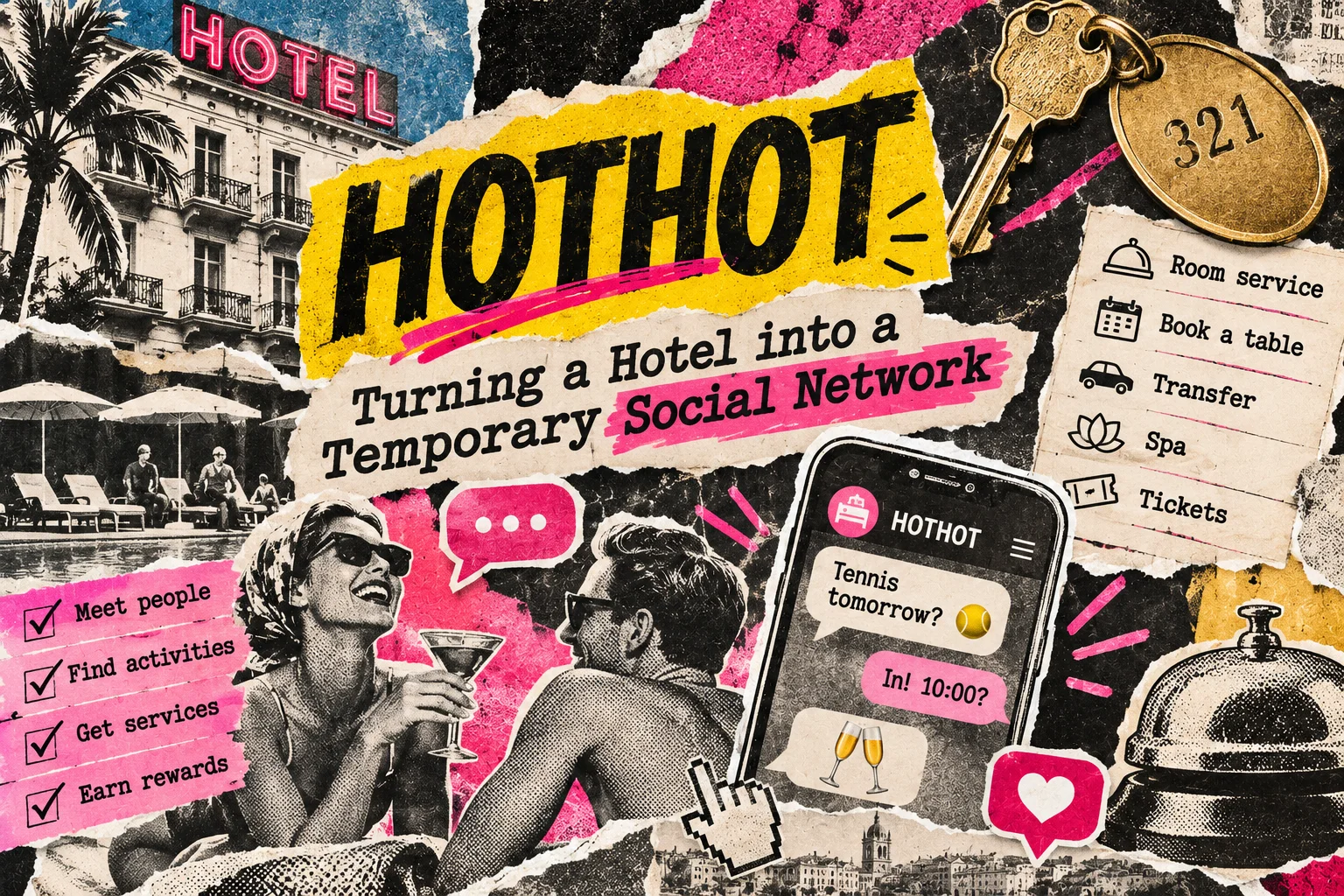
An early hospitality-tech concept that combined guest networking, digital concierge services, local commerce, and loyalty into one platform. The idea was simple: a hotel is already a community of people temporarily sharing the same place. Why not build services around that?
Project: HOTHOT Field: Hospitality Tech / Social Networking / Service Platforms Work: Product Concept, Business Model, Guest Experience, Service Architecture, Monetization Strategy Status: Product concept with an earlier hospitality pilot referenced in the project documentation. Full implementation of the proposed platform is not documented.
A Hotel Is Already a Social Network. It Just Doesn't Know It.
Imagine arriving at a hotel in an unfamiliar city.
You check in, receive your room key, leave your luggage, and perhaps ask the receptionist where you can have dinner.
Around you are another hundred or two hundred people.
Some are tourists.
Some are attending the same conference.
Some are travelling alone.
Others have come for a festival, exhibition, or business event.
A few might be looking for someone to explore the city with.
Others might be interested in a game of tennis, a morning run, a group excursion, or simply meeting someone for a drink.
These people are already connected by one important fact.
They are in the same place at the same time.
And yet, in most hotels, they remain almost entirely invisible to one another.
The hotel knows who is staying there.
The guests know practically nothing about one another.
And the only shared communication infrastructure is usually the reception desk.
That seemed like a missed opportunity.
The idea behind HOTHOT was to turn the hotel into a temporary, location-based social network, then connect that network to the actual services available inside and outside the property.
Not another generic social platform.
Not merely a mobile room-service menu.
And not a conventional hotel loyalty app.
The ambition was to create a digital environment in which guests could communicate, discover services, organise activities, and interact with the hotel throughout their stay.
The hotel would become more than accommodation.
It would become the centre of a temporary community.
Two Products That Become More Useful Together
The HOTHOT concept consisted of two major components.
The first was a social network and messenger for hotel guests.
The second was a digital service platform connecting guests with the hotel and selected local partners.
Each had value independently.
But the interesting opportunity came from combining them.
A guest might discover another person interested in visiting a museum.
They could start a conversation.
Decide to go together.
Book tickets.
Arrange transport.
And perhaps reserve a table for dinner afterward.
All within the same environment.
The social interaction would create an opportunity to use a service.
The service would make the social interaction easier to organise.
And the hotel could participate in both without having to own every service being offered.
This was the central product hypothesis:
A hotel could increase the value of each guest relationship by connecting social discovery, hospitality services, and local commerce.
The proposition was not limited to luxury hotels.
It could also apply to resorts, serviced residential complexes, private communities, and other environments where people share a defined physical location for a limited or extended period.
But hotels were the clearest starting point.
They already had guest registration.
A predictable period of participation.
Existing services.
A physical location.
And an immediate reason for people to use the application.
A Social Network That Exists for the Duration of Your Stay
The social component was built around temporary membership.
A guest would receive access during check-in.
Returning guests could reactivate an existing account during a later stay at the same hotel or within the participating hotel network.
The concept therefore connected digital membership to a real hospitality relationship.
You were not joining another global social network.
You were joining the temporary community of the place where you were staying.
Privacy was part of the original design.
Users would be invisible to other guests by default.
They could browse public profiles without making their own profile visible.
If they wanted to participate, they could choose a display name, including a pseudonym, select a status, and optionally add an avatar.
This allowed different levels of participation.
Someone travelling for business could make themselves available for networking.
A solo traveller could look for companions for a walk or excursion.
Guests attending the same conference could discover one another.
A group travelling together could create a shared conversation.
Someone who preferred privacy could remain outside the visible social layer altogether.
That flexibility was important.
The system was not intended to force hotel guests into social interaction.
It was intended to make interaction possible when they wanted it.
The Importance of Context
The advantage of a hotel-based social network is not that it has more users than an ordinary social platform.
It almost certainly has fewer.
Its advantage is context.
Everyone is already nearby.
People often have overlapping schedules.
They may be attending the same event.
They have access to the same lobby, restaurant, spa, meeting rooms, and surrounding attractions.
And they are more likely to need similar practical services.
Consider a hotel hosting participants of a technology conference.
Many guests may be interested in meeting other attendees.
Some want to discuss business.
Others want to share transport to the venue.
A few might organise an informal dinner.
Traditional social platforms can support these interactions.
But they require people to know whom to search for, which groups to join, or where conversations are happening.
HOTHOT proposed making that temporary community discoverable through the hotel itself.
The same idea would work differently at a resort.
Guests could look for people interested in tennis, yoga, sightseeing, or other activities.
The network would be smaller, but its relevance could be much higher.
The opportunity was not to compete with Facebook or a global messenger.
It was to create a useful social layer around a specific place and moment.
When an Emoji Becomes Room Service
One of the more unusual ideas in HOTHOT was a system of physical gifts sent through the messenger.
Imagine chatting with another hotel guest.
You send a coffee emoji.
Normally, that is just an emoji.
In HOTHOT, it could become an actual coffee delivered to the recipient's room.
A champagne emoji could represent a bottle of champagne.
Other digital gifts could be connected to whatever products or services the hotel offered.
The idea was simple but commercially interesting.
A social gesture could become a real hospitality transaction.
The sender would choose and pay for the gift.
The hotel would fulfil it.
The recipient would receive something tangible.
It was a small example of the broader product strategy.
Instead of treating the messenger and the hotel service system as separate products, use interactions in one to create useful possibilities in the other.
There is also a practical requirement that becomes obvious once the idea moves beyond a presentation.
A real implementation would need explicit recipient consent, clear pricing, delivery controls, and safeguards against unwanted gifts or harassment.
An amusing interaction should not become a way to discover someone's room number or pressure them into accepting a delivery.
The social gesture is the opportunity.
The fulfilment system must still respect the guest.
From Chat to Commerce
Another proposed feature connected conversations with contextual hotel offers.
If two guests discussed meeting somewhere, the system could suggest the lobby bar.
If they were discussing dinner, it might propose a restaurant reservation.
If a group was arranging an excursion, the hotel could offer transport or a relevant partner service.
The original concept included analysing conversational keywords to produce contextual recommendations.
That was commercially logical but would require considerable redesign under contemporary privacy expectations.
Private conversations should not silently become advertising inventory.
A modern version would need transparent opt-in controls, minimal data processing, and preferably recommendations triggered by explicit user actions rather than continuous scanning of private chats.
For example, users could choose an action such as Plan a dinner together.
The application could then present relevant hotel and partner offers.
That would preserve the commercial purpose while giving guests clearer control over how their information was used.
The wider idea remains interesting.
Social activity creates practical needs.
The hotel is often in a good position to satisfy them.
And the platform could connect the two without requiring people to leave the conversation and begin searching across several unrelated applications.
The Digital Concierge as a Service Layer
The second component of HOTHOT was a much broader hospitality-service system.
The concept included guest messaging with hotel staff, multilingual communication, room-service requests, restaurant reservations, spa bookings, and access to other hotel facilities.
A guest could ask for towels.
Request cleaning.
Indicate Do Not Disturb.
Book a massage.
Order food.
Arrange airport transport.
Or ask a question without calling reception.
Automatic translation was intended to reduce communication barriers between guests and staff.
This was especially relevant for international hotels.
A guest who spoke Ukrainian might need assistance from a receptionist who spoke French.
A digital communication system could translate the exchange, making routine requests easier to resolve.
The concept also included an automated first-response assistant.
Routine questions could be answered automatically.
Unusual or unresolved requests would be transferred to hotel personnel.
This is a familiar AI-agent pattern today.
But the original proposal anticipated the operational structure before modern conversational AI became widely available.
Importantly, the goal was not to remove hotel staff from the process.
It was to reduce repetitive communication and allow employees to concentrate on requests requiring human attention.
That distinction matters in hospitality.
A guest who needs another towel probably doesn't require a conversation with a sophisticated AI.
A guest dealing with a serious problem may need a real person immediately.
The platform should be able to distinguish those situations.
The Hotel as a Gateway to the City
I think one of the more commercially interesting parts of the concept was its approach to services outside the hotel.
Traditional hotels already help guests arrange taxis, recommend restaurants, book excursions, and find local entertainment.
But the commercial relationship is often informal.
The concierge provides a recommendation.
The guest leaves the hotel.
The transaction happens somewhere else.
HOTHOT proposed integrating these services into the same digital environment.
A guest could book a partner restaurant.
Arrange a taxi.
Purchase tickets for local attractions.
Reserve a guided excursion.
Or order delivery from an external restaurant.
The hotel could earn a commission from participating providers.
Consider a simple example.
A guest wants pizza.
The hotel restaurant serves French cuisine.
The guest is not going to order from the hotel restaurant, regardless of how enthusiastically the menu is promoted.
They will find a pizzeria elsewhere.
In a conventional arrangement, that transaction has little connection to the hotel.
Under the proposed model, the hotel could offer a partner restaurant through the application.
The guest gets the food they want.
The restaurant receives an order.
The hotel receives a commission.
And the guest can remain within the same service environment.
The platform would therefore allow the hotel to capture value from needs it could not satisfy directly.
The strategy was not to make the hotel provide everything.
It was to make the hotel the easiest place to organise everything.
Loyalty Beyond the Room Booking
The concept also included a unified loyalty system.
Guests could earn points through purchases and participating services.
Those points could contribute to status levels, discounts, and additional benefits.
The idea was to connect transactions across the broader hospitality experience.
Not merely the room booking.
A restaurant visit.
A spa treatment.
A transfer.
A partner excursion.
Potentially all could contribute to one relationship with the hotel.
The system also proposed gamified interactions.
For example, guests might receive rewards for visiting a collection of local attractions or combining relevant bookings.
The underlying commercial rationale was straightforward.
Encourage engagement.
Increase repeat use.
Make the guest's relationship with the hotel more valuable over time.
A CRM layer would maintain customer preferences and purchase history to support more relevant offers.
But here, too, there is an important distinction between commercial opportunity and responsible implementation.
A customer-preference system should improve relevance and service quality.
It should not become an opaque mechanism for extracting the maximum possible spending from guests through intrusive behavioural profiling.
A modern design would need clear consent, limits on data collection, transparent loyalty rules, and controls over personalisation.
The original concept established the commercial direction.
The responsible implementation of that direction would require a more detailed privacy and consumer-protection model.
One Platform, Several Revenue Streams
The HOTHOT business model was designed to create value for several participants.
For guests, the proposition was convenience, social discovery, communication, and a more connected hospitality experience.
For hotels, it offered opportunities to improve service delivery, guest engagement, loyalty, and ancillary revenue.
For local partners, it created a way to reach relevant customers already present in the area.
The revenue opportunities included greater sales of hotel services, commissions on external bookings, and potentially the commercial provision of the platform itself.
The original document focused primarily on the commercial benefits for hotels and participating properties.
It did not establish a final SaaS licensing model, commission schedule, or validated unit economics.
Those would have needed to be designed and tested.
And they would have mattered enormously.
A large feature list is not a business model.
An attractive guest experience only becomes commercially sustainable when the participants have good reasons to use it and the resulting revenue exceeds the costs of delivering it.
The hotel needs incremental value.
Partners need profitable transactions.
Guests need useful services without excessive friction.
And the platform needs enough activity to justify its development and maintenance.
This is why the relationship between the social and service components was important.
Neither component should exist merely to make the feature list more impressive.
Each needed to contribute to the usefulness of the other.
The Earlier Hospitality Pilot
The HOTHOT documentation also referenced previous practical experience.
An earlier MVP in this direction was reported to have operated within the Heliopark hotel network in Moscow and Germany between 2012 and 2014.
According to the project notes, the pilot ended after changes in the hotel network's ownership.
The documentation described the service positively, but did not provide numerical results, adoption statistics, revenue measurements, or a detailed technical inventory of the deployed features.
That distinction matters.
The earlier experience was a relevant part of the project's background.
It suggested that some aspects of the hospitality-service concept had previously been tested in a real operating environment.
But it would be inaccurate to present the full HOTHOT feature set as an implemented platform on the basis of that reference alone.
The document also identified DOOOD, a restaurant discovery, delivery, booking, and QR-menu service, as a potential source of reusable experience and technology.
That connection was particularly relevant to the food-and-beverage part of the proposed platform.
It illustrates another aspect of the development approach.
Rather than imagining that every component needed to be invented from zero, the concept explored how existing service capabilities could become part of a larger hospitality product.
The full proposed HOTHOT platform, however, remained a broader product concept in the available materials.
Its complete commercial rollout and performance are not documented.
What I Would Build First Today
Looking back at HOTHOT, I still find the overall architecture interesting.
But I would approach the execution differently.
The original proposal contained almost everything a guest might need.
A social network.
Messenger.
Digital concierge.
Food delivery.
Bookings.
Tickets.
Transport.
Smart-room controls.
Loyalty.
Travel planning.
Gamification.
A complete hospitality super-app.
The vision was coherent, but the scope was enormous.
Today I would begin with a much narrower product.
The first version would combine a verified guest account, opt-in guest discovery, a messenger, basic hotel requests, and a small number of useful bookable services.
That would be enough to test the central proposition.
Do guests actually want to discover other guests through their hotel?
Do they use the messaging features?
Do social interactions lead to useful bookings?
Does the hotel experience less repetitive service work?
Do guests find the application valuable enough to use during a short stay?
Only after establishing those behaviours would I expand the commercial layer.
Partner restaurants.
Transport.
Excursions.
Loyalty.
And eventually more complex integrations with property-management and smart-room systems.
This would reduce both technical risk and the danger of building a large product before validating the behaviour that makes it distinctive.
The original concept was ambitious.
A more focused launch would make the ambition easier to test.
Privacy and Safety Would Be Product Features
There is another area I would now treat as central rather than secondary.
Safety.
The original concept correctly recognised the value of letting guests use pseudonyms and remain invisible by default.
That was an important design choice.
It acknowledged that people may want temporary social interaction without sharing their permanent social-media identities or personal contact details.
But pseudonymity alone is not enough.
A hotel can verify that someone is a registered guest.
That does not guarantee that every interaction will be safe.
A contemporary implementation would require reporting, blocking, moderation, anti-harassment controls, and clear procedures for responding to serious incidents.
It would also need to avoid exposing room numbers and private information through social features.
Hotel verification could establish eligibility to participate.
It should not become a public disclosure of a guest's identity or accommodation details.
The same applies to commercial personalisation.
Guests should understand which data is used, for what purpose, and what choices they have.
And when a stay ends, temporary social participation should end with it unless the user explicitly chooses otherwise.
These are not peripheral compliance features.
They would be part of the product's fundamental value proposition.
A temporary social network is useful precisely because its boundaries are clear.
Guests need to know when they are visible, who can contact them, and how to leave.
The AI Layer Would Be Different Now
The original concept anticipated an automated assistant for routine hotel communication.
Today, that part of the system could be designed using modern language models and tool-based agents.
But I wouldn't make the model responsible for everything.
The underlying operations should remain structured.
Booking a restaurant requires a reliable reservation system.
Requesting towels requires a task routed to housekeeping.
Opening a room door requires a properly secured access-control system.
Ordering a service requires clear pricing, payment authorisation, and confirmation.
An AI assistant could make those functions easier to access through natural language.
It could translate guest messages.
Explain available services.
Help plan an evening.
Recommend an appropriate option based on an explicit request.
Or collect the information needed before passing an issue to the right employee.
But the model should not improvise reservations, transactions, or access permissions.
It should operate through approved tools with clear boundaries.
That would preserve the original idea of one intelligent guest interface while avoiding the temptation to make a probabilistic model responsible for critical hotel operations.
The intelligence belongs in the interaction layer.
The authority belongs in the underlying systems.
The Bigger Idea Behind HOTHOT
What still interests me most is not any single feature.
It's the relationship between the physical environment and the digital community.
Most social platforms begin online.
They attempt to connect people who may be geographically distant.
HOTHOT began with the opposite condition.
People were already sharing a physical place.
The digital system was intended to make that proximity more useful.
This changes the economics of discovery.
It also changes the relevance of services.
A generic social network knows that two people have a shared interest.
A hotel-based network may know, with appropriate consent, that they are attending the same event and staying in the same property.
A generic commerce platform suggests products.
A hotel-based platform can offer a table downstairs, a taxi outside, or an excursion leaving tomorrow morning.
The physical context makes the proposed action immediately practical.
And the temporary nature of the community creates a natural lifecycle.
Guests arrive.
They discover the environment.
They participate.
They use services.
They leave.
Then another group arrives.
The product doesn't need to become a permanent substitute for the guests' existing social lives.
It needs to make a particular period more connected and convenient.
That was the distinguishing idea.
A Concept Worth Revisiting
HOTHOT was not simply an attempt to put every hotel function into one mobile application.
It explored a more interesting proposition.
The hotel itself could become a digital meeting place.
Social communication could create demand for real services.
Local partners could extend the hotel's commercial offering beyond its own facilities.
And the entire system could strengthen guest engagement without requiring the hotel to operate every service directly.
The original documentation outlined the product architecture, user interactions, possible service integrations, and monetisation logic.
It also connected the concept to earlier hospitality experience.
What it did not provide was proof of a completed HOTHOT implementation, a measured commercial outcome, or validated adoption across the proposed feature set.
Those limits are worth preserving.
A concept is not a launched product.
And a feature is not a business until customers actually use it.
But concepts can still be valuable when they identify an opportunity clearly and explain how different parts of a system could reinforce one another.
I think HOTHOT did that.
It started from a simple observation.
A hotel contains a community of people with overlapping needs, interests, and opportunities.
The people are already there.
The services are already there.
The missing element is the connection between them.
And sometimes the most interesting product opportunities don't begin by inventing something entirely new.
They begin by noticing a relationship that already exists but has never been properly designed.
A hotel is a place to stay.
It can also be a place to meet.
A place to organise things.
A place to discover a city.
And potentially, a platform connecting guests, services, and local businesses.
The original HOTHOT concept tried to bring all of those possibilities into one system.
The full vision remains unproven.
But the underlying product question is still a good one:
What if the most valuable digital service a hotel could offer wasn't another booking interface, but a better way for the people inside it to connect with one another and the place around them?