
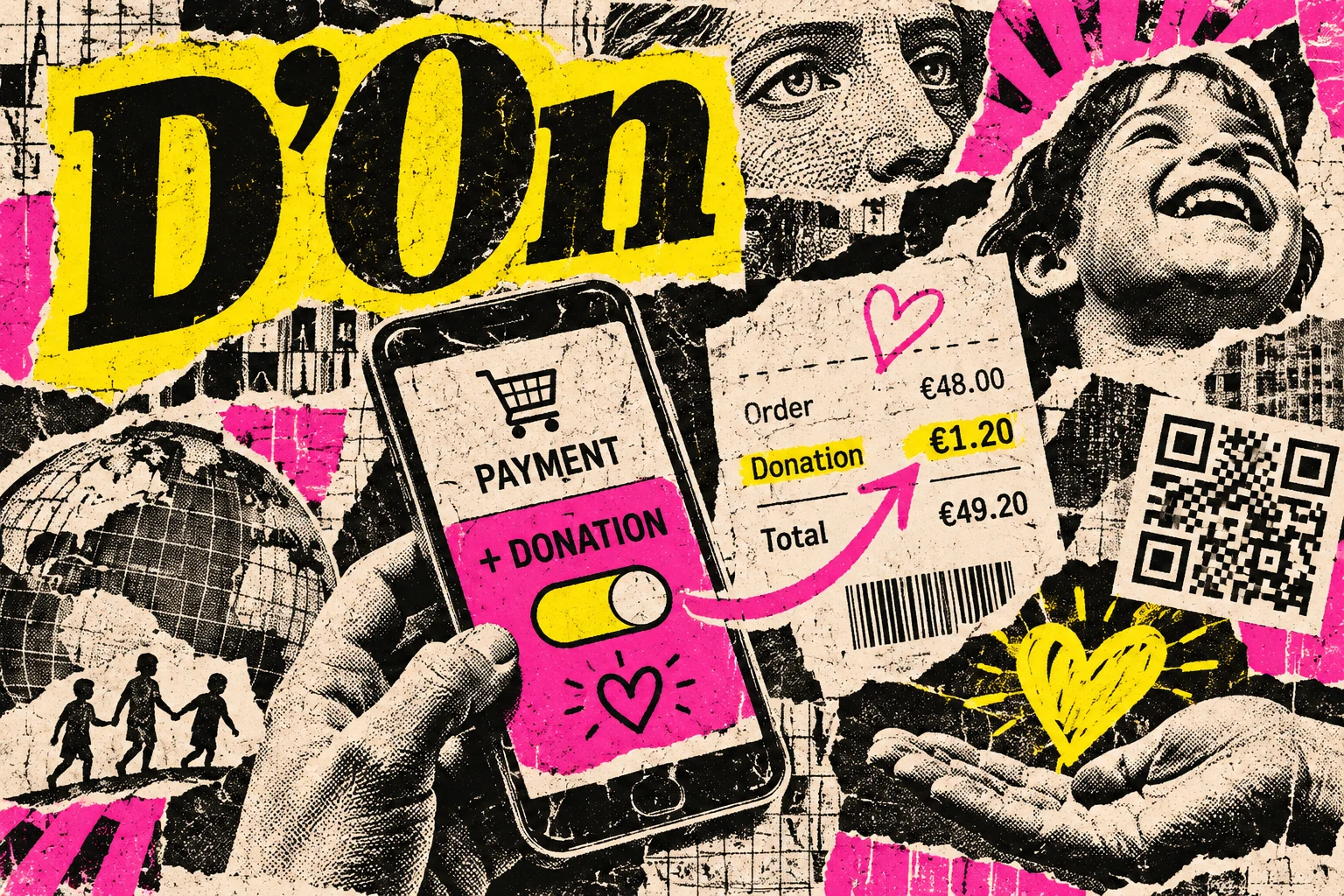
An ambitious donation-platform concept combining universal payment acceptance, recurring giving, volunteering, crowdfunding, and blockchain. The project reached investor presentations and early financing discussions, but Russia's full-scale invasion of Ukraine interrupted its development before launch.
Project: D’On Field: Fintech / Social Impact / Digital Payments / Web3 Work: Product Concept, Business Model, Platform Strategy, Product Architecture, Investor Presentations, Go-to-Market Planning Status: Advanced concept and investor discussions. Development suspended in 2022. Not launched.
The Problem with Giving Money
Imagine walking down a street and encountering someone collecting donations.
Perhaps it's a volunteer.
A small local organisation.
A person collecting money for a medical procedure.
Or a street musician whose performance you particularly enjoyed.
You want to give them something.
You reach into your pocket.
No cash.
You have a phone, several payment cards, and access to more payment services than you can reasonably remember.
But the person standing in front of you has a cardboard box.
They can accept coins.
You don't have any.
So you smile apologetically and continue walking.
It's a surprisingly absurd situation.
We have spent decades making commercial payments faster and more convenient.
You can buy something online in seconds.
Pay for coffee with your watch.
Send money across borders.
Subscribe to services you will forget to cancel.
And yet making a small, spontaneous donation can still be unnecessarily complicated.
Large charitable organisations usually have payment infrastructure.
They can accept cards, operate donation pages, and manage recurring contributions.
Smaller organisations and individuals may have much fewer options.
The problem isn't necessarily a lack of generosity.
Sometimes the transaction is simply too difficult.
That was the starting point for D’On.
We wanted to make giving money as easy as making an ordinary digital payment.
But the idea soon developed into something more ambitious.
What if giving itself became a routine part of everyday economic activity?
Not an occasional act requiring a special campaign.
Not another charity website visited twice a year.
A voluntary habit supported by the infrastructure people already use.
Beyond Another Donation Platform
The early D’On concept began with a philosophical proposition.
Giving should not be treated only as a way to solve someone else's problem.
The act of giving can also have value for the person who gives.
It can express a commitment.
Connect someone to a community.
Support a cause they care about.
And become part of how they choose to participate in society.
We wanted to explore a platform built around that understanding.
The intention was not to require everyone to contribute equally.
Quite the opposite.
Participation would be voluntary.
People would decide how much to give.
Which organisations or individuals to support.
How often to contribute.
And when to stop.
The community would not belong to one country or be limited to one category of charitable activity.
Its purpose was to make giving easier, more accessible, and more habitual.
This distinction mattered to the product architecture.
A conventional donation platform begins with a recipient.
A charity launches a campaign.
A donor decides whether to contribute.
D’On was intended to support that familiar model while also making the donor's continuing participation central.
A person might choose to donate a small percentage of every qualifying transaction.
Another might create a recurring contribution to a local organisation.
Someone else might make occasional gifts through a QR code.
The scale of participation would differ.
The underlying principle would remain the same.
Giving should be easy enough that people can incorporate it into ordinary life without having to organise a separate fundraising event every time.
A Universal QR Code for Giving
As we developed the concept, we began focusing on a more concrete starting product.
Universal donation acquiring.
The proposed experience was deliberately simple.
A recipient registers with D’On.
They provide the necessary information and complete the appropriate verification.
They create a donation page.
The system generates a link and QR code.
A donor opens the page and chooses how to contribute.
No special account should be required merely to make a basic donation.
The platform was intended to support several payment categories.
Bank cards.
Mobile wallets such as Apple Pay and Google Pay.
Local payment services where available.
And cryptocurrencies.
The exact methods would depend on the recipient's country, the payment providers, and the applicable regulations.
But the user-facing principle was straightforward.
One link. One QR code. Multiple ways to give.
The recipient should not need to build a separate payment integration for every service.
And the donor should not need to discover which application the recipient happens to use.
This could be useful in many situations.
A small charitable organisation collecting donations at an event.
A community project raising money for equipment.
A street musician accepting tips.
A family collecting contributions for a birthday.
A religious institution.
A school.
Or an individual seeking financial assistance.
The original proposal considered these as different account and payment categories within one platform.
Not necessarily identical legal categories.
That distinction would have been important during implementation, because charitable donations, personal gifts, crowdfunding, and commercial tips can have different regulatory and tax treatment.
But from the user's perspective, they share a familiar interaction.
Someone wants to transfer money voluntarily.
Someone else needs a convenient way to receive it.
Why the QR Code Was Only the Beginning
A QR payment service would have been the most accessible starting point.
But it was never intended to represent the entire D’On concept.
The next layer was recurring giving.
Imagine supporting a local animal shelter.
You could donate €10 today.
You could subscribe to a monthly contribution.
Or you could decide that a small percentage of certain future transactions should support the shelter automatically.
The original concept included payment schedules and transaction-linked contributions.
The donor would select a recipient and determine how much to allocate.
This was more ambitious than a conventional recurring donation.
It connected charitable participation to ordinary financial activity.
For example, a person might decide to allocate one percent of qualifying transactions to a selected cause.
The individual amounts could be small.
But the process would be continuous.
The real product opportunity was not necessarily increasing the size of each donation.
It was reducing the amount of attention required to maintain a commitment.
Once the donor had established their preferences, the system could handle authorised recurring transfers.
Naturally, this would require clear consent, spending limits, payment-provider integration, and controls allowing users to pause or cancel contributions.
A habit should not become a financial obligation that is difficult to escape.
But the idea remained attractive.
Small actions repeated consistently can produce meaningful cumulative results.
And the platform could make those actions easier to sustain.
Money Is Only One Thing People Can Give
One of the more interesting parts of the original architecture was that D’On was not limited to financial donations.
We also explored donations of physical goods and time.
Donating things
Suppose a charity needs children's clothing.
Another organisation needs office equipment.
A community centre needs furniture.
Meanwhile, people nearby have useful items they no longer need.
D’On could provide a matching system.
An organisation specifies what it needs.
A donor lists available items, with a description and photographs.
The platform identifies possible matches.
Both sides confirm that the transfer is practical.
The original concept assumed collection by the recipient as the default arrangement.
That avoided turning every physical donation into a logistics operation managed by the platform itself.
It was an important design consideration.
Matching an available object with someone who needs it is one problem.
Storing, transporting, inspecting, and delivering thousands of donated objects is an entirely different business.
The proposed system attempted to solve the discovery and coordination problem first.
Donating time
The same mechanism could apply to volunteering.
An organisation needs help.
A person has relevant skills or available time.
Both specify their requirements.
The system identifies possible matches.
A volunteer might offer two hours of assistance on Saturday.
A professional might provide a particular service.
A community organisation might need people for a specific event.
Availability, location, and the type of work would influence matching.
Once both sides agreed, they could arrange the activity directly.
The interesting aspect was the shared architecture.
Money.
Goods.
Time.
Different resources, but a related process.
Someone has something they can give.
Someone else needs it.
The platform helps them find one another and complete the exchange.
This made D’On closer to a general-purpose giving infrastructure than a simple payments product.
Crowdfunding Without Building Another Kickstarter
The concept also included event-based fundraising.
Not every charitable need is continuous.
Sometimes an organisation needs a specific amount by a particular date.
A medical purchase.
A playground.
Equipment for a school.
A community facility.
A targeted relief effort.
The proposed system would allow recipients to create campaigns with defined goals, deadlines, and contribution options.
Some campaigns could offer non-financial recognition.
A thank-you message.
A certificate.
A mention in project materials.
Or other appropriate forms of acknowledgement.
The original concept also explored an unusual treatment of campaigns that failed to reach their target.
Instead of automatically returning the money, the donation could be directed to an alternative cause selected beforehand by the donor.
This was an attempt to preserve the charitable intent even if the original project could not proceed.
But it introduced an important requirement.
The donor would need to understand and explicitly authorise that alternative destination before contributing.
A platform cannot assume that someone who supported one cause necessarily wants the money transferred to another.
The treatment of failed campaigns would also need to comply with the payment, crowdfunding, consumer-protection, and charitable-funds rules applicable in each jurisdiction.
The idea was worth exploring.
Its implementation would have required more precise contractual and financial design than the initial presentation provided.
The Crypto Layer: Charity Built into Transactions
The Web3 component introduced another possibility.
What if a digital currency or payment protocol included voluntary charitable contributions as part of its transaction logic?
The broader concept included support for existing cryptocurrencies.
This was intended to make it possible for donors and organisations to transact across borders and through different digital payment methods, subject to legal and provider restrictions.
But we also explored a proprietary token, provisionally called D-coin.
The idea was to connect transaction activity with charitable contributions through smart contracts.
A portion of certain transactions would be directed toward a designated charitable allocation mechanism.
The platform would provide visibility into those transfers.
And users could potentially participate in decisions about how some collectively accumulated funds were distributed.
The early documents considered governance mechanisms involving token holdings or charitable activity.
They also explored the possibility of integrating with a cryptocurrency exchange for conversion and settlement.
These were design hypotheses, not completed integrations.
No operational D-coin, exchange partnership, or functioning blockchain donation economy is established by the project materials.
Looking back, I would separate two ideas much more carefully.
The first is transparent, programmable charitable contributions.
That remains interesting.
The second is attempting to increase the economic value of donations through an appreciating proprietary cryptocurrency.
That introduces speculation and risks that can distract from the primary purpose.
A donor should know what they have contributed.
A recipient should know what they will receive.
And the value of a charitable transfer should not depend on an unsupported assumption that a token will become more valuable.
Blockchain can potentially support transparent records and programmable allocation rules.
It does not guarantee financial stability, legitimate governance, or effective charitable outcomes.
Those would need to be established independently.
Transparency and Trust
An important part of the original concept was making the movement of funds more visible.
The proposed system included verified recipient profiles, transaction records, and additional controls for higher-volume accounts.
It also contemplated publishing information about transfers, conversion costs, and distributions from collective charitable funds.
The principle was sensible.
Trust is essential when a platform handles other people's money.
Donors want to know where funds went.
Recipients want reliable settlement.
Organisations need documentation.
And the platform needs procedures for preventing fraud and abuse.
But transparency alone is not sufficient.
A blockchain record can demonstrate that a transaction occurred.
It cannot prove that an organisation used the money effectively.
Nor does publishing a bank account guarantee proper financial management.
A functioning version of D’On would therefore have needed conventional financial controls alongside any crypto infrastructure.
Appropriate payment-provider relationships.
Identity and organisation verification.
Anti-fraud and anti-money-laundering measures.
Safeguarding or settlement arrangements.
Auditing.
Clear transaction fees.
Data protection.
And the ability to investigate suspicious activity.
The original architecture anticipated additional verification as payment volumes increased.
A contemporary version would need to define those controls according to actual regulatory obligations and risks rather than relying only on fixed transaction thresholds.
A universal platform could provide a familiar interface across countries.
But that would not eliminate the need to comply with the different rules governing payments and charitable activity in each country.
The international vision was straightforward.
The operational implementation would not have been.
Gamification with a Purpose
D’On also explored achievements, ratings, and rewards for participants.
The basic idea was to recognise continuing engagement.
Someone contributes regularly.
Supports a campaign.
Volunteers.
Or participates in community activities.
The system could record those actions and provide feedback.
But there is a tension in gamifying charitable activity.
Recognition can help people maintain habits.
Yet an excessive focus on rankings and rewards can turn generosity into another competition for status.
The original concept proposed linking some rewards to internal digital assets.
Today, I would be particularly cautious about allowing financial incentives to dominate the experience.
Giving should remain voluntary.
Public recognition should be optional.
And recipients should not feel pressured to compete for attention through increasingly dramatic presentations of need.
The most useful role for gamification would probably be helping people maintain commitments they had already chosen.
A reminder.
A record of participation.
An overview of cumulative contributions.
Feedback about a completed project.
Perhaps a community milestone.
The objective should be to make giving easier to sustain.
Not to create a social hierarchy of generosity.
Designing a Business Around Voluntary Giving
The business model combined several possible sources of revenue.
Transaction fees were one.
Voluntary contributions toward operating the platform were another.
The early concept included a proposed option allowing recipients to allocate a small percentage of received contributions toward maintaining D’On.
The fee structure could also differ between categories.
For example, a verified charitable organisation might qualify for more favourable processing conditions than a commercial or personal tipping use case.
The logic was understandable.
A platform handling small donations must pay for payment processing, verification, support, security, and operations.
Those costs do not disappear simply because the purpose is charitable.
But the commercial model needed to avoid undermining the purpose of the service.
Fees must be visible.
Recipients must understand what they receive.
Donors should not encounter hidden allocations.
And voluntary support for the platform must genuinely be voluntary.
The early documents also considered revenue related to D-coin.
That was a much more speculative part of the model.
A production business could not responsibly depend on the presumed appreciation of a proprietary token as a reliable revenue source.
The stronger commercial proposition was simpler.
Build a service useful enough that recipients and donors have reasons to use it.
Then operate it through an understandable, sustainable payment and service-fee structure.
The Investor Presentations
The project progressed beyond an internal brainstorming exercise.
We developed the product concept and prepared investor-facing materials.
The more detailed working presentation explored the larger social and technical vision.
It described the community model, donation mechanisms, non-financial contributions, crypto architecture, verification, and monetisation.
The English-language pitch concentrated on a much clearer initial proposition.
Universal acquiring for donations, tips, and other non-commercial payments.
That was an important shift in emphasis.
A potential investor could immediately understand the problem.
People increasingly use cashless payments.
Small donation recipients may lack suitable payment infrastructure.
The service provides a link and QR code through which donors can choose an available payment method.
From there, the platform could expand.
Recurring contributions.
Goods and volunteering.
More sophisticated fundraising.
And eventually additional financial infrastructure.
The broad concept and focused pitch were complementary.
One explained the long-term ambition.
The other gave the project a more understandable starting product.
We actively presented D’On to potential investors.
There was encouraging movement in discussions about financing the start of development.
But no completed funding round or binding financial commitment is documented in the materials available for this retrospective.
The project had not yet reached the point of launching the service.
And then the external circumstances changed completely.
The War Interrupted the Project
Russia's full-scale invasion of Ukraine began on February 24, 2022.
For people and teams connected to Ukraine, the consequences extended far beyond ordinary business disruption.
Lives changed.
Priorities changed.
People had to address immediate safety, displacement, and extraordinary uncertainty.
Projects that had appeared realistic only weeks earlier suddenly became much less important than what was happening around us.
D’On was one of the projects that stopped.
The investor discussions did not develop into a launched company.
The proposed product was not brought into commercial operation.
And the broader platform architecture remained unrealised.
This is important when describing the outcome.
The project was not a business that launched and failed to find customers.
It did not demonstrate poor retention.
It did not exhaust its marketing budget.
Nor did the available materials document a rejection by the market.
It was a developed concept with positive financing discussions whose continuation was interrupted by war.
That doesn't prove the project would otherwise have succeeded.
It simply explains why the work stopped before its commercial hypotheses could be tested.
And for a retrospective case study, that distinction matters.
What I Would Change Today
Several parts of D’On remain interesting to me.
The strongest is the distinction between a donation platform and a platform for habitual giving.
The second is the ability to support different kinds of contribution through a coherent user experience.
Money.
Goods.
Time.
And specific charitable projects.
But if I were approaching the project again, I would reduce the first product to something much more focused.
A verified recipient account.
A donation page.
A QR code.
A limited selection of reliable payment methods.
Transparent fees.
And recurring contributions.
I would initially work with a licensed payment partner rather than attempt to build a complete cross-border payment infrastructure.
The first objective would be to establish whether a specific group of recipients experienced a meaningful improvement.
For example, small community organisations that currently struggle to accept contactless donations.
Or organisations running local fundraising events.
The most important early metrics would be practical.
How many recipients activate the service?
How often do people use it?
Does it increase completed donations compared with their previous process?
What proportion of donors choose recurring contributions?
How much does processing cost?
And do recipients continue using the system after the initial novelty disappears?
Only after validating the payment use case would I extend the platform to volunteering or donated goods.
Those modules involve different operational problems.
Matching, trust, scheduling, and physical fulfilment.
They would need their own validation.
I would also defer the proprietary cryptocurrency.
Programmable giving through existing payment systems or established digital assets could be investigated separately, but the original service should not depend on launching a speculative token.
The interesting product is giving.
The payment method is infrastructure.
It should not become the entire story.
Why I Still Think the Idea Matters
The project was conceived during a period when cashless payments, digital wallets, and cryptocurrency were changing how people thought about money.
But the underlying question was older.
Why is it so easy to spend money and sometimes so inconvenient to give it?
A person may want to contribute a very small amount.
Perhaps only once.
Perhaps every month.
Perhaps automatically whenever they complete a certain type of transaction.
The difficulty should not be the interface.
Nor should a small organisation have to become a fintech company simply to collect donations.
D’On attempted to bring those needs together.
Its early ambition was larger than the first product probably needed to be.
The business model required further work.
And the cryptocurrency elements introduced significant technical, economic, and regulatory complexity.
But the central design idea was clear.
Make giving an ordinary, accessible action rather than a separate administrative task.
The concept also illustrated something about product strategy.
A large vision becomes more credible when it can be translated into a small, understandable first product.
For D’On, that product was universal donation acquiring.
The broader community, recurring contributions, non-financial donations, and programmable giving could develop around it.
Not everything needed to exist on the first day.
The project never reached that first day.
But the strategic and product work had advanced far enough to define an interesting opportunity.
And the interruption did not make the question disappear.
A Project That Could Be Revisited
I don't present D’On as a launched platform.
There are no operating metrics to celebrate.
No revenue history.
No production payment infrastructure.
No completed global charitable community.
What remains is a developed product concept, two complementary presentations, a proposed business architecture, and the experience of taking the idea into investor discussions.
The funding process was gaining momentum before the full-scale war in Ukraine stopped further development.
That is where the story ended.
For now.
I still think there is room to rethink how small donations, recurring giving, and non-financial contributions are organised.
The technology has changed since the original concept.
Payment APIs have evolved.
Digital wallets have become more familiar.
AI can reduce some of the administrative work involved in matching donors with recipients or helping organisations manage requests.
But the difficult questions remain.
Who can receive money?
Who can be trusted?
How do we verify the intended use?
How do we protect donor choice?
How do we keep the service affordable?
And how do we make participation simple without turning charity into an opaque financial product?
Those are product, operational, and institutional questions.
Not merely programming tasks.
Perhaps a payment provider, foundation, social-impact investor, or experienced fintech operator will recognise a useful direction here.
Perhaps the concept would work best as an independent platform.
Perhaps as a service integrated into existing payment infrastructure.
Or perhaps as a specialised product for organisations that are currently underserved.
I would be interested in exploring those possibilities with a team capable of turning the concept into a compliant and sustainable service.
Because the most interesting part of D’On was never the QR code or the cryptocurrency.
It was the attempt to change how people think about giving.
Not something reserved for large campaigns.
Not something that requires a special effort every time.
But something that can become part of ordinary life.
A few euros.
A percentage of a transaction.
An hour of someone's time.
An object that another person needs.
None of these actions needs to be dramatic.
The system supporting them should be as straightforward as possible.
D’On was built around the idea that generosity becomes more powerful when the infrastructure makes it easy to practise repeatedly.
We didn't get to launch that idea.
But I still think it's worth discussing.
And perhaps worth building.