
How a Ukrainian flour producer turned a commodity into a premium consumer product, and accidentally discovered another export opportunity.
In 2021, a Ukrainian agricultural company I had been working with for years came to me with a familiar question.
They grew grain. They operated a large flour mill. They sold agricultural commodities.
And, like almost every business built around commodities, they were constantly looking for ways to increase margins.
Grain was one business.
Flour was already a better one.
But what could they make from flour that would be worth considerably more?
Ideally, without building another factory or investing millions in new production equipment.
My suggestion was simple.
Let's sell baking mixes.
Not a revolutionary idea, obviously.
Baking mixes had existed for decades. Ukrainian supermarkets were already full of them.
But that was precisely why the opportunity interested me.
The problem wasn't the baking mix
At the time, most baking mixes I encountered in Ukrainian retail looked remarkably similar.
Cardboard boxes.
A photograph of a cake or pancake.
A list of ingredients.
Some promises about how easy everything would be.
And somewhere inside, a plastic bag containing a vaguely brownish powder.
You couldn't really see the product.
The assortment was also relatively predictable.
A few cakes.
Some muffins.
Pancakes.
Perhaps brownies.
The entire category seemed to be communicating the same message:
Here is a convenient powder that becomes food if you follow the instructions.
I wanted something different.
Not just a convenient ingredient.
Something people would enjoy looking at, choosing, giving as a gift and keeping in their kitchen.
The interesting part was that we didn't need to invent a radically new food product to achieve that.
We needed to reconsider its presentation.
First, make the product interesting
Before thinking about packaging, we worked on the assortment.
I wanted a much wider range than the usual supermarket selection.
Sweet products.
Savoury products.
Brownies.
Brownies with cherries.
Different muffins.
Cakes.
Pancakes.
Unusual combinations involving dried fruit, chocolate, berries and nuts.
We even experimented with spirulina.
Part of the idea was to use natural ingredients and create combinations that felt closer to something from a small artisan bakery than an anonymous industrial food mix.
Unrefined cane sugar instead of simply making everything look like white flour.
Dried berries.
Chocolate pieces.
Fruit.
Ingredients that had their own colours and textures.
This also created an opportunity for better margins.
A premium baking mix is no longer priced simply as a quantity of flour.
Customers are buying convenience, a recipe, selected ingredients and, increasingly, an experience.
But I still needed a way to make that difference visible.
And that's where the bottle came in.
Why a milk bottle?
I suggested abandoning the conventional cardboard box entirely.
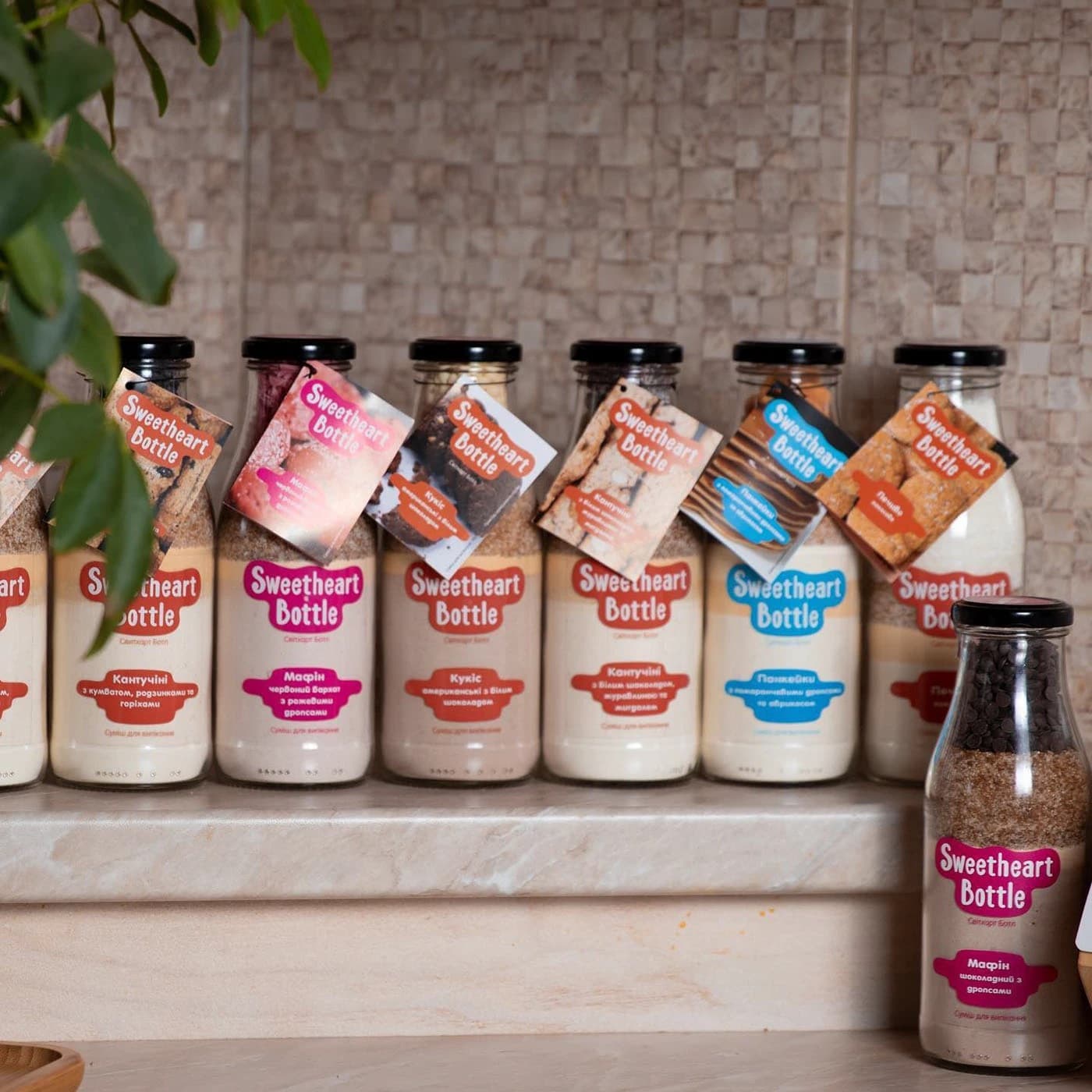
Instead, we would use transparent glass bottles.
More specifically, bottles resembling traditional milk bottles.
There were several reasons.
First, transparency.
If we were using attractive natural ingredients, why hide them?
Second, practicality.
Milk bottles have relatively wide necks, making them suitable for filling and emptying dry ingredients.
Third, perception.
A traditional milk bottle has an almost ridiculously domestic personality.
It feels familiar.
Homemade.
Comfortable.
A little nostalgic.
It looks like something that belongs in a kitchen rather than on an industrial production line.
And fourth, the bottle itself could become part of the product experience.
A glass container feels substantially different from a disposable cardboard box.
Of course, glass packaging costs more than cardboard. But our goal wasn't to compete with the cheapest baking mixes.
We were creating a different proposition.
I called it Sweetheart Bottle.
Don't mix the ingredients
Then came the detail that made everything work visually.
Normally, a baking mix is mixed.
That sounds reasonable. It is, after all, a mix.
But I suggested doing the opposite.
Don't mix anything until the customer actually wants to bake.
Put the ingredients into the bottle in separate layers.
Flour.
Cane sugar.
Chocolate.
Dried fruit.
Colourful ingredients.
Whatever the specific recipe required.
Now something interesting happens.
The bottle stops looking like packaged powder.
It becomes a composition.
A white layer.
A brown layer.
A dark chocolate layer.
Pink or red fragments.
Sometimes green, when we used ingredients such as spirulina.
You can almost read the recipe by looking through the glass.
The ingredients themselves become the packaging design.
And because every recipe contains different ingredients, every bottle develops its own visual character.
That was the central idea behind Sweetheart Bottle.
We didn't need to print an elaborate illustration of the product.
The product was already the illustration.
The label became secondary
Once the layered ingredients were visible, conventional packaging graphics became less important.
We kept the branding relatively simple.
The Sweetheart Bottle identity.
A colour-coded label for each product.
A small amount of necessary information.
And a miniature booklet attached to the neck of the bottle with the recipe and preparation instructions.
The label colours helped customers distinguish products, while the ingredients themselves provided most of the visual differentiation.
A brownie mix looked different from a fruit muffin mix.
A chocolate product looked different from a spirulina pancake mix.
There was no need to artificially create that difference.
It was already inside the bottle.
The entire range became surprisingly photogenic.
Which, as it turned out, was useful for the next stage.
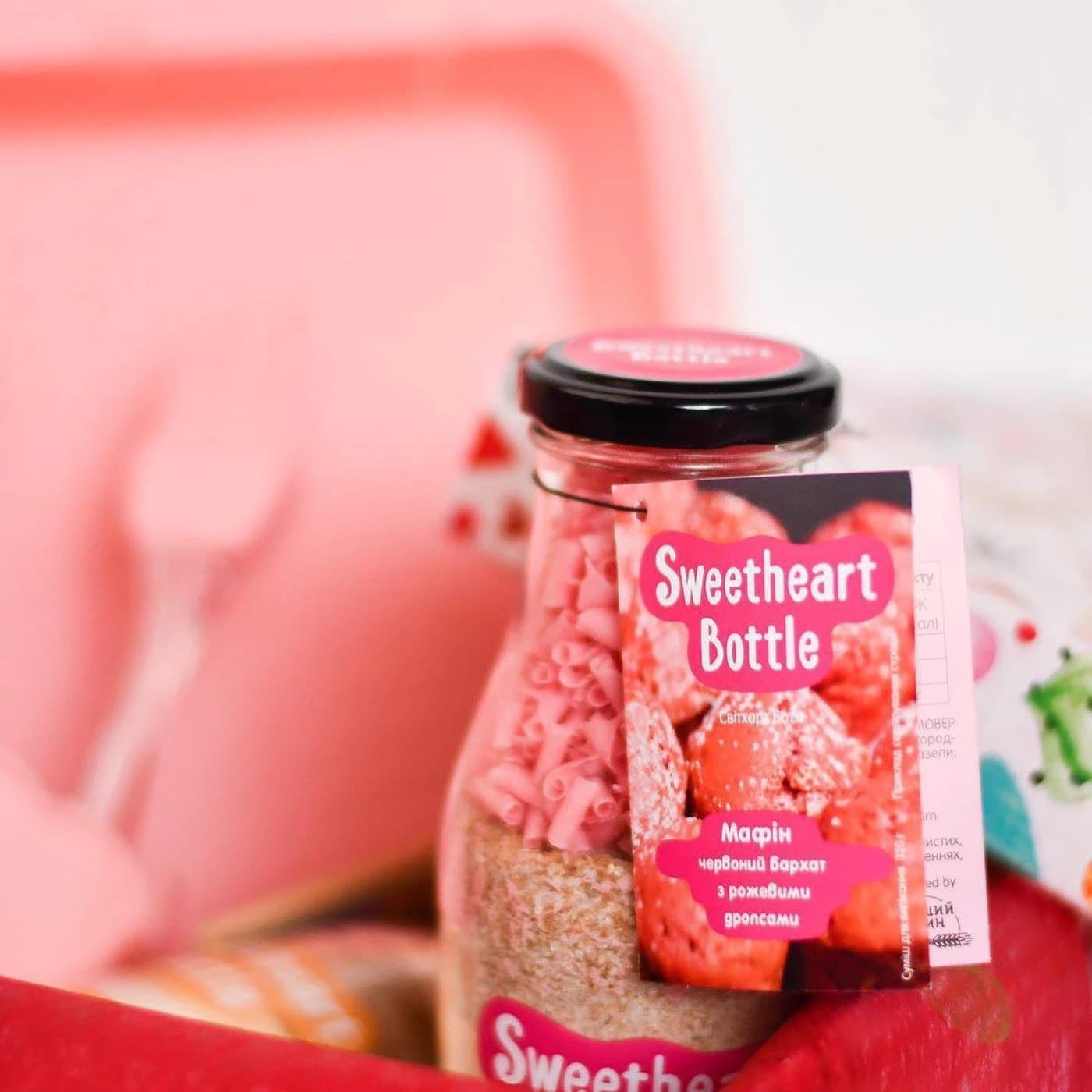
The recipe booklet and colour-coded identity sit alongside the visible layers of ingredients.
A product designed for Instagram before Instagram
Well, Instagram already existed, obviously.
But I wasn't thinking about the platform first.
I was thinking about a product people would naturally want to photograph.
Sweetheart Bottle had several useful qualities for visual marketing.
It was colourful.
It had an unusual shape for its category.
It looked good in groups.
It could be photographed as a product, as a kitchen object or as a gift.
And the preparation process created its own content.
You open the bottle.
Pour out the ingredients.
Mix them.
Bake something.
Show the result.
That gives you a complete little visual story.
We developed the brand and its product presentation, and I helped bring the range into premium and natural-food retail channels.
We also developed direct sales through the website and Instagram.
The social content largely explained itself: show the bottle, show the ingredients, show the preparation and show the finished food.
The assortment gave us plenty of material to work with.
And, importantly, the products were visually differentiated from the conventional baking mixes already available in supermarkets.
The idea worked.
But the most unexpected part came later.
Then some flour buyers visited the factory
The company also exported flour.
At some point, buyers from an African market visited the production facilities.
They came to see the mill and discuss flour supplies.
During the visit, they noticed something else.
The baking mixes.
These colourful bottles were not remotely what they had travelled to Ukraine to buy.
But the visitors were interested.
And their reaction revealed something I hadn't originally designed Sweetheart Bottle to solve.
They explained that prepared baking mixes were already popular in their market.
Not necessarily in pretty glass bottles.
Sometimes in large sacks, for commercial use or for preparing locally popular baked goods.
Then they mentioned another detail.
Their market treated certain prepared mixes differently from ordinary imported flour.
That distinction could matter commercially because flour imports were subject to specific quota restrictions, while some prepared food products could fall under different import rules.
Obviously, the actual classification depends on the ingredients, formulation and destination country's regulations. Calling flour a baking mix does not automatically make it one.
But we now had a genuinely different product to discuss.
And that created another opportunity.
From pretty bottles to industrial sacks
The original Sweetheart Bottle concept was designed for consumers.
Small quantities.
Premium positioning.
Attractive ingredients.
Retail stores.
Instagram.
But the underlying product development could serve a completely different market.
Instead of packaging the prepared mixes in glass bottles, the mill could manufacture suitable formulations in bulk.
The packaging became sacks.
The customers became distributors and commercial buyers rather than individual consumers.
The branding was no longer the central selling point.
The formulation was.
The buyers already knew what kinds of prepared mixes had demand in their market.
The company had flour production capacity, access to ingredients and experience in agricultural exports.
I had helped develop the original product concept, assortment, recipes and brand.
Now those elements could be adapted to another commercial format.
The company began supplying prepared mixes to interested export customers and exploring the same opportunity with other flour buyers.
The interesting thing is that this second direction was not part of the original brief.
It emerged because somebody came to buy one product and noticed another.
One idea, two completely different businesses
I find this case interesting because the same initial decision eventually produced two very different business propositions.
The first was about consumer perception.
Take a conventional baking mix and turn it into something visually attractive, premium and giftable.
The second was about product development and market access.
Take the knowledge and production capabilities developed for the consumer product and use them to create commercial mixes for export markets.
In the first case, the glass bottle was essential.
In the second, it was almost irrelevant.
And yet the second opportunity probably wouldn't have appeared in the same way without the first.
The buyers had visited a flour mill.
What caught their attention was a product that looked nothing like the flour they had come to purchase.
Sometimes the packaging changes the business
There is a tendency in business to separate product development, packaging, marketing and distribution into different departments.
First somebody develops the product.
Then somebody else designs the packaging.
Then marketing tries to sell it.
I have never particularly liked that separation.
In Sweetheart Bottle, the packaging decision influenced the recipes.
The recipes influenced the product assortment.
The assortment influenced the visual identity.
The visual identity influenced the marketing.
And the resulting product eventually helped reveal an entirely different export opportunity.
None of these decisions existed independently.
We started with a rather ordinary question:
How can a flour producer earn more money from flour?
We ended up with a premium consumer brand, a distinctive packaging system and an additional direction for international sales.
All because we decided that a baking mix didn't have to look like brown powder in a cardboard box.
Sometimes the most interesting business opportunity begins with changing the container.
And sometimes it ends with discovering that you no longer need the container at all.