
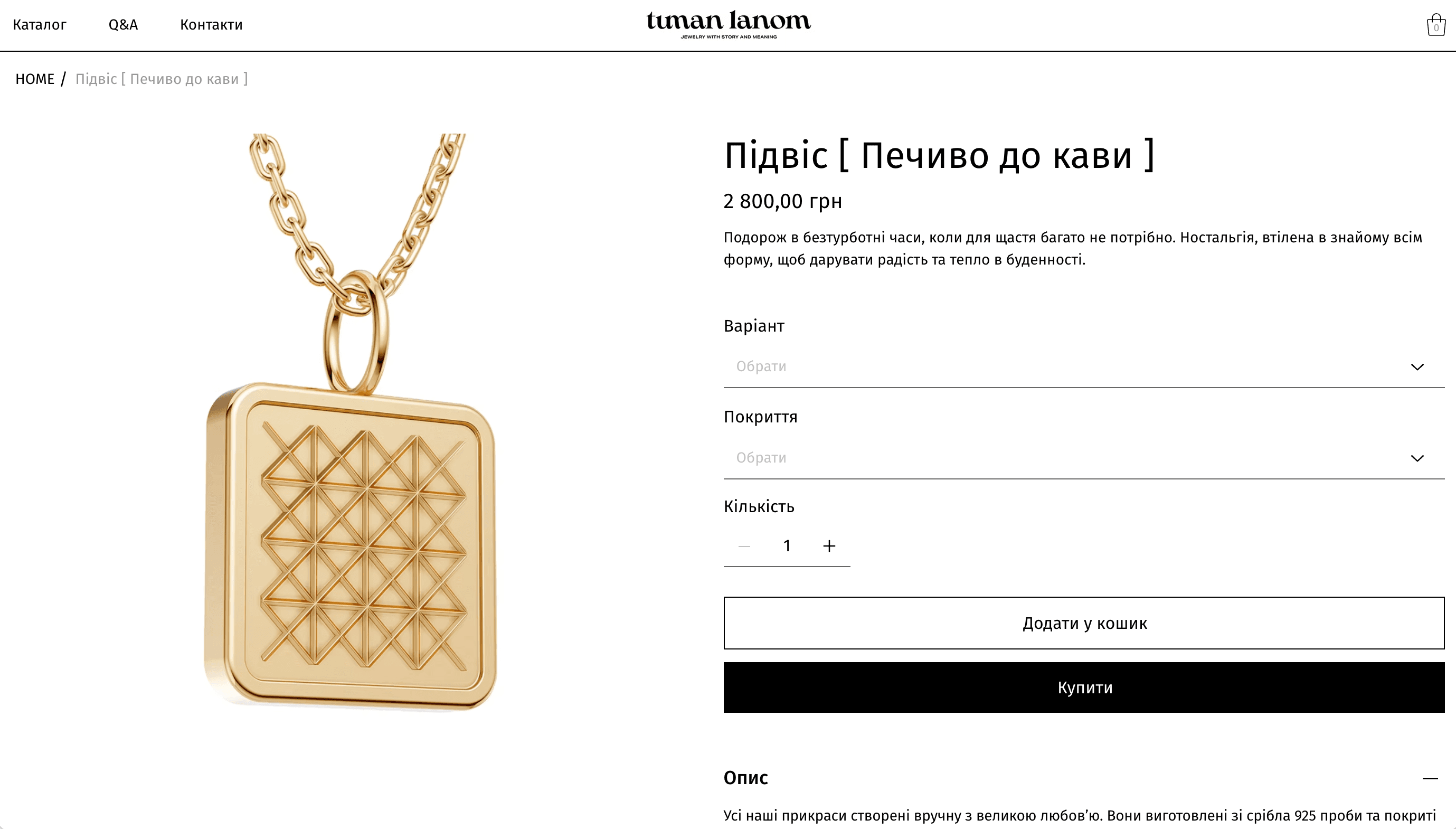
How a tiny piece of jewellery brought back my Soviet childhood, reminded me of biscuits with butter, and somehow connected my old life in Ukraine with my new one in France.
My wife's birthday is approaching.
She was born on October 31.
I was born on November 1.
Yes, Halloween.
An extremely convenient arrangement if your idea of celebrating your birthday involves spending the following day recovering from somebody else's party.
Anyway, I've been looking for a present.
We both love food. Not simply eating, although we're certainly quite capable of that, but the whole subject of food.
My wife studied at Le Cordon Bleu. I've spent a considerable part of my professional life in the restaurant business.
We appreciate interesting ingredients, good cooking, wine, desserts and occasionally rather strange culinary ideas.
So when I came across a small Ukrainian jewellery brand selling a pendant shaped like an ordinary biscuit, something clicked.
Not because I particularly needed a biscuit made of precious metal.
But because I knew that biscuit.
Very well.
The jewellery that started it
The pendant is made by a Ukrainian brand called Tuman Lanom.
It's called Pechyvo do kavy, literally Biscuit for Coffee.
A tiny square biscuit, complete with the familiar geometric pattern pressed into its surface.
Except this particular biscuit is made from sterling silver, with different finishes including 18-karat gold plating.
And it costs considerably more than the edible version.
Which is understandable. Most biscuits don't survive for decades, even if you keep them in a jewellery box.
The design immediately reminded me of the inexpensive rectangular biscuits that were practically permanent residents of Soviet kitchens.
До чаю.
До кави.
For tea.
For coffee.
Very practical names.
No complicated branding strategy.
No French aristocrat on the packaging.
Just an honest declaration of what the biscuit was supposed to accompany.
And that was enough to send me straight back to my childhood.
The cheapest biscuits in the house
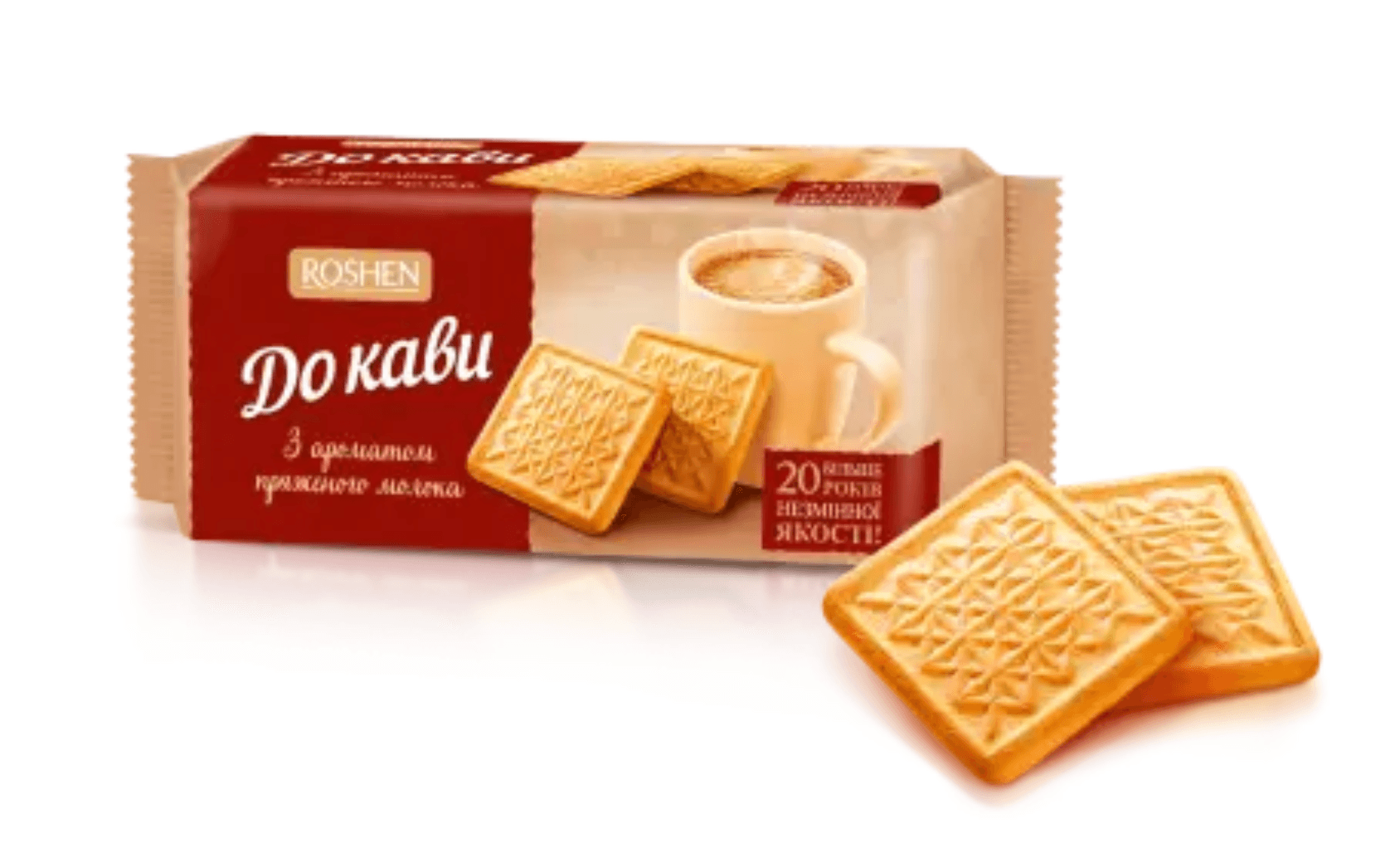
Do Kavy biscuits, shown in the supplied product image.
I grew up in Mykolaiv, a city in southern Ukraine.
We were an ordinary Soviet family.
Not wealthy, not particularly poor.
Like most families at the time, we occasionally encountered shortages, although I wouldn't describe my childhood as a permanent struggle to find something sweet.
There were inexpensive cakes.
Pastries.
Candies.
And biscuits.
Always biscuits.
Some people remember the classic Soviet children's dessert of bread sprinkled with sugar, sometimes moistened with water to make the sugar stick.
I remember that too.
Although I preferred a more luxurious version.
Bread.
Butter.
Sugar.
That's it.
And I still think it's rather good.
But my most memorable improvised dessert involved biscuits.
Those plain rectangular ones.
The cheapest kind.
The sort that nobody would ever consider particularly exciting.
Until you added butter.
The original Soviet biscuit sandwich
Here's the recipe.
Take one ordinary biscuit.
Spread a generous layer of butter on it.
Put another biscuit on top.
Congratulations.
You've made a biscuit sandwich.
No oven required.
No special equipment.
No pastry chef.
Not even a particularly advanced understanding of cooking.
Just two biscuits and some butter.
And I absolutely loved it.
With strong black tea, it was wonderful.
Later, with coffee, equally good.
The butter softened the dryness of the biscuits slightly, while adding a rich, creamy layer between two crisp surfaces.
It's a very simple combination.
But a surprisingly satisfying one.
Today, of course, supermarkets are full of sandwich biscuits.
Oreo.
Prince.
Countless variations with chocolate, vanilla cream, hazelnuts and things that apparently require entire laboratories to formulate.
But when I was growing up, those products weren't part of our everyday shopping.
So we made our own.
And the funny thing is that I still occasionally do.
Not because I can't buy something more sophisticated.
Because I genuinely like the taste.
There are childhood foods you eventually realise weren't particularly good.
And then there are those you try again thirty or forty years later and think:
No, actually, this was excellent.
The butter-biscuit sandwich belongs firmly in the second category.
Then I moved to Nantes
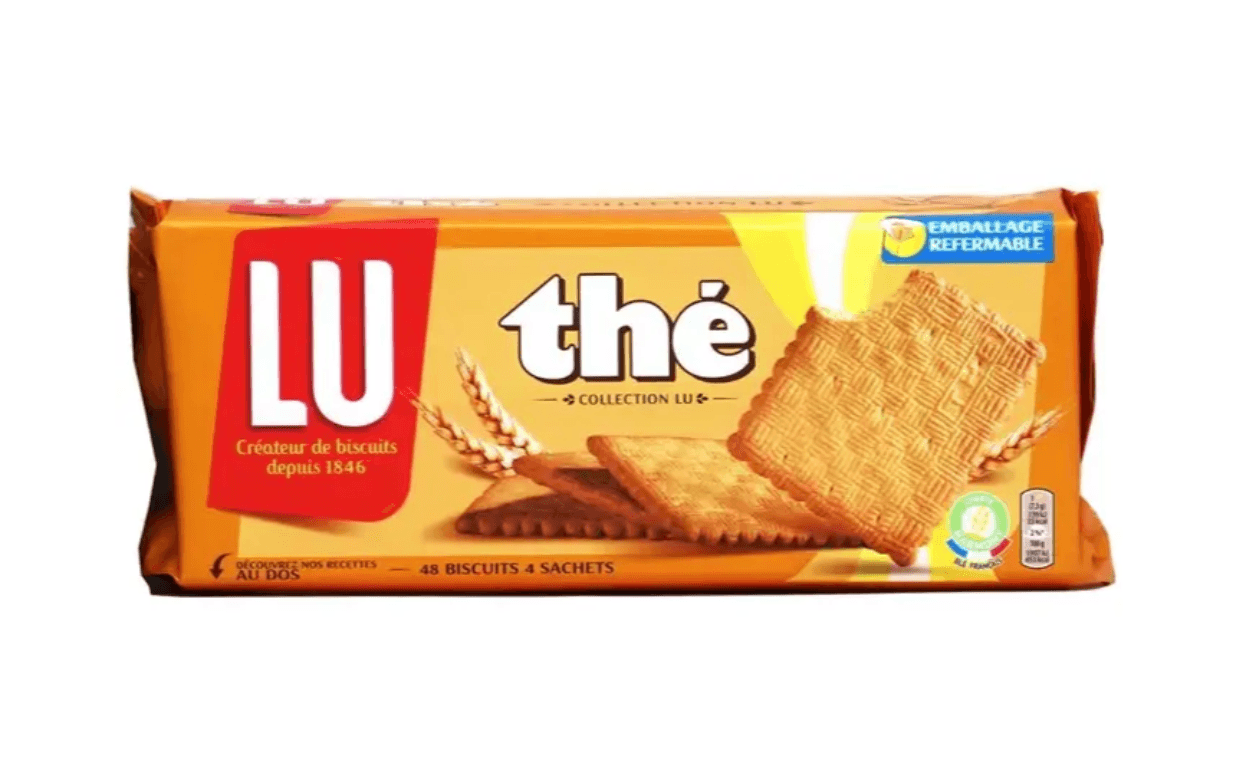
LU Thé biscuits, the French counterpart discussed in the story.
Now here's where the story becomes more interesting.
I currently live in Nantes, France.
Nantes has a remarkable biscuit-making history.
It is the birthplace of Lefèvre-Utile, better known as LU.
The business began here in 1846, and in 1886 Louis Lefèvre-Utile developed the famous Petit-Beurre, which became one of France's iconic biscuits.
LU didn't invent every rectangular tea biscuit in existence, of course. Similar products already existed, and the company's history was itself influenced by British biscuit manufacturing.
But Nantes played an important role in making this type of biscuit familiar to generations of French consumers.
And today, LU remains closely associated with the city's identity. patrimonia.nantes.fr
There is even a LU biscuit called Thé.
Simply Tea.
Not For Tea.
Just Tea.
The French apparently decided that the relationship between biscuits and hot beverages required even fewer words.
And here's the amusing part.
It looks remarkably similar to the biscuits I remember from Ukraine.
Rectangular.
Thin.
A regular geometric pattern.
An inexpensive, familiar product intended to accompany a cup of something hot.
The flavour is close too, although LU Thé has its own character, including a subtle orange-blossom note. Carrefour.fr
Personally, I think the French biscuit is a little more delicate.
Perhaps slightly thinner.
A bit more refined.
But the basic experience is immediately recognisable.
I don't know whether the Ukrainian biscuit designs were historically influenced by LU or developed through the broader European tradition of industrial tea biscuits.
I'm not going to invent a genealogy.
What matters to me is the resemblance.
Because suddenly, something from my Ukrainian childhood had an almost identical counterpart in the city where I now live.
A biscuit connecting two countries
There is something rather strange about rebuilding your life in another country.
You leave behind an enormous number of things.
Some important.
Some trivial.
Some you don't even realise you remember until something unexpectedly reminds you.
A smell.
A particular food.
An old advertisement.
A familiar package in a supermarket.
Or, apparently, a little gold-plated biscuit pendant.
My wife and I have a somewhat different relationship with the Soviet past.
I was born in the Soviet Union.
She wasn't.
For me, these biscuits are connected to very specific childhood memories.
For her, they belong more to the Ukrainian food culture that continued long after the Soviet Union disappeared.
But we both have our Ukrainian history.
And now we have our French one.
Nantes is becoming part of that history too.
I genuinely like living here.
The city feels comfortable to me.
And its biscuit-making heritage is one of those small cultural details that make the place particularly appealing.
So this little pendant suddenly acquired two meanings.
On one side, Ukraine.
The familiar До кави biscuit.
Childhood.
Family kitchens.
Homemade biscuit sandwiches with butter.
On the other, Nantes.
LU.
French biscuits.
Our new life.
Different countries, different periods, different memories.
Connected by a rather ordinary square biscuit.
I think that's a lovely idea for a gift.
An ordinary biscuit can carry quite a lot
I haven't decided whether this will be the final birthday present.
There are practical details, including whether ordering it from Ukraine to France would be convenient.
But I wanted to save the discovery.
And share it.
Not as an advertisement. I have no commercial relationship with the jewellery brand.
I simply came across something I liked.
The Tuman Lanom biscuit pendant is a small, beautifully executed object based on one of the most ordinary products imaginable.
Incidentally, the shop also has jewellery inspired by other familiar foods, including bread with butter.
Which suggests that I'm not the only person who associates extremely simple food with rather complicated emotions.
Perhaps that's what I find most interesting about this whole thing.
A biscuit that once cost almost nothing can become a symbol of childhood.
Then somebody turns it into jewellery.
And that little object becomes a connection between the country you came from and the country where you're building a new life.
Quite a lot of meaning for something that originally existed to accompany tea.
And perhaps a little butter.