
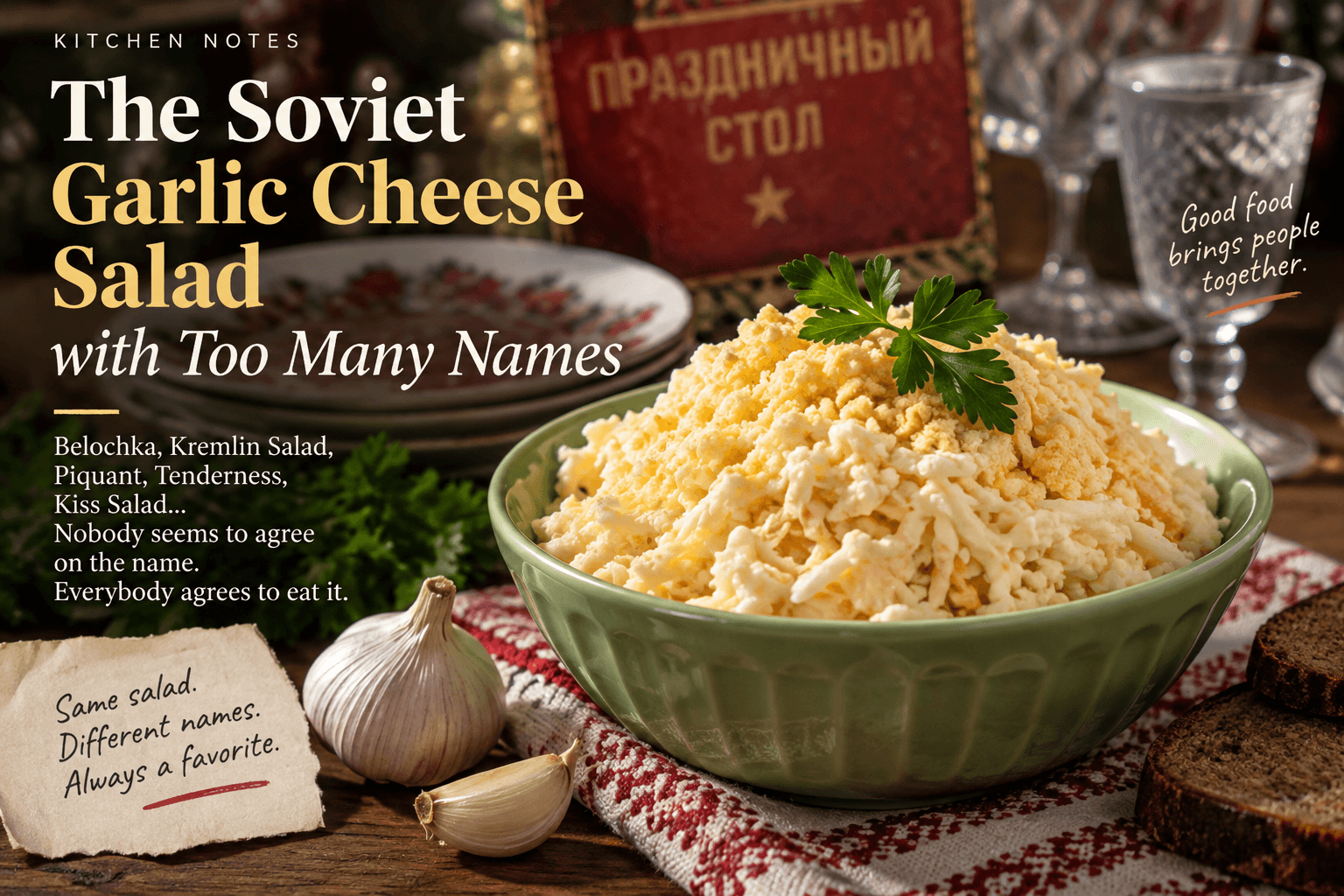
Belochka, Kremlin Salad, Tenderness, Piquant, Kiss Salad... Nobody seems to agree on the name. Everybody agrees to eat it.
There was one salad that appeared at almost every celebration during my Soviet childhood.
Not on ordinary Sundays. Not at casual family dinners.
Only on holidays.
And even today, whenever I get together with older relatives, parents, aunts, uncles, people of my generation and above, there's a good chance this salad will be on the table.
The strange thing is that nobody seems to agree on what it's called.
Some call it Belochka (Little Squirrel).
Others call it Kremlin Salad.
Or Piquant.
Or Tenderness, which seems like a rather optimistic description of something containing this much garlic.
There's also Kiss Salad. Presumably because after eating it, your kisses become particularly memorable.
And in some families, it's called Jewish Salad, although I have no idea where that name came from.
The names vary. The basic recipe barely does.
Three ingredients you cannot escape
At its simplest, the salad contains just three things:
Processed cheese, garlic and mayonnaise.
Grate the cheese. Crush the garlic. Mix everything with mayonnaise.
Done.
But most families make a slightly more elaborate version.
The one I remember usually included grated hard-boiled eggs, a little salt and sometimes black pepper.
My own preferred version has evolved slightly since moving to France.
I use:
- Processed cheese, finely grated.
- Grated Emmental or another mild hard cheese.
- One or two hard-boiled eggs, grated.
- Fresh crushed garlic, generously.
- A little dried garlic for extra depth.
- Black pepper and a pinch of paprika.
- Mayonnaise, preferably mild and not overly vinegary.
Mix everything until you get a thick, creamy consistency.
The cheese and mayonnaise soften the garlic's sharpness, but don't expect them to make it disappear.
Garlic is very much the point.
The French adaptation
Sometimes I also add finely grated carrots.
Back in Ukraine, that meant grating a fresh carrot.
In France, I have discovered the convenience of carottes râpées, which supermarkets sell ready-made, often lightly dressed with lemon juice and seasoning.
They work surprisingly well here.
The carrot adds a little sweetness, freshness and acidity to an otherwise rather unapologetic combination of cheese, eggs, mayonnaise and garlic.
Traditionally, the salad is served in a small bowl, sometimes decorated with a sprig of parsley.
It doesn't need much decoration.
It will disappear anyway.
Not really a salad
Calling this a salad is perhaps slightly misleading.
You can eat it with a fork.
You can spread it on bread.
You can serve it as a cold appetiser, including alongside vodka or other strong drinks, as was common at Soviet-style celebrations.
But I also use it as something closer to a sauce or condiment.
For example, take a serving of classic Olivier salad, add a couple of spoonfuls of this garlic cheese mixture, and stir.
Suddenly, your Olivier becomes richer, creamier and considerably more garlicky.
It also works surprisingly well with steak.
Or simply on a piece of good bread.
No special occasion required.
The bowl that always comes back empty
I don't know exactly when this salad became part of our family tradition.
I don't know who invented it.
And I'm certainly not going to try to settle the argument over its proper name.
What I do know is that during my childhood, it belonged to the holiday table.
It wasn't expensive or complicated. In fact, it was made from some of the most ordinary ingredients available in Soviet kitchens.
But somehow, it always felt festive.
And there's another thing I remember.
However many other dishes were on the table, this little bowl was usually one of the first to become empty.
Forty years later, that hasn't changed much.
Some family recipes survive because they're extraordinary.
Others survive because everybody keeps asking you to make them again.
This one belongs firmly to the second category.
Another family memory: my father's Saturday morning sausage pancakes.
Recipe at a glance
Number of portions not specified.
Ingredients
- Amount not specified; finely grated processed cheese
- Amount not specified; grated Emmental or another mild hard cheese
- 1–2, grated hard-boiled eggs
- Generously, crushed fresh garlic
- A little dried garlic
- To taste black pepper
- A pinch paprika
- Enough for a thick, creamy consistency mild mayonnaise
- Optional, to taste salt
- Optional; amount not specified finely grated carrots or ready-made carottes râpées
Method
- Finely grate the processed cheese, Emmental or another mild hard cheese, and one or two hard-boiled eggs.
- Add generously crushed fresh garlic, a little dried garlic, black pepper and a pinch of paprika. Add salt if desired.
- Mix with mild mayonnaise until thick and creamy. Add finely grated carrots if desired.
- Serve in a small bowl, spread on bread, or use as a condiment alongside steak or Olivier salad.