
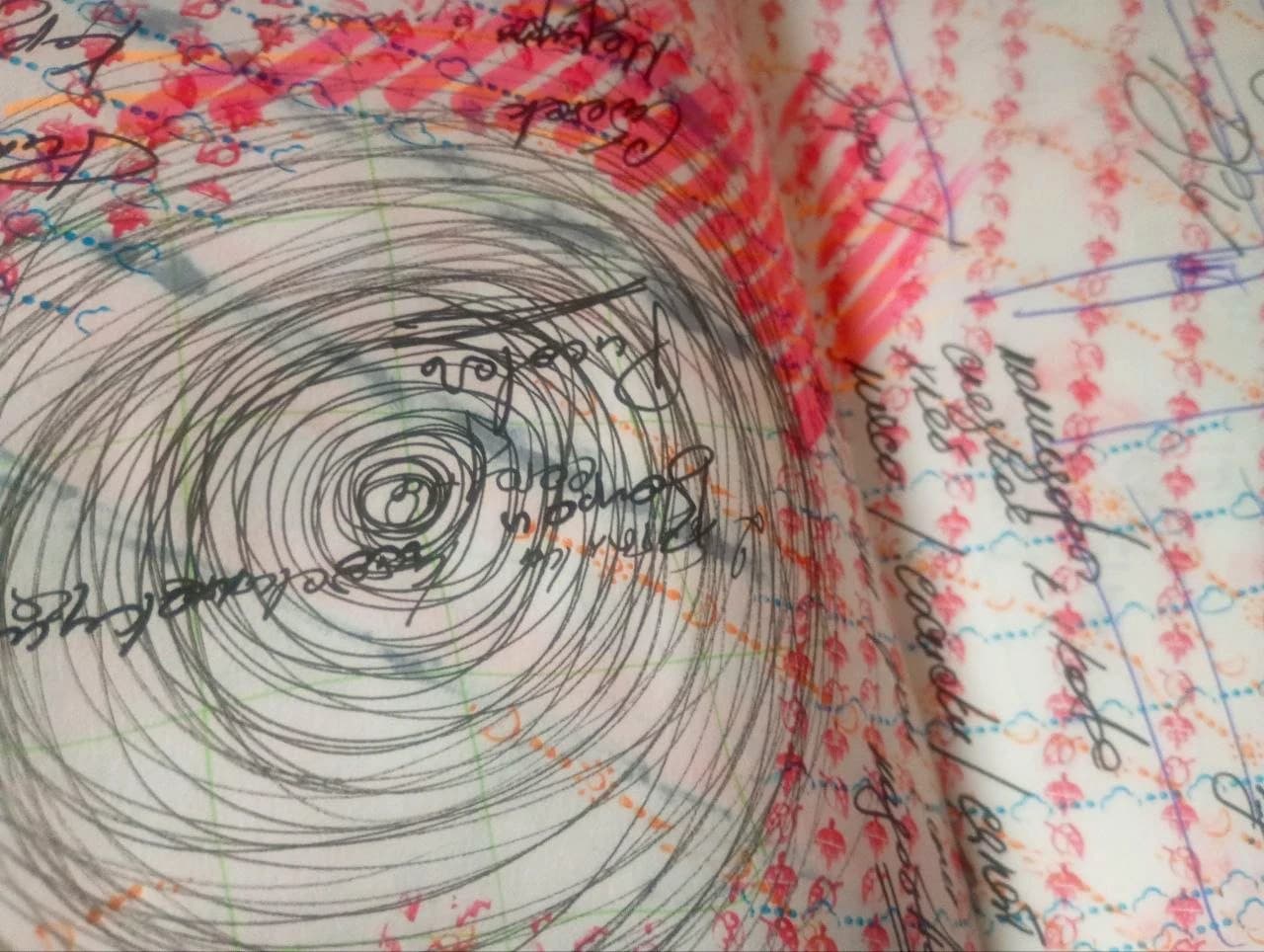
Cover artwork by Anton Biletskyi-Volokh, from an unpublished reusable sketchbook in progress.
A thematic selection of translated notebook fragments.
You walk over, sit down in the chair, look across and ask without words: ‘What is it like living inside yourself?’
Unmanageable debts can be a sign of an unrealistic assessment of yourself and excessive impulsiveness.
Emotional maturity is essentially the ability to regulate your own emotions without constantly looking for an external regulator.
Someone asked how to stop devaluing people. Well, start by imagining that you are not trying to strip someone outside you of their worth: through that devaluation, you are trampling on yourself.
Feeling deprived as a way of giving yourself more rights and fewer obligations. I have suffered and put up with so much that I am now allowed more than other people, and they owe me more than I owe them.
Everything is fine with the consumer position, except that the consumer feels bad. A subject is always happy, whereas a consumer is always being used. Used by themselves, at that.
Hostility requires polarisation. Arguments sustain polarisation; empathy reduces it. ‘A person has no enemies but themselves.’
An adult is someone who can distinguish themselves within the endless stream of experiences and sensations.
Anxious people calm down when there is danger. Like: everything is just as I thought. If there is no danger, anxious people invent it for themselves. To calm down.
A loser easily finds a place in a dictatorship because a run of failures is usually tied to an external locus of control, while a dictatorship rests on the illusion that someone else knows better.
The fear of being left and abandoned is self-objectification. You can discard a little object; you cannot discard a subject, because a subject is always one, and even when beside someone, is beside another one.
Being unable to do anything without an external observer who evaluates you and tells you what to do is like having a faulty system for getting yourself going.
The skill of turning experiences into a coherent story and telling it brings considerable relief in itself.
Self-esteem is not the same as self-worth. Self-esteem means knowing your actual capabilities and abilities. Self-worth is the ability to value yourself rather than assess yourself: for existing, not for achievements.
Suffering in love is built on being able to tell yourself that happiness was so possible while you are being rejected, pushed away or simply met with indifference.
Until you know how to treat yourself well, the hope that someone else’s good treatment will break the spell and fix things is doomed to fail.
You can only abandon someone who has no self. Otherwise, it is not abandonment but parting and gradually living through the loss.
Repeating stories are an attempt to replay the first story in which we felt pain. The trouble is that you cannot replay it differently while playing the very same role.
External evaluations matter where the sense of self is very weak. Either I score 110 out of 100, or I simply do not exist.
Being drawn into a parental role means trying to become not even the parent the person you look after apparently needs, but the parent you needed yourself.