
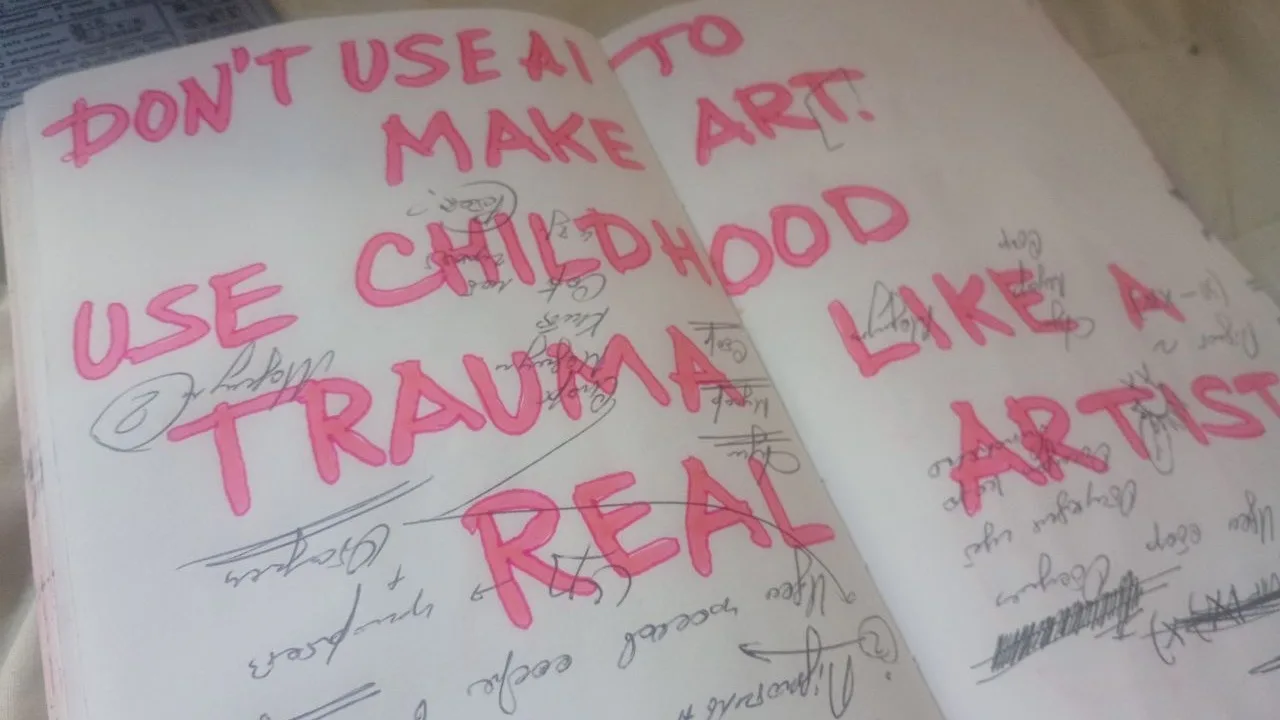
Cover artwork by Anton Biletskyi-Volokh, from an unpublished reusable sketchbook in progress. Other work from my sketchbook practice.
A thematic selection of translated notebook fragments.
Trying to solve material problems with spiritual practices mainly works when you're selling the practices. Otherwise, of course, exercises for the body and attention work wonderfully. But meditation won't learn a profession or find an occupation for you.
Remember that reassessing and changing your goals when external or internal circumstances change isn't an excuse for weaklings. It's an important skill for professional resilience.
Procrastination is perfectionism's best friend.
‘I have no energy left at all.’
‘But you're constantly punching a wall…’
‘I can't stop.’
‘Why?’
‘I've put too much into this!’
The idea of ‘never give up’ is certainly inspiring, but it often leads to burnout and exhaustion rather than actual results. If a situation consumes so much energy that your body cannot recover, all that catching up and overtaking at any cost, higher, stronger, more, seventy-hour working weeks and training yourself into the ground is closer to self-destruction than movement towards the result you want.
On burnout.
Many people make it to their first burnout. Fewer make it to the second. The third is for the most stubborn and unteachable, though admittedly very tough.
nobody:
absolutely nobody:
not a single soul:
burnt-out perfectionist: i don't have burnout. i haven't worked hard enough to have it.
Me: I'm resilient to stress.
My stress resilience: a delayed emotional reaction.
Coping requires awareness.
Without self-monitoring skills, you don't know when to use it.
Stress resilience isn't about not reacting to stress at all and facing every situation with Chuck Norris's expression.
It's about how adaptive your personal ways of coping with threats, losses and challenges are, how your inner resources are spent and distributed on adaptation, and how quickly and easily you recover after stress.
It's important to remove sources of stress in your inner world as well as the outside one. The stronger the inner conflict, the lower your stress resilience.
The more illusory your picture of the world, the more resources it takes to maintain it.
For some people, overexertion is a way to get to relax.
Helping people at your own expense actually harms both them, because they don't get to experience boundaries, and you, because if your resources aren't replenished, they can run out. And run out unexpectedly.
If you give yourself time for despair, hope comes afterwards.
Under stress, all feelings are ways of adapting. It's important neither to push them away nor to get stuck in them.
In times of instability, a well-established everyday routine is an important support.
Tiredness can be useful in creative work too. You can turn it to your advantage when there's no energy left for inhibitions and blocks, and spontaneity emerges.
Creativity and making something new are signs of having energy to spare. Want to create? Take care of replenishing your energy.
Fixed, habitual behaviour is wonderful in a stable situation and destructive in a changing one.
I love the joke about a bloke who comes to audition at a children's theatre and says: ‘I'm a little bear.’ They tell him: ‘We're putting on Cinderella.’ He replies: ‘I don't give a fuck. I'm a little bear.’
Rest is an important part of work. Work hard at it over the holidays.
Psychology Notebook is a translated personal archive of observations, study and lecture notes, paraphrases, quotations and remembered ideas. A fragment's presence here does not establish exclusive authorship or scientific consensus. These are notebook fragments, not clinical guidance.