
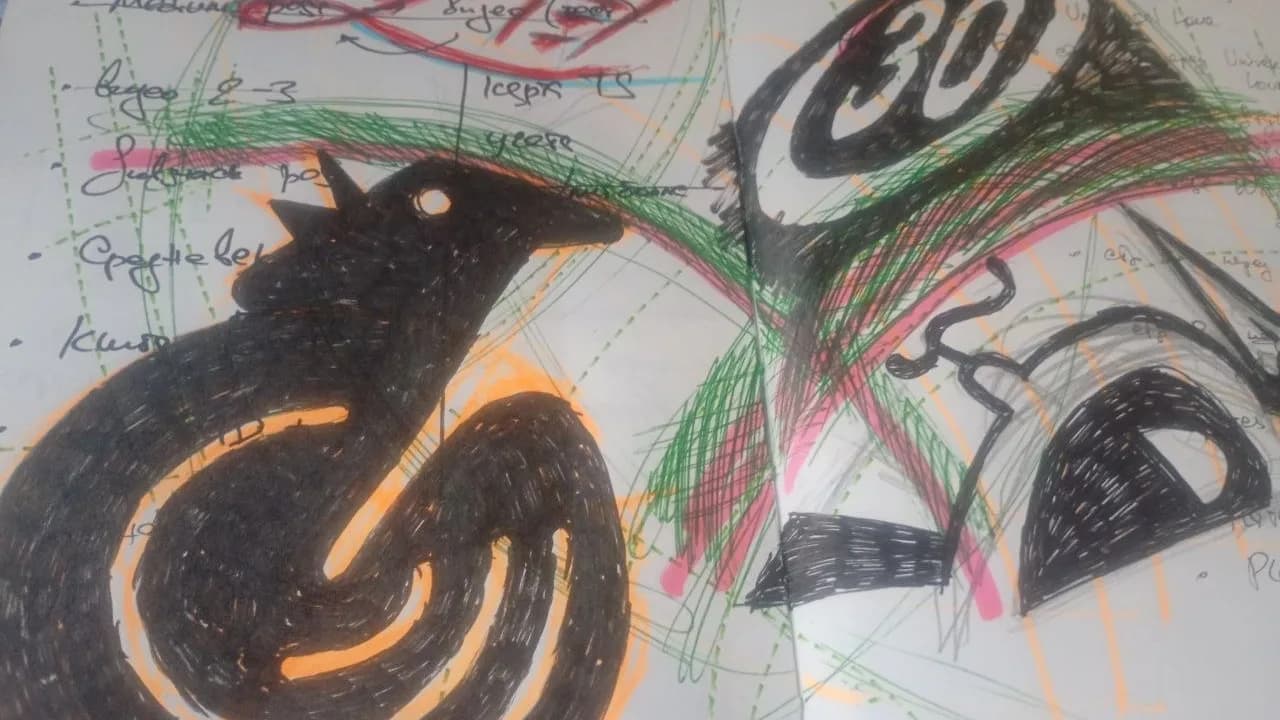
Cover artwork by Anton Biletskyi-Volokh, from an unpublished reusable sketchbook in progress. Other work from my sketchbook practice.
A thematic selection of translated notebook fragments.
There is a whole world of possibilities around us, yet we persist in trying to get a particular response from people who have often existed only in our heads for a long time.
Levels of mature love: pleasure, closeness, cooperation.
‘Once N becomes M, then we'll really start living!’
When we pin our hopes on changes in another person, we're usually doomed to disappointment.
Love's spell wears off with too much of it.
It's particularly interesting when someone tries to entice you into contact with their boredom rather than their liveliness. As in: interest me, and then we'll see.
Manipulation has everything going for it. You're such a cunning little operator: you've fooled and used everyone, as though they were things rather than living beings. The only drawback is that afterwards, you clever thing, life among all those things feels rather soulless and dead.
Being in a subject–object relationship, turning the other person into a little thing or becoming inanimate yourself, is like sitting at a feast wearing a metaverse headset, unable to eat anything and satisfy your hunger.
Love is the desire to fill your own lack with the person you're in love with.
Unrequited love is a kind of recursive exercise: filling a lack with another lack.
‘I'm being used’: doing things for other people that they haven't asked for, so I can feel needed.
When you can see what might have shaped a person's pattern of behaviour, you become much less judgemental about people.
Sometimes what keeps you in a bad relationship is the fear of spoiling the relationship by leaving.
For many people, a relationship isn't the joy of closeness and love, but an endless discussion of the relationship. And not even the relationship itself, but why your partner doesn't notice your wounds while you refuse to see theirs.
What keeps a long romantic drama going often isn't love, but the desire to get your own back.
‘She'll come back, she'll understand everything, but then I'll give her the cold shoulder!’
A relationship without symmetry is one held together by an economy of sacrifice.
Relationships are emotional investments. One-sided investment makes for a sacrificial relationship.
In dramas, what usually torments people isn't love, but unrealistic expectations.
Once you stop taking the bait when somebody tries to hurt you, it becomes so obvious how wounded the person doing the hurting is.
Tolerance matters towards things that don't directly concern you. Tolerating something that does concern you and doesn't suit you isn't tolerance. It's being a doormat.
To receive anything from other people, those people have to be included. You have to see and notice them. However much you demand ‘give me’, if there are no other people there, there's nobody to receive anything from.
A lack of interest in other people impoverishes a person.
Psychology Notebook is a translated personal archive of observations, study and lecture notes, paraphrases, quotations and remembered ideas. A fragment's presence here does not establish exclusive authorship or scientific consensus. These are notebook fragments, not clinical guidance.