
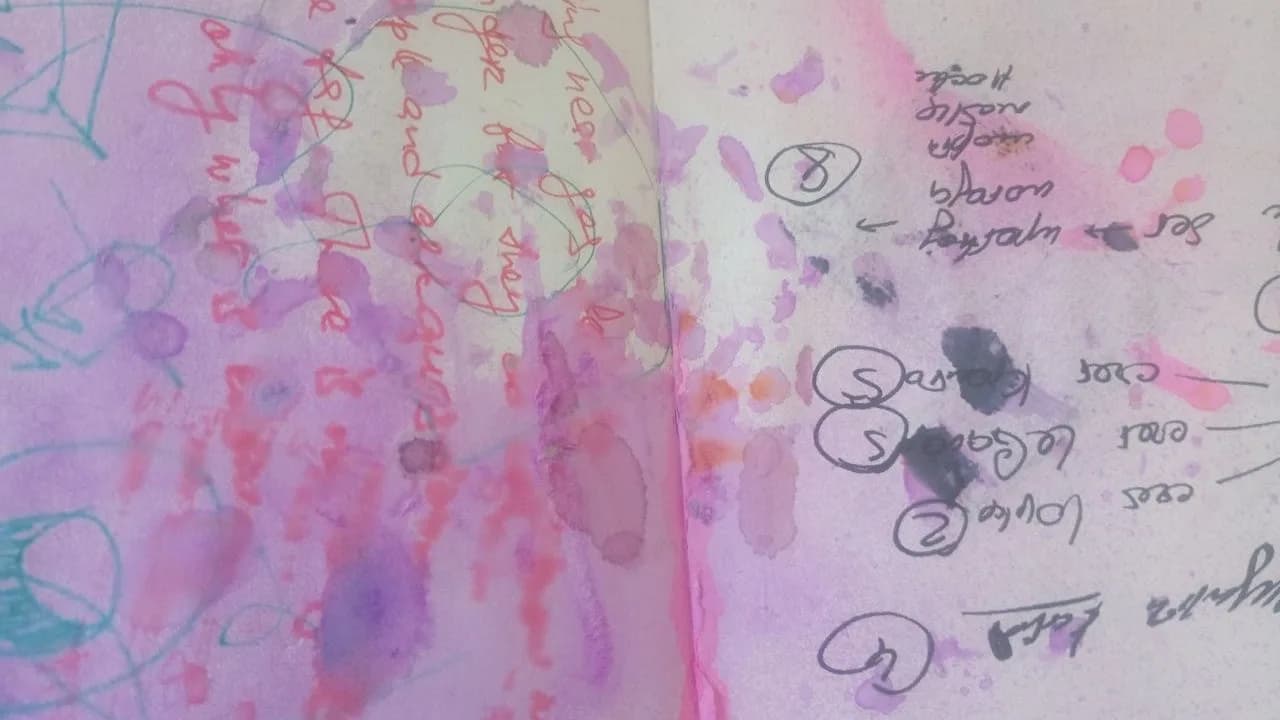
Cover artwork by Anton Biletskyi-Volokh, from an unpublished reusable sketchbook in progress. Other work from my sketchbook practice.
A thematic selection of translated notebook fragments.
The urge to take every possible precaution ends up making you opt out of life. Yet the fact that nobody is insured against everything is precisely what gives existence its particular charm.
Wanting absolute guarantees of the outcome usually really messes up the process.
The fear of making the wrong choice leads to doubts that use up more energy than it might have taken to put the consequences of a wrong choice right.
Of course it's hard to explain the joy of freedom to someone who has never known it. You have to make your own decisions and answer for them. Can't I be free, but have somebody else decide for me?
It's important to choose from your own centre, not from the position of a prison guard. What would be better for me, rather than how can I be better?
From your centre, you can make a realistic assessment of your strengths and needs. From the guard's position, there are demands that may have nothing to do with what you're capable of.
There is no choice when all you have are unconscious patterns.
Choice begins when the unconscious becomes conscious.
People without the capacity for reflection tend to have no choice, because they act on impulses whose nature they don't understand and which they have no alternative ways of expressing.
There are no alternatives because they cannot assess an impulse from different sides: examine whether it is fruitful or destructive, find other ways to express it, or transform it into something new.
Therapy doesn't make you a different person. It widens your range of choices.
People make choices according to how external circumstances are perceived and analysed through their inner world. The way that inner world is shapes the way we live.
People's actions are guided by their current idea of what is good for them. It's just that sometimes the desire for an immediate benefit blocks the ability to think through the consequences.
Giving up your desires can offer the pleasure of feeling strong and superior to other people. Look how good I am at denying myself everything. The downside is that your desires don't get fulfilled.
Wanting to become like somebody else is a natural part of growing up, an integral part of early adolescence. If things go okay, that desire fades by late adolescence. But, as you can imagine, not for everyone.
And you cannot become yourself while still taking somebody else's ready-made image as your guide.
Wanting to get closer to people who reject you is a clever way of avoiding admitting that you yourself are afraid of real contact and interaction, and are avoiding it.
The more childlike your position in a relationship, the stronger your desire for asymmetry.
‘I want to be loved, entertained, pampered, fussed over, and have every demand answered. In return, I offer myself: bored, helpless and unable to cope.’
But the other person, alas, isn't a fairground ride. Even if they are one for a while, the ride can break down or stop, the tickets can run out, the fair can leave town.
To free yourself is to stop waiting for the impossible.
The least change happens when you talk about doing everything to change things while actually doing nothing.
And if someone says nothing suits them, but takes no steps to change the situation, it means it suits them and they just want to talk.
Self-development and spiritual growth are actions. Courses called ‘Develop Your Personality’ don't develop you. Studying and doing something systematically do, preferably working. Sitting on a bench, toes turned in, eyes on the sky, with self-development in your head is a wonderful occupation. It just doesn't develop you very much.
Spiritual growth comes from the choices you make in your actions, from giving up a quick advantage when you act, rather than from asanas and retreats.
Doing what you love doesn't mean getting ten-out-of-ten thrills all the time. It's something you want to keep doing when the thrills are scarce and there are no results, but the process still draws you in.
The desire to learn, putting it into practice, and a lively interest in the world are important signs of psychological well-being.
When striving for transformation, remember that deterioration is a transformation too.
Being the author and protagonist of your own life is the active voice. The victim position is often cosy, but it's the passive voice: an inability to acknowledge your opportunities to choose or notice your own acts of will.
Psychology Notebook is a translated personal archive of observations, study and lecture notes, paraphrases, quotations and remembered ideas. A fragment's presence here does not establish exclusive authorship or scientific consensus. These are notebook fragments, not clinical guidance.