
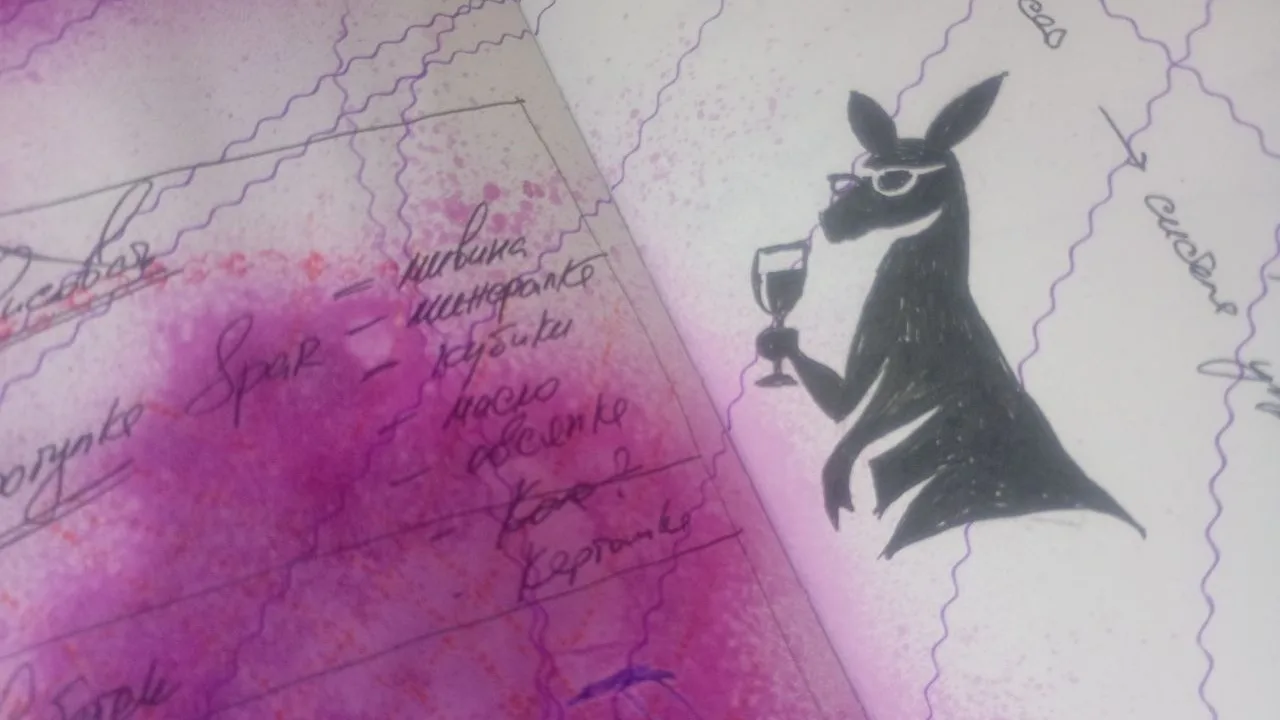
Cover artwork by Anton Biletskyi-Volokh, from an unpublished reusable sketchbook in progress. Other work from my sketchbook practice.
A thematic selection of translated notebook fragments.
Wanting to claim someone else's ready-made story as your own is hoping that an attached template will spare you danger and wrong choices. But a ready-made template won't spare you your own little existential crisis over the life you're missing.
If we don't accept a need of our own, we look for someone outside us to act it out.
Sometimes the inner critic wants what's good for us so badly that it overdoes things and stops being on our side.
Revenge is wanting someone to grieve for you as you grieved. Company for a grief you refuse to go through.
Without the acting out of neurotic dramas, so much time opens up that, whether you like it or not, you'll have to find something you enjoy doing and learn to rest.
Doubt feeds on the idea that, once you've chosen something, you won't be able to change your mind — and if you don't like it, you'll have to put up with it.
— In the discourse of master and slave, the slave doesn't want freedom. He wants to become the master. — The slave doesn't want to become the master. He just wants the master to do everything for him, which is what usually happens. Because an unfree person does everything pretty badly himself.
— What if I don't make my own decisions and just listen to other people? — For a masochist, that's an excellent decision: in the end, nothing will suit you and you'll have to put up with it.
Helping people without clarifying their needs means getting in their way.
When we decide to make decisions for another person, we decide to carry someone who often hasn't even asked us to.
Neurosis is living someone else's desire.
Neurosis is choosing absolute sameness from the entire variety of plots.
Character is a set of choices a person makes. The narrower the range of choices, the more predetermined life becomes. Character is fate.
Choosing people who don't choose you is a way to remain safely isolated.
Spontaneity is often confused with a lack of consistency. Spontaneity means having resources available for freedom. A lack of consistency means sabotage and an unwillingness to compare the facts.
Tolerance of frustration matters for adaptation. But it needs to be tolerance, not endless putting up with things and an unwillingness to change the frustrating situation.
Not making a decision is usually the most resource-intensive decision.
Not choosing and waiting for things to work themselves out means making a choice that might not suit you at all.
The victim's position blocks the sight of a choice where there is one.
Fear of making a mistake leads to wanting someone else to choose for you. If you like it, you chose well. If you don't, bad people gave you bad advice.
Psychology Notebook is a translated personal archive of observations, study and lecture notes, paraphrases, quotations and remembered ideas. A fragment's presence here does not establish exclusive authorship or scientific consensus. These are notebook fragments, not clinical guidance.