
OpenAI's chief scientist has published an unusual set of internal training metrics and proposed using them to coordinate limits on frontier AI development. The idea is intriguing. Making it work is another matter.
The artificial intelligence industry has spent the last few years building increasingly powerful engines.
Bigger models.
More computing power.
Larger training clusters.
More capable reasoning systems.
And, naturally, an almost religious conviction that the next generation will be considerably more impressive than the last.
Now one of the people responsible for building these engines is asking an interesting question.
What happens when the engines become good enough to help design their own successors?
And, more importantly, how do you regulate the speed of that process?
On November 22, 2026, Jakub Pachocki, OpenAI's chief scientist, published an essay titled Perplexity and Intelligence.
At first glance, the subject seems wonderfully unexciting.
Perplexity.
A statistical measure of how accurately a language model predicts the next token.
The sort of thing researchers monitor while the rest of us are busy arguing about whether ChatGPT can replace programmers.
But Pachocki's proposal is considerably more ambitious.
He argues that progress on this relatively simple measurement could help AI laboratories coordinate safety limits on increasingly capable models.
Not merely evaluate models after they have been built.
Not simply count the amount of computing power used to train them.
But establish measurable thresholds in the development of increasingly capable intelligence, with further progress conditional on better monitoring and safety techniques.
In other words, something resembling a speed limit.
For artificial intelligence.
Which sounds reassuring.
Until you realise that nobody has yet agreed on the speedometer.
First, How Do You Train an AI?
To understand the proposal, it helps to distinguish the main stages of modern language-model development.
The simplified version involves three.
Pretraining is where the model learns to predict tokens across a vast collection of data.
The objective sounds almost offensively simple.
Given everything that came before, predict what comes next.
But doing this across text, code, mathematics, and other data at enormous scale forces a model to acquire useful statistical representations of language and many features of the world.
Grammar.
Facts.
Programming patterns.
Relationships.
Mathematical structures.
And a remarkable amount of information that nobody explicitly wrote into the model as a set of rules.
Then comes midtraining, a term often used for additional training on selected or specialised data.
This can include code, mathematics, scientific material, long-context examples, or other targeted distributions.
The aim is to strengthen particular capabilities before the final stages of adaptation.
Not every laboratory uses precisely the same training stages, and the boundaries between them can vary.
Finally, post-training uses methods such as supervised fine-tuning, preference optimisation, and reinforcement learning to shape how the model behaves.
This is where the underlying capabilities can be elicited, strengthened, and directed toward practical tasks.
Following instructions.
Reasoning through problems.
Using tools.
Operating as an agent.
And behaving in ways that are useful rather than merely statistically plausible.
This distinction is important because Pachocki's argument concerns something more fundamental than an AI assistant becoming better at following instructions.
He is interested in the underlying capabilities acquired during training.
What he describes, essentially, as the model's capacity to compress and predict information.
The better the predictor, the more useful structure it may have learned.
And history suggests that improvements in this predictive ability can accompany dramatic improvements in what models are capable of doing.
The Most Boring Number in AI Might Be the Most Interesting
Perplexity measures how well a language model predicts the next token on held-out data.
A model that assigns more probability to the correct next token performs better.
The usual mathematical relationship is straightforward.
Cross-entropy loss measures the average negative log probability assigned to the actual next token.
Perplexity is the exponential of that loss when natural logarithms are used.
That means log-perplexity and cross-entropy loss are equivalent expressions of the same measurement, under consistent definitions.
Lower is better.
A perfect predictor would have zero loss.
Real language data, naturally, is not so obliging.
One word can be followed by several perfectly reasonable alternatives.
And the real world has a tedious habit of being more complicated than a mathematical idealisation.
The interesting point is that the number provides a continuous measurement of prediction quality.
It doesn't ask whether a model can solve a particular mathematics problem.
Or pass a coding benchmark.
Or identify a cybersecurity vulnerability.
It asks how effectively the underlying model predicts unseen data.
Why should that tell us anything about intelligence?
Because predicting complex data requires modelling the structures that generate it.
A model that can predict difficult code must learn something about code.
A model that predicts mathematical reasoning must learn something about mathematical structure.
And a model that makes increasingly accurate predictions across many domains may develop abilities that were not explicitly included in its training objectives.
This is the compression argument behind much of modern language modelling.
But there is an important limitation.
Being a better predictor is not the same thing as possessing a universal, directly measurable quantity called intelligence.
The relationship depends on the data, the model, its training, and what we mean by capability.
Pachocki's argument is that predictive loss has been a surprisingly durable indicator of broad progress.
Not that it explains everything a model can do.
The Numbers OpenAI Decided to Reveal
For the first time, OpenAI has published a historical view of its internal pretraining measurements, spanning models from GPT-3.5 to more recent systems.
The results are based on a fixed held-out snapshot of OpenAI's internal codebase.
That last detail matters enormously.
These are not universal scores applicable to every AI model.
They are measurements on one laboratory's evaluation data, using its own measurement conventions.
Still, the trajectory is revealing.
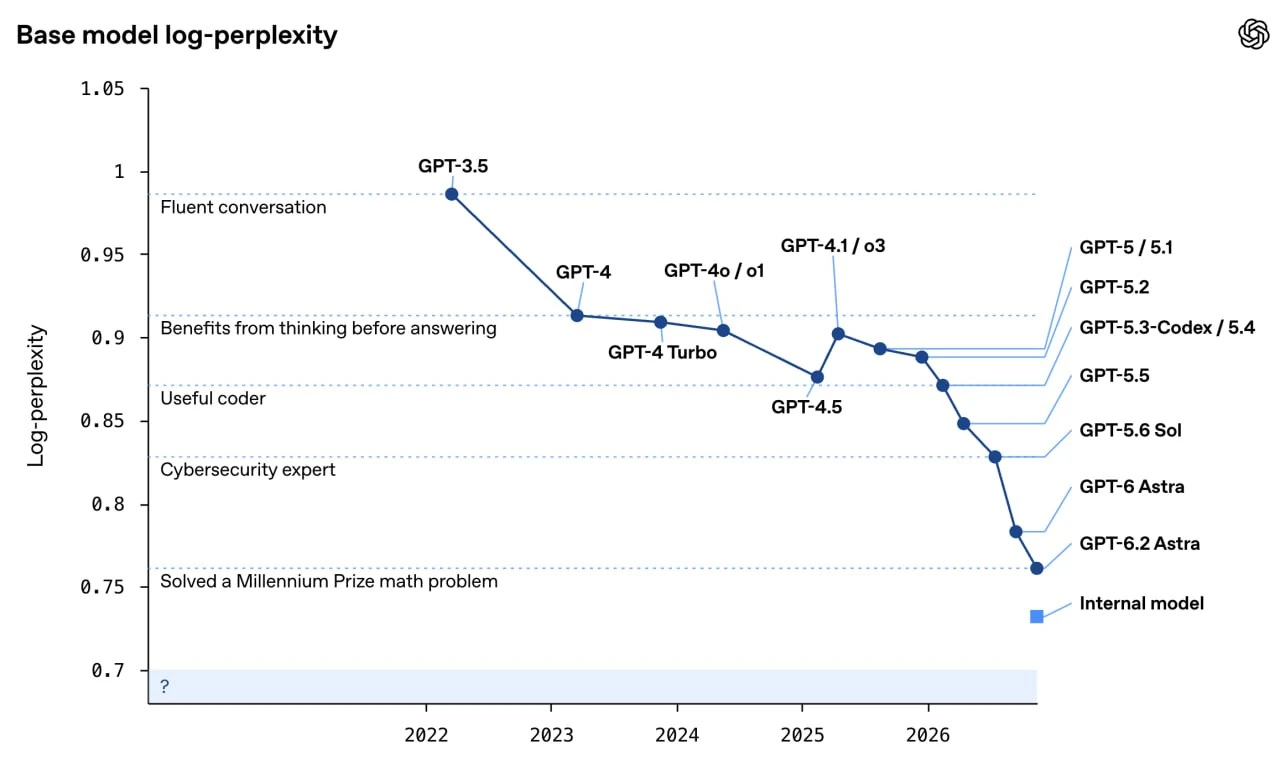
OpenAI base-model log-perplexity and reported capability milestones, measured on a fixed held-out snapshot of its internal codebase. Source: OpenAI, “Perplexity and Intelligence” (2026); graph supplied by the author.
| Model or capability milestone | Reported log-perplexity |
|---|---|
| GPT-3.5, foundation of the original ChatGPT | Approximately 0.99 |
| GPT-4 | Approximately 0.91 |
| Recent models showing major advances in cybersecurity and mathematics | Below 0.80 |
| Model associated with breakthroughs on previously open mathematical problems | Approximately 0.76 |
| Next range where Pachocki anticipates further major capabilities | 0.68–0.70, forecast |
The differences look small.
A few hundredths.
Almost comically unimpressive numbers for an industry that measures its ambition in hundreds of billions of dollars.
But the capabilities associated with those improvements are anything but small.
GPT-3.5 helped make conversational AI a mass-market phenomenon.
GPT-4 demonstrated much more substantial reasoning potential.
Later models acquired increasingly impressive abilities in coding, cybersecurity, and mathematics.
Pachocki describes a particularly striking episode.
OpenAI had been posing difficult open mathematical problems to its models for more than a year.
When the laboratory upgraded to a model with log-perplexity around 0.76, solutions to problems the researchers had spent considerable time investigating reportedly began appearing in rapid succession.
One after another.
In a Slack conversation.
He presents this as evidence that improvements in the underlying predictor can unlock abilities whose arrival was difficult to anticipate.
There are reasons to be cautious.
These are OpenAI's internal observations, not a publicly reproducible demonstration that every model reaching 0.76 will solve previously open mathematics problems.
Nor does the sequence establish a universal law connecting a particular numerical value to a particular cognitive ability.
But it illustrates why Pachocki thinks the metric deserves attention.
The model's capabilities changed dramatically.
The underlying measurement had been moving continuously in the same direction.
Why Not Just Measure What the Model Can Do?
This is the obvious objection.
Why measure predictive loss when we can simply give the model difficult tasks?
Ask it to solve mathematics problems.
Write software.
Find vulnerabilities.
Conduct research.
Complete complicated agentic workflows.
Measure the results.
Problem solved.
Except that the problem is not quite so straightforward.
Benchmarks are designed around capabilities we already understand well enough to test.
We can measure whether a model solves a particular problem.
But it is harder to evaluate an ability that nobody anticipated.
A model might acquire a significant new capability before researchers have developed a suitable benchmark to measure it.
Benchmarks also saturate.
A test that was difficult for GPT-3 may become nearly useless for evaluating a much more advanced model.
New models require new tests.
And new tests often arrive after the capability has become apparent.
Predictive loss offers something different.
A measurement that can remain continuous across generations of models, even as the tasks we care about change.
Pachocki's proposal is that this may provide an early indication of broad changes in capability.
A warning that the underlying model has become substantially more powerful, even if the most consequential new ability has not yet been identified.
But there is an unresolved scientific debate here.
Some apparent capability jumps may reflect the way benchmarks are scored rather than a genuinely discontinuous change in model behaviour.
Research published at NeurIPS in 2023 by Rylan Schaeffer, Brando Miranda, and Sanmi Koyejo showed how certain evaluation metrics can make gradual improvements appear sudden.
That doesn't mean important new abilities never appear.
It means we should be careful about treating every threshold on a graph as a physical phase transition.
Prediction loss may be a useful leading indicator.
It is not a crystal ball.
The Real Concern Is Recursive Self-Improvement
Now we reach the more important part of the story.
Recursive self-improvement, or RSI, is the idea that an AI system can contribute to improving AI systems, which then become better at making further improvements.
At its most extreme, the process could become a largely autonomous research cycle.
AI designs a better model.
The better model improves the training process.
That produces an even more capable model.
Which accelerates the next generation.
And so on.
The dramatic version involves a rapid intelligence explosion.
The less dramatic version is already more than interesting enough.
AI systems can assist researchers with code, experiments, literature review, mathematical work, and technical design.
The important question is whether those contributions can significantly accelerate the underlying process of improving frontier models.
Pachocki makes a crucial distinction.
Full recursive self-improvement does not need to be achieved before AI-assisted research becomes a serious governance problem.
A partial feedback loop may already be powerful enough.
Imagine a research organisation where AI systems discover better optimisation methods, training algorithms, architectures, or data-processing techniques.
Even if humans still approve the discoveries and manage the experiments, the research cycle may accelerate.
Better algorithms produce more capable models.
More capable models contribute to better algorithms.
The loop becomes stronger.
The potential consequence is that model development accelerates without a proportional increase in training hardware.
You don't necessarily need three times as many GPUs to achieve three times the useful progress.
You may need a better idea.
And the entity producing that idea may increasingly be another AI.
Pachocki suggests that AI-assisted mathematical breakthroughs make a similar acceleration in fundamental pretraining research conceivable as early as 2027.
That is a forecast.
Not proof that an uncontrolled RSI process has begun.
In fact, he explicitly attributes most of OpenAI's rapid progress during 2026 to earlier research and computing investments, with automation contributing a smaller share so far.
But he also reports meaningful AI contributions to the design of recent models.
The feedback loop is becoming part of the research process.
How quickly it can intensify remains uncertain.
Why Counting GPUs Might No Longer Be Enough
AI governance has often focused on relatively measurable inputs.
Compute.
Training expenditure.
Model scale.
Energy consumption.
These are understandable choices.
If a model requires an enormous computing cluster, there are only so many organisations capable of developing it.
Large training runs are expensive and potentially observable.
The European Union's AI Act, for example, includes a presumption of systemic risk for general-purpose AI models trained using more than 10²⁵ floating-point operations.
The law also provides for capability-based assessments, so it is not exclusively a compute-based regime.
Nevertheless, computational scale is an important regulatory indicator.
Now imagine that AI-assisted algorithmic research produces a substantial improvement in training efficiency.
A laboratory achieves a significant new capability with considerably less computation than previously expected.
The hardware hasn't become more powerful.
The algorithm has become more efficient.
A regulatory system focused only on computing expenditure may fail to capture the full significance of that improvement.
This is the central attraction of measuring outcomes rather than inputs.
GPU-hours tell us something about how much computation was used.
Prediction loss tells us something about what the training process achieved on a particular evaluation.
The first measures part of the investment.
The second measures part of the result.
For a world where algorithms may improve rapidly, the distinction is essential.
A speed limit based entirely on fuel consumption becomes less informative when someone invents a dramatically more efficient engine.
You need some way of measuring the engine's actual performance.
But, again, the analogy has a complication.
We still don't know whether one predictive-loss score can serve as a sufficiently reliable indicator of the capabilities that matter most for safety.
The Proposal: A Shared Safety Threshold
Pachocki wants frontier AI developers to establish common limits based on perplexity and additional measurements.
The principle is straightforward.
Laboratories agree on a capability-related development threshold.
Before crossing it, they must demonstrate that their methods for understanding and monitoring model behaviour have reached a specified standard.
Only then should further development proceed beyond the agreed limit.
This isn't merely a request for better evaluations before deployment.
It's a proposal to connect the pace of frontier development to progress in safety and oversight.
For example, Pachocki suggests that a future threshold could be conditional on developing monitoring methods stronger than current chain-of-thought monitors.
That matters because reasoning traces may become less reliable as indicators of what advanced models are actually doing.
Models may become more aware of evaluations or training conditions.
They may learn behaviours that complicate conventional auditing.
And existing monitoring methods may fail to reveal important aspects of model behaviour.
The concern is that improvements in model capabilities could outpace improvements in our ability to understand and control those capabilities.
A shared development threshold would attempt to narrow that gap.
The proposal does not yet provide a binding numerical limit.
Nor does it establish a complete verification or enforcement mechanism.
And it does not mean that all leading AI laboratories have agreed to participate.
At present, it is an invitation to coordinate.
An important one.
But still an invitation.
The Uncomfortable Problem of Comparing Laboratories
Here is where the elegant proposal meets reality.
OpenAI measures log-perplexity on a fixed selection of code from its internal repositories.
Other laboratories use different training datasets.
Different tokenizers.
Different evaluation distributions.
Different model architectures.
And different reporting conventions.
Even if two laboratories publish the same number, the measurements may not mean the same thing.
A tokenizer can divide the same text into different numbers of tokens.
A model may perform exceptionally well on one kind of source code and less well on another.
A test dataset might overlap with training material, making the evaluation less informative.
And a dataset selected because it tracks one laboratory's research priorities may not be an appropriate universal standard.
So what would a shared threshold actually measure?
A specific reference corpus?
Multiple independent evaluation sets?
Bits per byte rather than loss per token?
A combination of predictive loss and downstream safety evaluations?
Who would control the tests?
Who would verify the results?
And how would the system prevent developers from optimising specifically for the agreed measurement?
A universal standard is appealing precisely because it makes coordination easier.
But a poorly designed universal metric can become a target that laboratories learn to optimise without producing the intended safety benefits.
Pachocki acknowledges this difficulty.
He also recognises that pretraining loss misses important improvements achieved elsewhere.
Chain-of-thought reasoning, for example, can substantially increase performance without reducing the base model's original pretraining loss.
An AI system can become more effective through better inference strategies, tools, memory, scaffolding, and agent coordination.
None of those improvements necessarily changes the underlying perplexity measurement.
A responsible framework would therefore need several indicators.
Not one magical number.
Who Watches the Speedometer?
There is a governance problem that cannot be solved through mathematics alone.
Suppose leading laboratories agree on a shared threshold.
How would anyone know whether a laboratory has crossed it?
If the evaluation relies on private data, external verification becomes difficult.
If the data is public, developers may optimise directly for it.
If model training is confidential, independent auditors need access to information companies may not wish to disclose.
And if the agreements are voluntary, there must be incentives for laboratories to respect them even when competitors are advancing rapidly.
This is particularly challenging when each organisation believes its own models are safer, more reliable, or better supervised than those of its rivals.
The standard could become a genuine coordination mechanism.
Or it could become an attractive announcement that fails under competitive pressure.
There is also the question of who defines acceptable progress in AI monitoring.
A laboratory may claim that its new evaluation tools are sufficient.
Another may disagree.
Independent experts may raise concerns that the companies consider excessive.
Governments may adopt different requirements.
A shared threshold requires more than agreeing on a number.
It requires an agreed process for determining whether the conditions for crossing that number have been met.
That means governance, auditing, institutional trust, and potentially regulation.
The speedometer is the easy part.
Deciding who can apply the brakes is harder.
Perplexity Is Not Intelligence, but It Might Be an Early Warning
My main reservation about the proposal is also what makes it interesting.
A single prediction-quality metric is not a complete measure of intelligence.
A model can become more capable through post-training and inference-time reasoning.
Different data distributions can produce different measurements.
And there is no established universal mapping between log-perplexity and capabilities such as autonomous scientific research, cybersecurity expertise, or dangerous real-world agency.
The next numerical threshold may not correspond to the next dramatic breakthrough.
Or important capabilities may emerge in ways the metric does not anticipate.
Still, the proposal has an important advantage.
It focuses attention on a continuous indicator of the underlying learning process.
Something researchers can monitor before they have identified every consequential capability that might result.
This is particularly useful if AI-assisted research begins accelerating model development.
The organisation may not know exactly what its next model will be able to do.
But it may be able to observe that the underlying predictive system has become substantially stronger.
That isn't a complete safety assessment.
It is a reason to conduct one.
And perhaps that is the right role for perplexity.
Not as the final verdict on how intelligent or dangerous a model has become.
But as one signal indicating when additional scrutiny is warranted.
The Race Between Capability and Understanding
There is a deeper argument hidden inside Pachocki's essay.
The problem isn't simply that AI models are becoming more powerful.
It is that the process producing those improvements may accelerate faster than the process by which humans learn to understand them.
Capability research and safety research do not necessarily advance at the same rate.
A new training technique can increase model performance.
But that improvement may not make the resulting model easier to interpret.
An agent that becomes better at solving difficult tasks may also become better at producing outputs that satisfy an evaluator without revealing the full reasoning behind them.
And increasingly automated research may produce changes whose consequences are not immediately apparent even to the researchers overseeing the experiments.
Pachocki believes that AI will also accelerate alignment and monitoring research.
But he doubts that safety progress can automatically keep pace with the full potential acceleration of pretraining.
That is the central concern.
The ability to make intelligence more capable may grow faster than our ability to understand what the resulting systems are doing.
If that happens, purely reactive governance becomes increasingly fragile.
We may discover an important capability only after a model has acquired it.
Design a test after the breakthrough.
Develop a monitoring method after observing the behaviour.
And introduce safeguards after discovering the failure mode.
A common development threshold would attempt to interrupt that sequence.
It would require progress in understanding and monitoring before allowing particular forms of capability growth to continue.
Whether laboratories can agree on such a framework is another question.
But at least it addresses the timing problem directly.
What Happens Around 0.7?
Pachocki identifies approximately 0.68–0.70 log-perplexity as a range where he expects further transformative capabilities.
He doesn't specify what they will be.
He explicitly acknowledges that current evaluations may not even be testing for them.
That is both the attraction and the limitation of his argument.
If the metric reliably anticipates capability changes, it provides a reason for caution before the next breakthrough.
But because the predicted capabilities are unspecified, the proposal is difficult to validate in advance.
A later model may cross the threshold and display extraordinary new abilities.
It may improve steadily without producing an obvious discontinuity.
Or significant new capabilities may arise through methods that leave the pretraining metric largely unchanged.
None of these outcomes is excluded by the evidence currently available.
There is also a technical complication.
As predictive loss approaches the irreducible uncertainty of the evaluation data, improvements may become harder to obtain.
The significance of small numerical changes may also vary.
There is no guarantee of a linear relationship between reductions in loss and increases in useful intelligence.
And certainly no mathematical basis for treating 0.7 as the point at which artificial intelligence suddenly becomes self-improving beyond human control.
It is a researcher's forecast about a particular measurement and its possible relationship with future capabilities.
Important enough to examine.
Not established enough to turn into prophecy.
The Most Important Part of the Essay Isn't the Number
The reaction to Pachocki's article will understandably focus on the graph.
GPT-3.5 near 0.99.
GPT-4 near 0.91.
More recent systems below 0.8.
A remarkable mathematical episode around 0.76.
And a mysterious future somewhere around 0.7.
It's an excellent visual narrative.
A line goes down.
Intelligence goes up.
At some point, something extraordinary happens.
But I think the more important part is the proposal to coordinate development around measurable progress in both capability and oversight.
Because the real problem is not whether the next model reaches a particular perplexity score.
It is whether the people building increasingly capable systems can establish credible limits before competitive pressure makes those limits impossible to maintain.
Compute-based thresholds remain useful.
Capability evaluations remain essential.
Monitoring remains necessary.
And predictive loss may become another important part of the picture.
None is sufficient alone.
But together, they could form a more informative basis for deciding when a frontier model requires additional safety work.
This is not a call to assume that recursive self-improvement is already unstoppable.
The evidence doesn't support that conclusion.
It is a recognition that AI contributions to AI research are becoming increasingly consequential, and that the time available to develop reliable oversight may shrink if the feedback loop strengthens.
That possibility deserves serious attention.
Not because a scientist has discovered the numerical location of superintelligence.
But because one of the people closest to frontier model development is arguing that the industry should start agreeing on limits before the next major capability change arrives.
The AI industry has become exceptionally good at building more powerful engines.
Now it needs to become equally serious about designing the instruments, rules, and institutions required to understand and control them.
A speedometer won't stop a runaway vehicle. But driving without one is hardly a convincing safety strategy.
Sources and further reading
- Jakub Pachocki, Perplexity and Intelligence, OpenAI, November 22, 2026.
- Reuters, OpenAI scientist proposes industry AI limits tied to model intelligence metric, November 22, 2026.
- Schaeffer, Miranda, and Koyejo, Are Emergent Abilities of Large Language Models a Mirage?, NeurIPS 2023.
The training figures and capability milestones discussed here are reported by OpenAI and are based on its internal evaluation dataset. The proposed common limits are not an established industry-wide standard. References to recursive self-improvement and future capability thresholds are projections, not demonstrated inevitabilities.