
An accidental mushroom-hunting adventure, a surprisingly useful AI conversation, and one of the best things I've cooked in a tiny hotel kitchen.
I have a rather unfortunate relationship with geography.
I can work with complex systems, design business processes, build software and occasionally understand things that are supposed to be incomprehensible.
But ask me to walk 700 metres to a supermarket and return by the same route, and there's a reasonable chance something will go wrong.
Which is exactly how I ended up discovering a rather spectacular mushroom in Nantes.
And eventually cooking it.
With some help from ChatGPT.
A short walk that became an expedition
I'm currently spending quite a lot of time in a hotel apartment while we finish moving into our new home.
The apartment has a small kitchenette, a frying pan, a couple of burners and enough cooking equipment to survive.
There's also a supermarket nearby.
Perhaps 700 metres away. Maybe a kilometre.
Getting there is almost embarrassingly simple.
Walk down the street.
Turn.
Turn again.
Supermarket.
Even I can manage that.
The outward journey went perfectly.
The return journey was more interesting.
Somewhere along the way, I missed a turn.
I kept walking, confident that everything looked familiar.
Eventually, I arrived at a little park that definitely shouldn't have been on my route.
At this point, a sensible person would have turned around.
But I had a vague idea of where the hotel was.
Surely I could find my way back by taking another street?
I changed direction.
Walked some more.
Changed direction again.
And eventually found myself on the grounds of the University of Nantes.
So much for navigation.
It was around six in the evening, and I was walking between university buildings when I noticed something interesting growing on a large tree stump.
The enormous yellow mushrooms
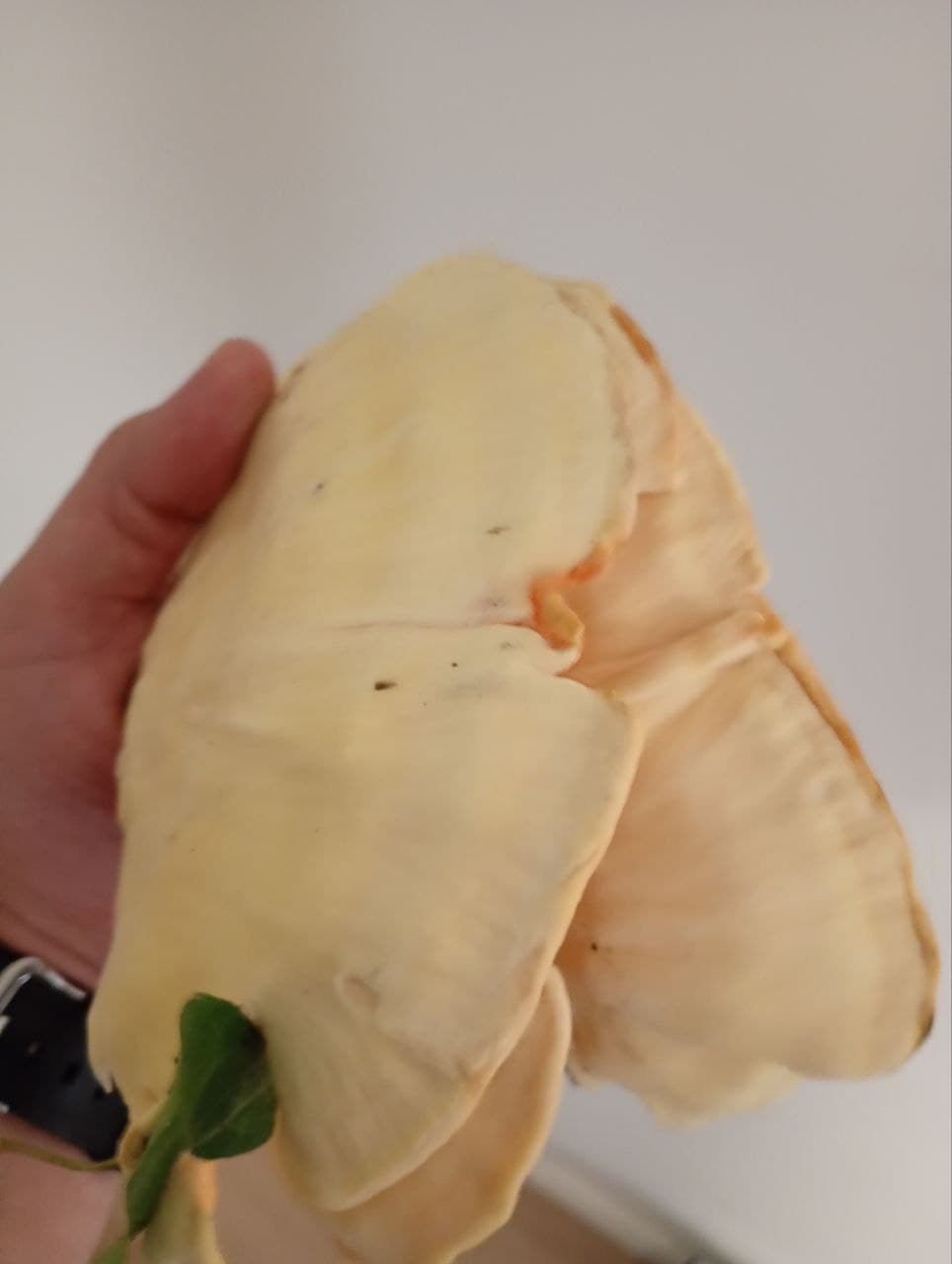
The underside of one of the fungi I brought back.
The stump was wide, probably the remains of a fairly substantial tree.
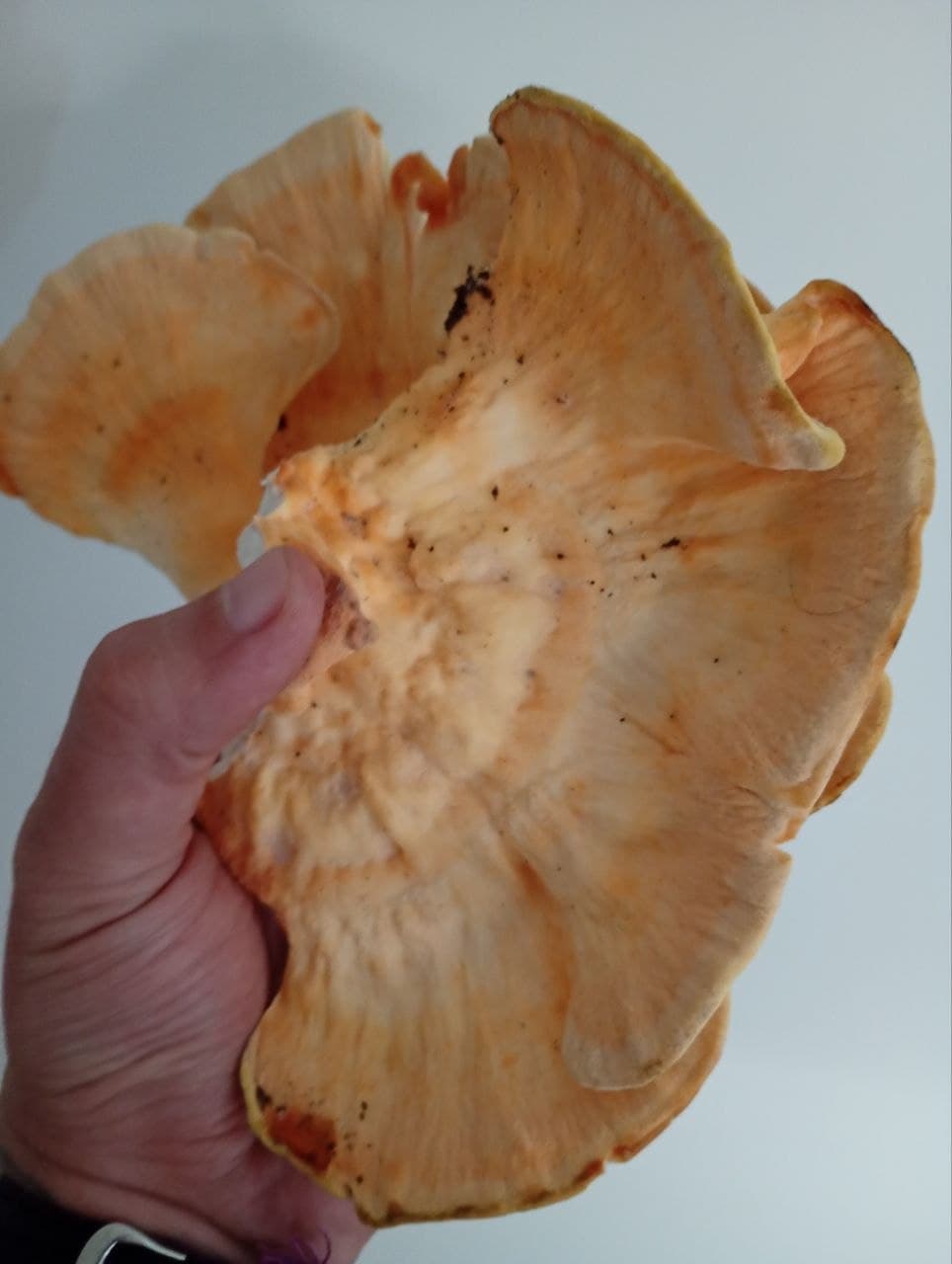
Growing from its side was a collection of enormous, overlapping yellowish-orange fungi.
Not conventional mushrooms with stems and little umbrella-shaped caps.
These looked more like thick shelves or large, irregular plates attached to the wood.
I remembered something a friend had once told me.
Apparently, there are mushrooms that grow on trees, particularly oaks, that are remarkably tasty and have a texture somewhat reminiscent of chicken.
They're commonly known as chicken of the woods, or Laetiporus.
I had never collected them myself.
But what I was looking at seemed remarkably similar.
There were several large sections.
I broke off two.
Not because I wanted to harvest the entire fungus, but because two pieces already seemed like rather a lot.
Together they were close to a kilogram, or at least felt that way.
I continued wandering around the university grounds and eventually worked out how to get back to the hotel.
So I arrived home with my shopping.
And two enormous mystery mushrooms.
Not bad for somebody who'd only gone out to buy groceries.
ChatGPT, meet my mushrooms
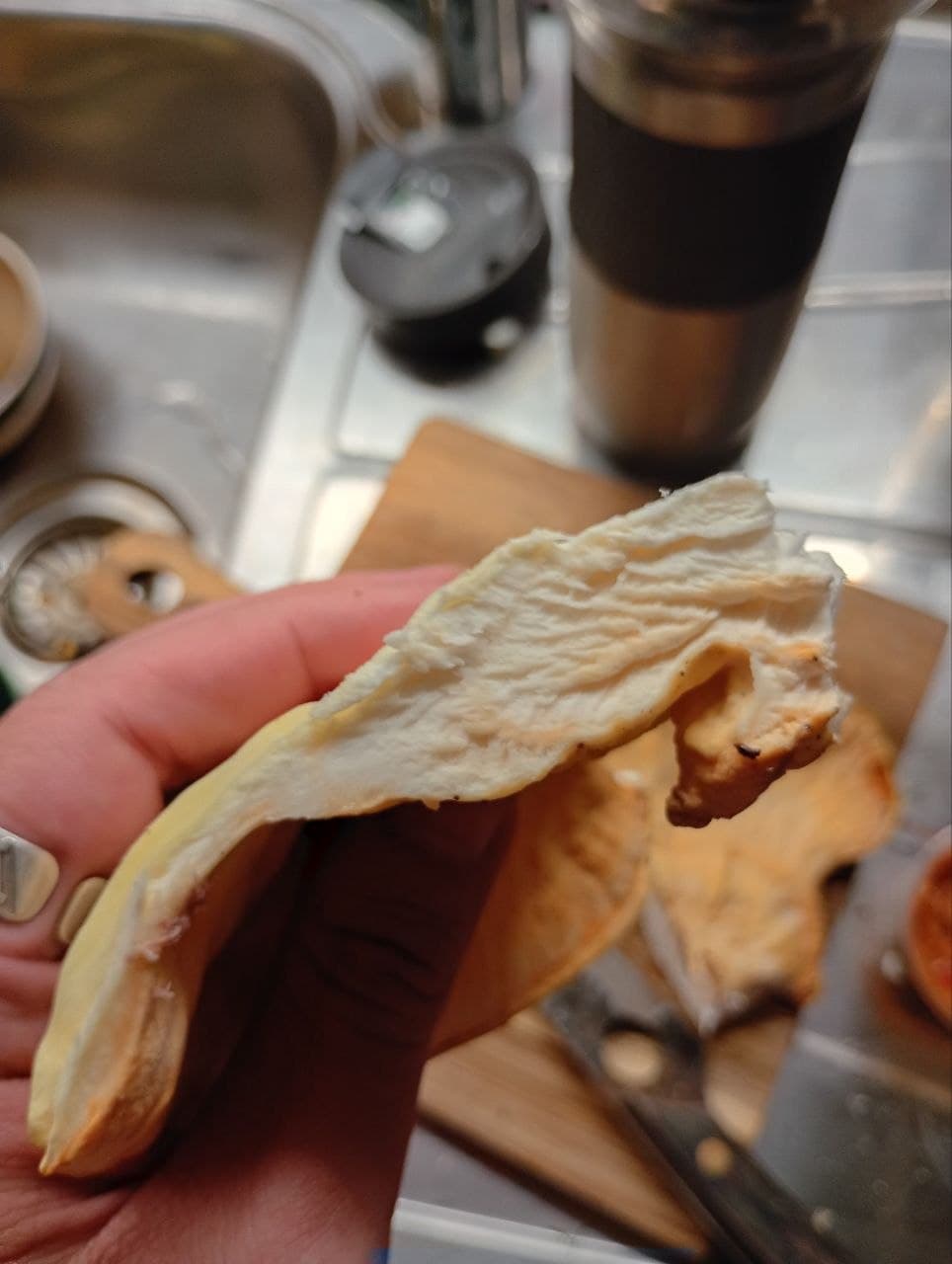
The thickness and internal texture, photographed back in the kitchenette.
Back in the apartment, I photographed the mushrooms from several angles.
Then I opened ChatGPT.
I explained the story.
Where I'd found them.
How they were growing.
What they looked like.
And what my friend had told me about the mushrooms that supposedly taste like chicken.
We started investigating.
The visible characteristics appeared consistent with descriptions of chicken of the woods.
The large, overlapping growths.
The yellow-orange colouring.
The way the fungus grew directly from wood.
The general shape and structure.
We discussed the characteristics described for these mushrooms, how they differ from more familiar culinary mushrooms, and what people report about their texture.
The conversation was considerably more detailed than simply uploading a photograph and asking whether something was edible.
But it also had an important limitation.
ChatGPT could compare what I showed it with available descriptions. It couldn't independently establish the species.
That distinction remained part of the conversation.
Then I asked the next question.
Assuming this really is chicken of the woods, how is it normally prepared?
Now we were getting somewhere.
Apparently, you can cook it like chicken
One of the interesting things about chicken of the woods is its reputation as a rather unusual culinary mushroom.
People describe it as substantial and meaty, with a texture quite different from ordinary button mushrooms.
There are plenty of recipes involving butter, frying, onions and other familiar savoury ingredients.
ChatGPT suggested a relatively straightforward preparation.
Cut the mushroom into pieces.
Use butter and some neutral vegetable oil.
Cook it thoroughly.
It suggested at least fifteen minutes of cooking for this type of preparation, while noting that larger specimens could become tough.
Then, naturally, I started modifying the recipe.
Because that's what I do.
I looked around the kitchen.
I had onions.
"Why don't we add some onion?"
Good idea.
Then I remembered I had garlic.
"Garlic too?"
Certainly.
And then I thought about mustard.
"Would mustard work?"
Apparently, yes.
By this point, we'd moved from investigating an unfamiliar mushroom to designing a rather promising dinner.
I like this way of working with ChatGPT.
It proposes a method.
I look at the ingredients I actually have.
We discuss variations.
And gradually arrive at something practical.
Much more useful than receiving a perfect recipe requiring twelve ingredients that aren't in my refrigerator.
Butter, onions, garlic and mustard
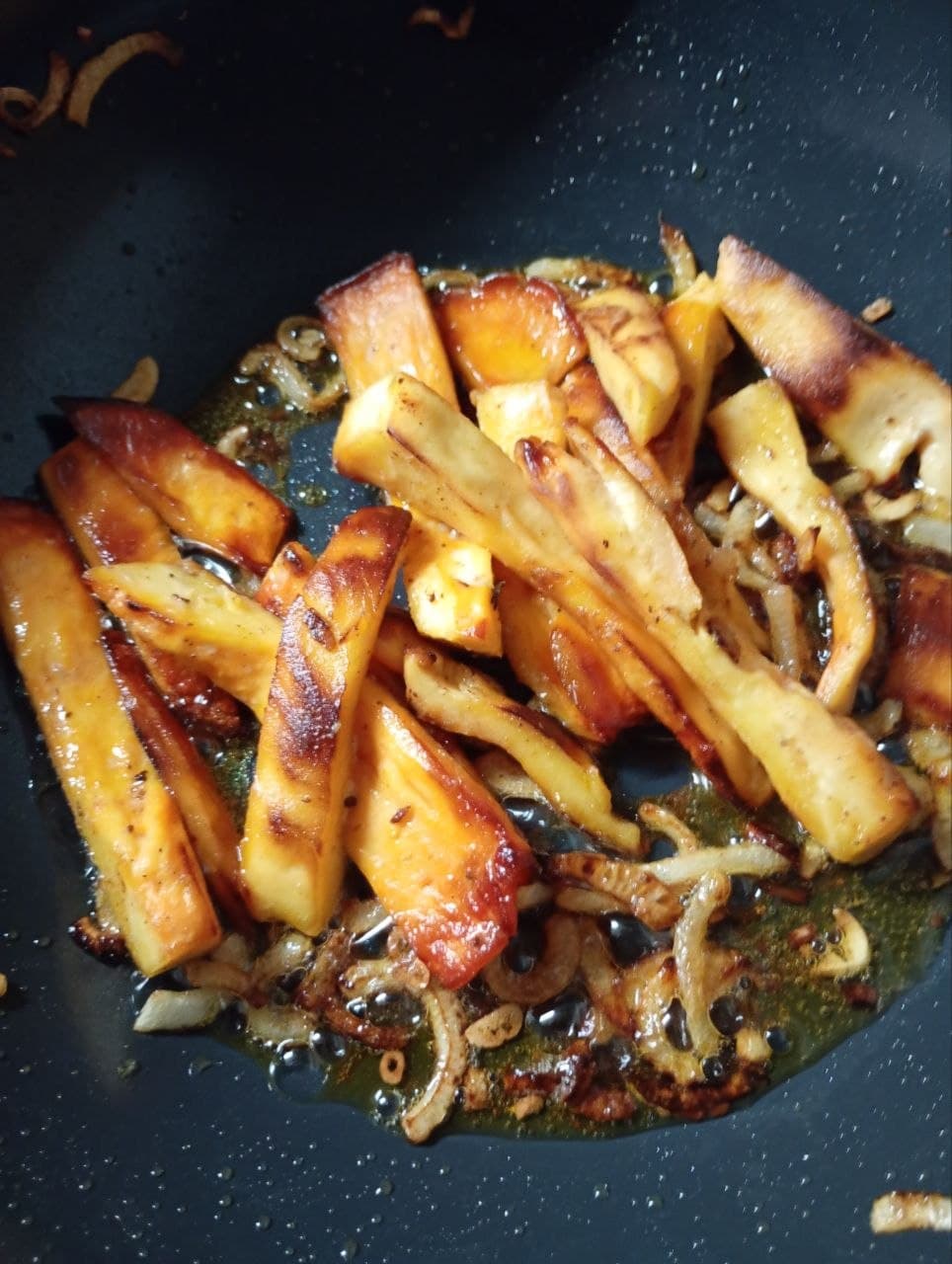
One of my batches in the frying pan, with butter, onions, garlic and mustard.
I decided to cook one of the two large mushroom pieces.
The other went into the refrigerator.
I cut the first one into substantial strips, somewhat like pieces of chicken.
Then I prepared the frying pan.
Butter.
A little vegetable oil.
Onions.
The mushroom.
Later came garlic and mustard.
I cooked everything over moderate heat, allowing the mushroom to brown and the onions to soften and caramelise.
The kitchen smelled wonderful.
The mushroom developed golden and darker brown patches, while the butter, onions and garlic created a rich coating.
I kept checking the texture.
And, as usual, I became slightly overenthusiastic.
I cooked it for longer than necessary.
The edges became nicely browned, but some pieces were starting to dry out.
Still, the result looked very promising.
And when I tasted it, I was delighted.
The flavour was rich, savoury and quite unlike the ordinary mushrooms I usually cook.
The substantial texture worked beautifully with the butter and onions.
The mustard added a little sharpness.
The garlic did what garlic usually does, which is improve practically everything.
I thought it was genuinely excellent.
About that 50-gram suggestion
During our conversation, ChatGPT had suggested trying only a small initial portion, around 50 grams, because the identification remained uncertain.
I understood the caution.
But by the time I finished cooking, I was hungry, curious and increasingly pleased with the result.
And there was a rather substantial amount of food in the pan.
So my experimental portion turned into half the pan.
The other half became breakfast the following morning.
I experienced no apparent problems.
That experience didn't independently establish the mushroom's identity or safety, of course. But it was part of what actually happened, and I see no reason to rewrite the story as though I had followed a perfectly measured laboratory protocol.
I hadn't.
I was a man in a hotel kitchenette, enjoying something he'd just cooked.
The second mushroom was even better
I still had the second large piece.
And because I'd enjoyed the first batch so much, I decided to repeat the experiment.
This time, I already knew what I wanted to change.
Less aggressive cooking.
The first batch had become slightly too dry.
I wanted to preserve more of the mushroom's original texture while still getting a good golden surface.
Otherwise, I kept essentially the same combination.
Butter and vegetable oil.
Onion.
Garlic.
Mustard.
I again cooked the pieces thoroughly, paying more attention to the point at which they were browned without becoming overly dry.
And I preferred the second result.
The texture was more pleasant.
The pieces remained more substantial.
The onions and mustard complemented the mushroom without overwhelming it.
It was a genuinely good dish.
Since that first discovery, roughly two months ago, I've eaten these mushrooms on several occasions, most recently around a month ago.
My impression of their culinary qualities has remained extremely positive.
And yes, the flavours and textures we discussed afterwards were consistent with many descriptions I'd found of chicken of the woods.
The recipe: Chicken of the Woods with Butter, Onions and Mustard
For anyone who already has reliably identified edible chicken-of-the-woods mushrooms, this is the basic preparation I used.
It's simple, requires no special equipment and works in an ordinary frying pan.
Ingredients
For approximately two servings:
- 300–400 g correctly identified chicken-of-the-woods mushrooms
- 1 medium onion
- 1–2 cloves of garlic
- 20–30 g butter
- A little neutral vegetable oil
- 1–2 teaspoons mustard, to taste
- Salt and black pepper, if needed
These quantities are approximate. In my original experiment, I measured almost everything by eye.
Preparation
1. Prepare the mushrooms.
Clean and trim the identified edible mushrooms as appropriate, then cut them into substantial strips.
I prefer pieces that retain some of their natural structure rather than chopping everything into tiny cubes.
2. Prepare the pan.
Heat the butter with a little vegetable oil over moderate heat.
I like this combination because it provides the flavour of butter while making the cooking process easier to control.
3. Add the onion and mushrooms.
Slice the onion and add it to the pan with the mushroom pieces.
Cook, turning occasionally, so that everything heats and browns evenly.
4. Add garlic and mustard.
As the onions soften and the mushroom begins developing colour, add the chopped garlic and mustard.
Mix so the flavours distribute throughout the pan.
5. Cook thoroughly without drying everything out.
Chicken-of-the-woods recipes commonly call for thorough cooking. My original batches spent at least fifteen minutes in the pan, although the exact time depends on the pieces and method.
For a correctly identified edible specimen, follow appropriate species-specific preparation guidance rather than treating a fixed frying time as proof of safety.
The culinary goal is a cooked-through mushroom with a golden exterior and a pleasant, substantial texture.
6. Serve hot.
That's it.
The mushroom, butter, onions, garlic and mustard already create a satisfying combination.
I didn't need a complicated sauce or elaborate garnish.
And I was perfectly happy eating it on its own.
The most interesting ingredient was the accident
What I like about this story is how completely unplanned it was.
I didn't decide to go mushroom hunting.
I didn't research edible fungi around Nantes.
I didn't organise a walk through a forest.
I went to a supermarket.
Got lost.
Found myself at the university.
Noticed something enormous growing from a tree stump.
And returned to my hotel with two pieces of a fungus I'd never cooked before.
Then ChatGPT became part of the adventure.
Not as an all-knowing authority declaring that the mushroom was safe.
But as a tool for comparing observations, researching descriptions, discussing cooking methods and helping me develop a recipe using the ingredients available.
The final decisions were mine.
The recipe evolved through conversation.
And the result, from a purely culinary perspective, was one of the more memorable things I've made in that little kitchenette.
There is something I genuinely enjoy about this kind of cooking.
Discovering an unfamiliar ingredient.
Understanding what makes it interesting.
Trying a simple preparation.
Then adjusting the technique based on the result.
The first batch was good.
The second was better.
And both came from a shopping trip that was supposed to take about fifteen minutes.
I still haven't become any better at navigation.
But at least getting lost occasionally produces something useful.
Sometimes you go out for groceries and come back with dinner growing on a tree.
That's a pretty good return on a wrong turn.