
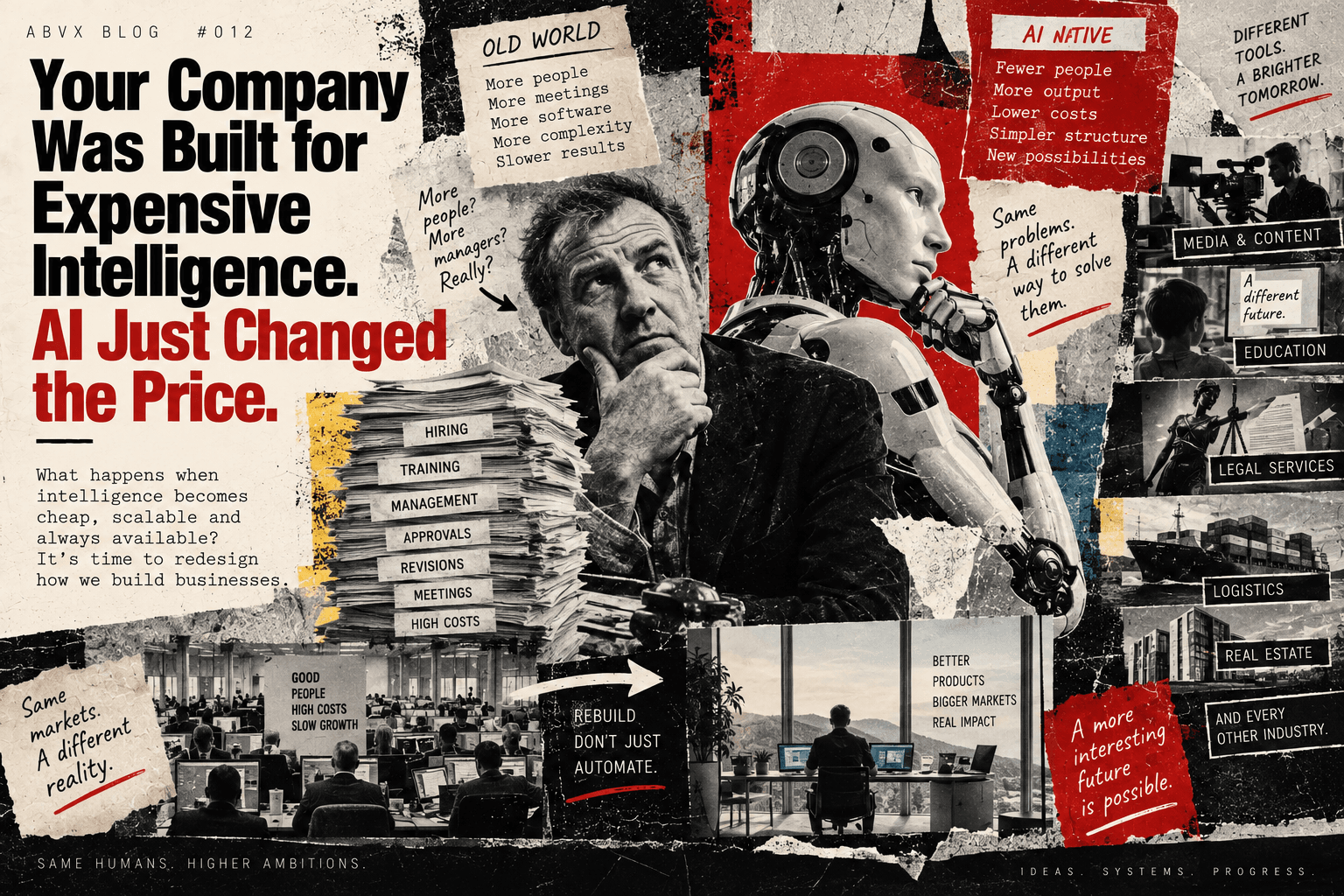
Why AI-native business models are not about adding chatbots, but redesigning entire industries around a very different cost of getting things done.
Imagine designing a company in 2026.
You have a problem to solve, customers willing to pay, and access to AI systems capable of writing code, researching markets, analysing documents, preparing contracts, producing content and coordinating complex workflows.
Naturally, you begin by hiring a department manager.
Then six specialists.
Then somebody to coordinate the specialists.
Then another manager to coordinate the coordinator.
Then you purchase an enterprise software platform so everybody can exchange information without having to speak to each other.
Six months later, you've created a perfectly respectable business.
It has 47 employees, eleven SaaS subscriptions, four weekly meetings and a splendidly complicated organisational chart.
Unfortunately, nobody has remembered to build the product.
Welcome to traditional business management.
There's nothing inherently wrong with employing people. Quite the opposite.
But an enormous number of companies were designed around one fundamental assumption:
Intellectual work is expensive, and the people capable of performing it are scarce.
That assumption is becoming considerably less reliable.
And I suspect we're about to discover that many industries are organised in ways that no longer make much economic sense.
The company was designed around the cost of thinking
Consider how a conventional professional business works.
First, you need specialists.
Then you need to train them.
Then somebody has to distribute tasks between them.
The specialists produce something.
Another specialist checks it.
A manager approves it.
Somebody combines the results.
Then legal gets involved.
Then compliance.
Then the manager's manager.
And eventually the customer receives a PDF.
Which is probably wrong because the client changed one requirement three weeks earlier.
Much of this structure exists because expertise is expensive and information is fragmented.
A person cannot know everything.
A person cannot process unlimited documents.
A person cannot work continuously.
So we divide knowledge into departments and divide work into increasingly specialised jobs.
But what happens when AI can execute a significant proportion of those tasks?
The human role begins to change.
Less execution.
More problem definition.
More judgement.
More verification.
More responsibility for the result.
This doesn't mean AI can reliably perform every task today. It can't. Reliability, access to information, regulation and real-world complexity still matter enormously.
But capabilities are improving quickly enough that I think every industry should be asking a rather uncomfortable question.
If we were creating this business from scratch today, would we organise it anything like this?
My suspicion is that the answer, surprisingly often, would be no.
Media: what happens when content becomes cheap?
Take publishing.
Or film.
Or games.
Or online video.
Traditionally, producing content required substantial human resources.
Writers.
Editors.
Designers.
Translators.
Production teams.
Researchers.
Video editors.
Marketing departments.
Distribution specialists.
And managers to ensure everybody attended the correct meetings.
AI is already reducing the cost of many parts of this process.
A small team can produce material that previously required a much larger organisation.
Translation and localisation are becoming dramatically cheaper, although quality control remains necessary.
Research can be conducted at a scale that would have been financially absurd a few years ago.
Distribution workflows can be automated.
Analytics can move beyond somebody announcing that the latest video "feels like it performed quite well."
Does that mean authors and editors are finished?
No.
It means the economics of employing a large production organisation are changing.
A media company that previously required hundreds of people to maintain its output may discover that a much smaller team can produce substantially more.
The difficult parts increasingly become editorial judgement, originality, credibility, audience trust and distribution.
And here's the interesting thing.
People haven't stopped wanting news.
Or stories.
Or books.
Or entertainment.
Demand hasn't disappeared merely because production has become cheaper.
So why couldn't somebody build the next great international media business using an entirely different operating model?
Not necessarily another New York Times.
Perhaps something that wouldn't have been economically possible when every additional language, format or audience segment required another team.
The opportunity isn't simply to produce the same content more cheaply.
It's to create products and experiences that conventional media economics never allowed.
Education: the textbook is no longer the product
Education is another interesting example.
For centuries, we've organised learning around the availability of teachers.
One teacher.
Twenty students.
A fixed curriculum.
A timetable.
Everybody moves through approximately the same material at approximately the same speed.
If somebody doesn't understand something, the teacher explains it again.
If half the class doesn't understand it, everybody stops.
If one student is three months ahead, congratulations. They can enjoy being bored.
Now imagine an AI tutor that can adapt explanations, exercises, examples and pacing to an individual learner.
Available whenever needed.
Able to generate unlimited practice material.
Capable of changing its approach when the first explanation doesn't work.
Suddenly, delivering educational content is no longer the central economic problem.
Neither is producing another textbook.
That doesn't make human teachers irrelevant. Motivation, social development, assessment, safeguarding and genuine pedagogical judgement remain important.
But it changes what an educational institution needs to organise.
Perhaps the scarce resource becomes trust.
Or certification.
Or access to real practical experience.
Or the ability to keep a student engaged long enough to finish.
And there's a slightly amusing consequence.
If educational content becomes cheap and widely available, acquiring students and convincing them that your programme is worth completing may become more expensive than teaching them.
A business designed around selling access to lessons will need a better reason to exist.
Professional services: stop selling hours
Now consider lawyers, accountants, consultants and compliance specialists.
These businesses traditionally sell time.
Very expensive time.
You hire highly educated people.
They analyse documents.
Prepare reports.
Review contracts.
Search for relevant information.
Exchange emails.
And record how many hours they spent doing it.
A model that has worked rather well for professional-service firms.
Less wonderfully for their clients.
But suppose agents can handle much of the document preparation, research, comparison and preliminary checking.
The professional still needs to validate the work.
They still carry responsibility.
A lawyer cannot simply shrug and explain that the language model was feeling creative when it invented a legal precedent.
But the amount of human labour required for a given assignment can fall.
Which creates a different business model.
Instead of charging for every hour spent, charge a fixed price for a clearly defined outcome.
And if the work becomes more efficient, the provider benefits.
An example is Athena, an AI-native law firm focused on M&A and commercial real estate transactions.
Its model combines experienced legal professionals with proprietary AI technology and fixed-fee services.
According to its a16z Speedrun profile, Athena secured 16 client account relationships across engagements and design partnerships, representing approximately $700,000 in committed legal fees during its first five weeks.
That's not the same as $700,000 in collected revenue.
But it is an interesting early commercial signal.
And, more importantly, the business model is interesting.
If you can deliver professional outcomes with substantially less repetitive labour, the economics begin to resemble software.
Not perfectly. Liability, supervision and professional regulation don't disappear.
But the old relationship between billable hours and revenue becomes less inevitable.
The client never wanted to buy your hours anyway.
They wanted the problem solved.
The boring industries are suddenly rather exciting
Here's where I think things become especially interesting.
Everybody in technology wants to build the next revolutionary consumer application.
Another social network.
Another AI companion.
Another platform for creators.
Another product described as the Uber of something that probably doesn't need an Uber.
Meanwhile, there are enormous industries operating through email attachments, PDFs, spreadsheets and phone calls.
Freight forwarding.
Waste management.
Commercial lending.
Energy infrastructure.
Industrial procurement.
Agricultural trading.
Businesses where somebody receives a document, copies information into another system, sends an email, waits for a reply and repeats this process approximately seventeen thousand times.
Wonderful.
These industries aren't necessarily inefficient because their employees are incompetent.
They're inefficient because the processes are complicated, information is fragmented and traditional software has struggled to accommodate all the exceptions.
Which is exactly where modern AI agents become interesting.
An agent can read incoming messages.
Extract information from documents.
Compare data.
Prepare quotations.
Check inconsistencies.
Draft responses.
Track missing information.
And send the result to a human when a decision requires responsibility or judgement.
Consider Colmez.
It works in hazardous-waste management, an industry that probably doesn't feature prominently in most startup founders' childhood dreams.
Colmez connects commercial, regulatory and operational information to help waste-management businesses handle sales and operating processes.
According to its a16z profile, the company reported more than $800,000 in contracted ARR after launching its private beta, with five of the seven largest operators among its customers.
Those are company-reported figures, not independently audited results.
Nevertheless, the underlying opportunity is obvious.
Huge industries.
Complicated workflows.
Expensive manual coordination.
And relatively little software designed around what current AI can actually do.
Another example is Rumbo, which builds AI agents for freight forwarders.
Its systems help process emails, prepare shipping quotations, check documents and identify operational exceptions.
Not terribly glamorous.
But if you've ever worked with international logistics, you'll understand why eliminating a few hours of repetitive work from every shipment could be commercially significant.
And this brings me to a market I'm working in myself.
MN7R: the same problem, but with grain
A significant part of my current work is concentrated on agricultural commodity infrastructure.
One of the projects is MN7R, an AI-assisted operating system for commodity brokerage teams.
Grain trading is an excellent example of an industry that has become highly sophisticated commercially while remaining surprisingly fragmented technologically.
Brokers receive offers through messaging applications.
Traders negotiate prices.
Somebody checks the market.
Somebody else prepares contracts.
Execution officers coordinate delivery.
Logistics teams calculate freight and available routes.
Documents move between departments.
Information is copied between applications.
And apparently the entire international grain market has agreed that spreadsheets are an essential natural resource.
We are trying to change that.
MN7R connects brokerage workflows, client information, bids, offers, trades and contract execution inside a shared operating environment.
The core process runs from BID → OFFER → MATCH → TRADE → EXECUTION → REPORT.
Spike Brokers is the first production partner, using MN7R in real brokerage operations. Current AI development includes supervised assistance for execution workflows and document preparation. MN7R
But the interesting part isn't simply creating another ERP.
It's asking how brokerage itself should work when AI agents can perform a growing share of the information-processing tasks.
What if the broker no longer needed to spend much of the day transferring offers between messages and spreadsheets?
What if an execution officer could focus on exceptions and decisions instead of repeatedly checking documents?
What if market data, logistics information and commercial workflows could be connected automatically?
And what if the same infrastructure could support not just one brokerage company, but multiple participants in a physical commodity market?
That's the broader direction behind our AMI infrastructure, which also connects projects such as 1D3X and commodity-market indices.
I don't think AI will eliminate brokers.
Physical trading depends on trust, relationships, market knowledge and responsibility.
But I do think the optimal structure of a brokerage company may become very different.
And if that's true, simply adding a chatbot to an existing ERP is missing the point rather spectacularly.
Related reading: How I Work With AI Agents in 2026.
Operations: what if administration stopped growing with the business?
Another category worth reconsidering is operational management.
Property management.
Accounts receivable.
Patient administration.
Customer support.
Insurance claims.
In traditional operations, growth usually creates more administrative work.
More properties require more people answering tenants.
More invoices require more people chasing payments.
More customers require more support agents.
More patients require more administrative coordination.
The relationship isn't always linear, but it's familiar.
AI creates the possibility of breaking part of that relationship.
An agent can receive a maintenance request.
Identify the property.
Review the relevant records.
Contact an approved contractor.
Prepare a response.
Track the repair.
Escalate unusual situations.
And keep a human manager informed.
One employee could potentially supervise workflows that previously required a much larger administrative team.
Of course, there are limits.
An AI agent cannot physically repair a leaking pipe.
It shouldn't make unsupervised clinical decisions.
And it certainly shouldn't begin inventing insurance claims because the paperwork is inconvenient.
But a large proportion of the coordination around physical work can potentially be reorganised.
That's the important distinction.
AI doesn't need to perform the physical job to transform the business around that job.
The luxury market is about to get strange
There's another consequence I find particularly interesting.
Many services have historically been expensive because they required dedicated human attention.
A personal assistant.
A financial adviser.
A private tutor.
A concierge.
Someone to organise your schedule, research your options, manage paperwork or simply remember what you were supposed to do next.
These services were effectively reserved for people who could afford to employ or regularly hire specialists.
Now some of that functionality can be provided through software subscriptions.
Not necessarily for the price of Netflix in every case, and certainly not with the same professional guarantees as a qualified human adviser.
But the cost of accessing useful assistance can fall dramatically.
And when the price falls, the market changes.
A service that was previously relevant to a few million wealthy customers might become accessible to hundreds of millions of people.
Sometimes the largest opportunity isn't taking customers away from existing companies.
It's serving people who were never customers because the service was too expensive to exist for them.
That is a much more interesting form of market expansion than simply selling the same product at a discount.
The real bottleneck is moving
There is an important catch to all this enthusiasm.
Producing work is becoming cheaper.
But that doesn't mean every part of business becomes cheaper.
Some things become more valuable precisely because execution is easier.
Understanding what customers actually need.
Building trust.
Accessing reliable data.
Getting distribution.
Managing liability.
Evaluating quality.
Making good decisions when several plausible answers exist.
And taking responsibility when something goes wrong.
Research into real-world AI use already shows the tension. Anthropic's 2026 Economic Index reports substantial productivity benefits, but also finds that reliability and the need to validate outputs reduce the gains implied by raw task-speed measurements. Anthropic
This is why I don't think the future belongs to businesses that simply replace employees with agents.
It belongs to companies that understand which parts of the workflow should change, which should disappear, and which still require human judgement.
The distinction matters.
A badly designed company with AI agents is still a badly designed company.
It just produces mistakes considerably faster.
Don't automate the company. Rebuild it.
This is where I think most corporate AI strategies go wrong.
They begin with the existing organisation.
Here is our sales department.
Here is our legal department.
Here is our operations team.
Here is the reporting process.
Where can we insert AI?
Perhaps we can summarise meetings.
Perhaps we can generate emails.
Perhaps we can add a chatbot.
Perhaps the chatbot can generate summaries of the emails generated by the previous chatbot.
Excellent.
We have achieved digital transformation.
Now everybody can spend the saved time attending another meeting about AI adoption.
I would approach the problem differently.
Imagine the company doesn't exist yet.
You know what customers need.
You know what outcome they are willing to pay for.
And you have access to current AI capabilities.
How would you design the entire business?
Would you still need the same departments?
The same handoffs?
The same software?
The same pricing model?
The same number of employees?
Would you sell a product, a subscription, a completed outcome or something else entirely?
And here's the most important question:
What could you offer customers that would have been economically impossible before AI?
Not a cheaper version of yesterday's service.
Something fundamentally better.
More personalised.
More comprehensive.
Available continuously.
Accessible to people who previously couldn't afford it.
Or capable of solving problems that used to require an impractical amount of human work.
That's where I think the really interesting businesses will emerge.
The opportunity isn't disruption. It's reinvention.
People keep asking which industries AI will disrupt.
Law?
Education?
Media?
Logistics?
Finance?
Agriculture?
My answer is that almost every industry deserves to be reconsidered.
Not because every job can be automated.
And not because AI is magically competent at everything.
But because so many business models were designed around the economics of human intellectual labour.
Those economics are changing.
And when the cost of a fundamental input changes, the optimal design of the system around it changes too.
The question isn't whether AI can perform somebody's existing job.
That's a relatively small question.
The larger question is whether the job, the department, the process or even the company's business model would exist in its current form if we were designing it today.
I suspect many wouldn't.
And that's why I find this period so interesting.
We have spent decades optimising organisations around expensive intelligence.
Now we're beginning to make parts of that intelligence dramatically cheaper.
The real opportunity isn't to make the old machine run faster.
It's to ask why we built such a ridiculous machine in the first place.